They do not question the utopian faith in globalization. They support preemptive war, at least before it goes horribly wrong. And they accept unfettered capitalism, despite what it has done to the nation, as a kind of natural law. The reigning corporate ideology has infected the Times as it has most other liberal institutions. Because this ideology does not challenge the status quo it is defended by these editors as evidence of the paper’s impartiality, balance and neutrality. ExxonMobil, Citibank and Goldman Sachs are treated with deference and respect. The inability to see that major centers of corporate power are criminal enterprises that are plundering the nation and destroying the ecosystem is evidence not of objectivity but moral bankruptcy.Or maybe it has already come?
Showing posts with label Government. Show all posts
Showing posts with label Government. Show all posts
6 Feb 2012
Coming Soon To A Paper Near You


3 Jan 2012
Democracies Tend To Bankrupt Themselves
A Note on Race, Caste and Fiscal Prudence
It is a core view that I have elaborated on in prior letters that democracies with universal suffrage have a long run tendency to spend their way into fiscal bankruptcy and degrade their currencies along the way. Investors have to recognize this phenomenon. The so called advanced West has reached that point of bankruptcy now. Politicians pass measures to please the majority that elected them, regardless of whether the country can afford it or not.
This phenomenon becomes more politically complicated if there is some difference – be it race, religion or caste – that differentiates the recipients of the government largess from those who produce the wealth, pay most of the taxes and dominate the professional and entrepreneurial classes. Normally in these situations the recipients, who are of a different race, religion or caste, believe they cannot compete with the professional/entrepreneurial groups and regard the government largess as an equalizer and redress for current and past wrongs.
Indian democracy provides an interesting case study regarding this point. The so-called Indian masses tend to be from “lower” castes (India has a complicated definitional scheme to formally identify these groups) than the professional and entrepreneurial groups running the businesses and generating the wealth. The democratic process in India has become a mechanism whereby the lower castes, who constitute significant “votebanks” and regard themselves as having been oppressed for centuries, appropriate wealth to themselves through the (unfortunately corrupt) political system. This may be why Indian politicians, who presumably really do know better, cannot say “no” to fiscally irresponsible welfare schemes.
The same phenomenon is observable in other countries, including South Africa and Brazil and even in the US where the word “race” can be substituted for caste and to some extent welfare and subsidy schemes carry racial overtones. In the US, when the real brawling over cutting back government spending starts after the 2012 elections, the subject of race will come up. Things could get ugly. Economists and Wall Street analysts don’t like to talk about these things for fear of being labeled politically incorrect. But they have investment significance.
China on the other hand does not have this problem, partly of course because it is not a democracy in which politicians have to appeal to voters but also because ninety percent of its people define themselves as Han and its minority groups are on the geographic and political periphery of the country. The lower income Han do not perceive themselves as different from the professional and entrepreneurial groups which are also Han. In this case China’s relative homogeneity – which is sometimes criticized as an impediment to creativity –can be viewed as an investment plus.
29 Nov 2011
"Why are women's health outcomes in India so poor?"
Why are women's health outcomes in India so poor?
Those graphs tell a story. Sri Lanka is much much better than India on most women's health parameters and on health-care spending.
Those graphs tell a story. Sri Lanka is much much better than India on most women's health parameters and on health-care spending.
19 Nov 2011
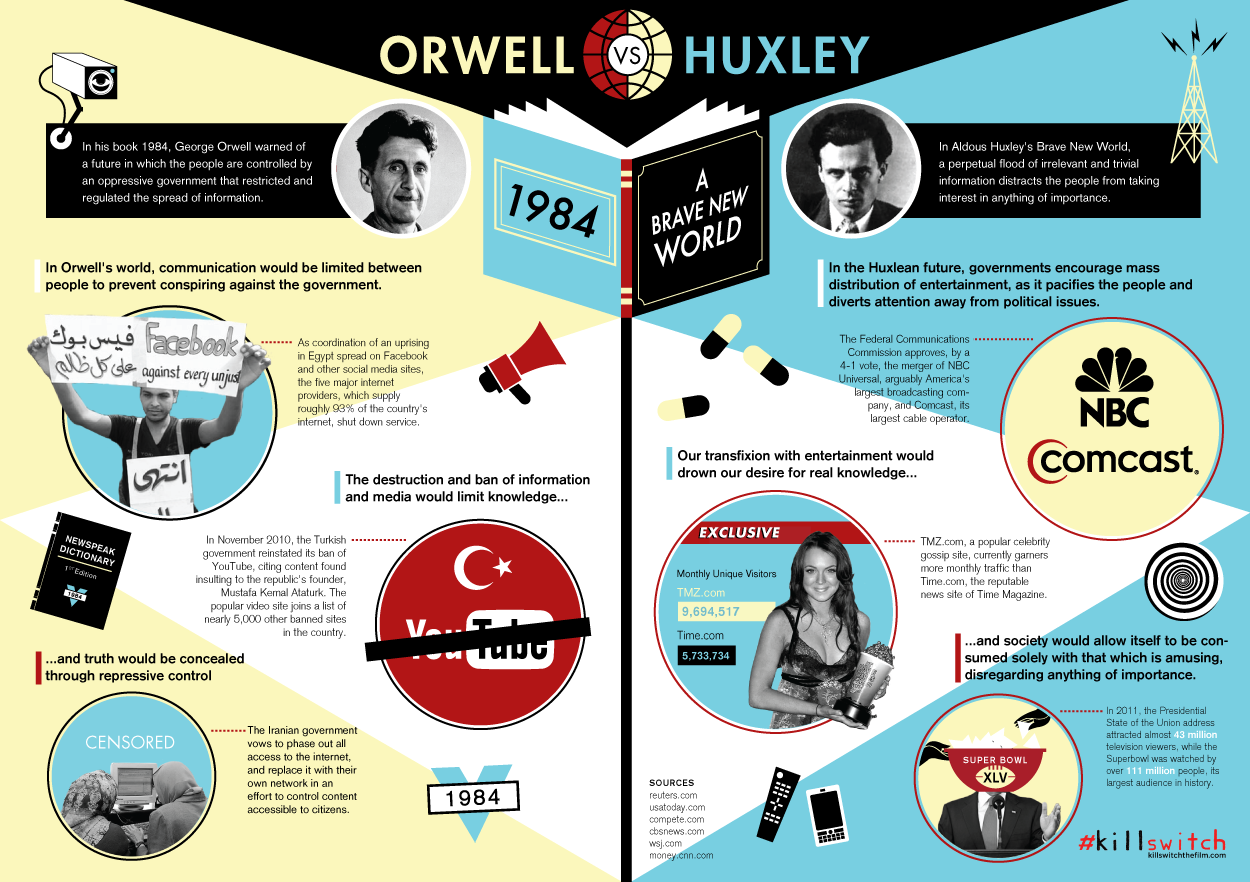
Orwell vs Huxley
Orwell vs Huxley: 1984 vs Brave New World.
 But then, as a comment there points out, we could as well go the whole hog and head to this 1984 speech by Neil Postman: Amusing ourselves to death.
18 Nov 2011
Advice for Indian Politicians
Who want to make quick money: Get with the times. Change your methods. Learn. There is an easier way to make easy money. No taint of the 'C' word attached too! Link.
As many as a dozen members of Congress and their aides took part in insider trading based on foreknowledge of market moving information on Capitol Hill, disgraced Washington lobbyist Jack Abramoff told CNBC in an interview.
Abramoff, who was once one of the wealthiest and most powerful lobbyists in Washington before a corruption scandal sent him to federal prison for more than three years, said that many of those members of Congress bragged to him about their stock trading prowess while dining at the exclusive restaurant he owned on Pennsylvania Avenue.
60 Minutes on the same issue:
Hey, if the elected reps of the US are doing it, it must be fine!
PS: Top Favorite Stock Holdings of Congress
PS: Top Favorite Stock Holdings of Congress
'Blind Faith In Private Health'
So what lies behind the Republican obsession with privatization and voucherization? Ideology, of course. It’s literally a fundamental article of faith in the G.O.P. that the private sector is always better than the government, and no amount of evidence can shake that credo.The same ideology thrives here too.
28 Jul 2010
Wikileaks Remembered
Wikileaks is in the news big time and I remembered that I'd posted on it in 2008. This is what I wrote:
Another story which I saw on cnet.com reinforces that the Internet has made so many things possible. And a lot of them are a force for the good. Like exposing Swiss Banks that apparently help launder money among other shady activities.
I definitely got that one right. Wikileaks is a force for the good, exposing Swiss Banks or exposing hubristic war-mongers.
23 Dec 2009
BIAL PPP - More Public Less Private
From The Hindu:
Bangalore: The notion that the public-private partnership (PPP) model is the salvation for Bangalore’s infrastructure deficit has been sharply questioned by the report of the Joint Legislature Committee on Bengaluru International Airport (BIA).The report, tabled in the Legislative Assembly on Monday, reveals that the Karnataka Government spent a significant proportion of the project cost for the construction of the BIA without incurring any returns for a project that was promoted by three private companies — Siemens, Larsen and Toubro and Unique (Flughafen Zurich AG) Zurich Airport.
What the report establishes is that although the Government held only a 13 per cent share in the company, it spent substantial amounts, which, rightfully, should have been counted as equity in the project. If this had been done, the Government would have been entitled to its share of profits.
...
In effect, after having invested Rs. 50 crore as its share of share capital, the Government spent at least Rs. 600 crore more.
22 Dec 2009
Govt Not To Involve Itself in Land Grab
From FT:
India’s top business organisation is warning that a bill on land purchasing due to be introduced in parliament this week would hinder industrial development by making it more difficult for private companies to buy sites for big factories.Nice. But as expected, the business world doesn't like it one bit. Too bad.Under the proposed bill, state power to acquire land for infrastructure or defence would be enhanced and protections would be put in place to ensure fairer compensation for farmers whose land was taken.
The state, however, would no longer take the lead in buying land for factories, office parks, residential areas or economic zones. Instead, that would be left to private groups, with the condition that once the buyer was able to secure at least 70 per cent of the required land, the state could step in to compel those holding out to sell.
15 Dec 2009
Nuclear Liability Bill
Soli J. Sorabjee warns against a new bill that is being planned to appease foreign companies who want to get into the Nuclear power generation sector in India:
It is claimed that foreign companies are reluctant to invest in India as they do not want to run the risk of having to compensate without a cap for a nuclear accident on account of imposition of absolute liability. It is understood that the government to appease the foreign investors proposes to introduce a Civil Nuclear Liability Bill whereby inter alia the compensation payable in case of a nuclear accident is capped at $450 million.
In effect, this means that in case the actual damage and the cost of remedying environmental degradation exceeds the proposed ridiculously low cap of $450 million or any other sum, the government would have to bear the remaining burden. This would be directly contrary to the Supreme Court’s ruling that it is not the role of the government to meet the costs involved. The effect of a cap in reality would be to shift the financial burden of the consequences of the accident to the taxpayer. According to the Polluter Pays Principle that has been embedded in our jurisprudence, the liability and responsibility for compensating the victims of accident and remedying the environmental damage caused is that of the offending industry alone. No part of the liability can be limited nor passed on to the government.There can be two views about the advantages or disadvantages of foreign investment in India in the nuclear energy sector. But there can be only one view: health well-being and protection of our people are paramount and must override dollar considerations. Foreign multinationals are not solicitors of the fundamental rights of our people. The Bhopal Gas case is a burning reminder.
27 Mar 2009
Oligarchy
When will the revolution happen here? Or has it already occurred and we don't even know about it?
The reality is that the worldwide economic meltdown and the bailout that followed were together a kind of revolution, a coup d'état. They cemented and formalized a political trend that has been snowballing for decades: the gradual takeover of the government by a small class of connected insiders, who used money to control elections, buy influence and systematically weaken financial regulations.Link.
30 Dec 2007
Profit-Making PSU?!
From The Hindu. KSRTC gets an award for
the successful delivery of “multiple end results” ranging from quality customer care, environment protection and fuel conservation to better overall use of available resources, transforming a typically cash-constrained transportation PSU into a viable business entity, thereby becoming a role model for other State PSUs.But PSU''s are not supposed to be viable business entities! Loss-making, draining the public exchequer, yes. Profit-making, no. That's what I was led to believe.
23 Mar 2007
The Motive Is Everything
From The Hindu:
It is still under wraps. Despite an effort made through the Right to Information, no one outside government has seen it. The Ministry of Environment and Forests (MoEF) has proposed to introduce the Environment Tribunal Bill, which envisages the setting up of "green" courts to deal with environmental disputes. Why is this necessary? How will the "green" courts work? Who will benefit from them?
...
The excuse being used to set up an environmental tribunal is that there are too many cases pending in courts. A Central tribunal in Delhi and regional ones, it is argued, will take the burden off the courts. The plan is based on the assumption that the groups presently taking matters to court will be satisfied with the civil remedies that the environmental tribunal will offer. What is not so well known is that apart from communities with grievances, proponents of projects can use the tribunals to clear their projects if they feel aggrieved that they have been denied permission on environmental grounds. The government would argue that such a set-up would obviate the need for specific committees as the tribunal could set up its own committees to look into specific projects.On the surface, this appears reasonable. But people selected by the government will man the tribunals. When the majority of the cases that land up in court concern government policy and the perception of groups and communities that the government is violating its own laws, how can such tribunals be viewed as impartial?
18 Mar 2007
Boosting Religion
Albeit, under the radar. Also, it is news to me the Sri Sri Ravishankar has achieved "enlightenment". Wonder how it feels like. He's eversmiling, so must be good.
More Freedom
Governments don't work - can't work. Can never work. So they should get out of everything except law and order, defense, and 'a handful of things'. The handful of things is left artfully unelaborated. Probably would include education, healthcare and so on. Some of the most important things for common citizens.
The questions is: if government can't do anything else straight, why would a libertarian expect it to do well in these important fields?
I need to really read up on libertarianism.
The questions is: if government can't do anything else straight, why would a libertarian expect it to do well in these important fields?
I need to really read up on libertarianism.
20 Feb 2007
Navratna List Expands
To include HAL, BEL and five others. From The Telegraph:
For navratna status, a PSU needs to be up to the mark on six parameters set by the department of public enterprises.They say government has no business being in business. But these PSUs seem to be doing well enough.
These include the ratio of manpower cost to cost of production; ratio of net profit to net worth; ratio of profit before interest and tax to turnover; earnings per share; and the performance of the PSU vis-a-vis others in its sector.
The scoring is on 100, and a PSU needs to score at least 60. The highest weight of 25 is given to the net profit to net worth ratio followed by the performance of the PSU in its sector. The parameters will be checked for three consecutive years.
9 Feb 2007
Twist Their Arms
Till they do it. But please do provide a route from Indiranagar to Jayanagar. I'm prepared to walk the last-mile[or part thereof] if I can get there in 30 minutes total. And yes, others may want their favourite routes too. Consider how you will provide those. And please do it quickly.
4 Feb 2007
Freedom To Default
In which we learn that someone has been very clever in framing the pensions reform bill. Putting it briefly:
Freedom. Smells nice.
1. We want more money to flow into the stock market.Read about it in the Freedom paper [ registration required ].
2. It has been seen that a majority of people who opt for pension plans go with the default option when asked to choose an investment option.
3. So we ensure that the default option in our pensions reforms bill, is the one in which the money is invested into the stock market.
4. Voila, our end is achieved!
...the government is keen to move forward on it as it faces major problems in sustaining current pension plans that promise certain fixed payments to its employees, irrespective of the actual returns on the amounts collected from employees.Delectable. Another way of putting the second line would be:
In return for moving to a flexible returns system, contributors will get the option to invest their contributions in riskier investment avenues that could offer better returns.
Contributors' money will be put into inherently risky investments and they could end up losing their pension money.Again, from the article:
..the move is sure to increase the flow of pension money into stocks, given India’s soaring markets that are generating double-digit annual returns to investors.True, the Indian stock market is soaring right now, but what about the long term - after all, the young risk-taking guy choosing to park his money there is in it for more than an year or so.
Freedom. Smells nice.
3 Feb 2007
Safeguarding The Citizenry
Looking around on a topic related to the first Mint post, I found this:
Kelo* has several important lessons for all of us. We are witnessing the destruction of any last remnants of the separation of powers doctrine, a doctrine our founders considered critical to freedom. The notion that the judicial branch of government serves as a watchdog to curb legislative and executive abuses has been entirely exposed as an illusion. Judges not only fail to defend our freedoms, they actively infringe upon them by acting as de facto legislators. Thus Kelo serves as a stark reminder that we cannot rely on judges to protect our freedoms.*Kelo refers to a judgement passed by the US Supreme Court.
It is folly to believe we will regain lost freedoms if only the right individuals are appointed to the Supreme Court. ... Even the most promising jurist can change radically over the course of a lifetime appointment. We are supposed to be a nation of laws, not men, and the fixation on individuals as saviors of our freedoms is misplaced. America will regain lost freedoms only when her citizens wake up and reclaim a national sense of self-reliance, individualism, and limited government. A handful of judges cannot save a nation from itself.
20 Dec 2006
Promises
Kept and unkept. A point worth noting:
Starting with the Second Plan, for the last 50 years our policy-makers have insisted that the salvation of India's countryside lies in urbanisation and industrialisation. Completely overlooking that for a nation whose cities are its biggest emerging disasters and where more than 700 million people are engaged in farming, there can be no escape from improving its agriculture — a sound agrarian base on which could develop a whole range of other nature-based livelihoods.Also, I always thought our politicians were the new maharajahs. But no, there are others too.
Subscribe to:
Posts (Atom)