Showing posts with label Media. Show all posts

10 Feb 2012

BJP In Karnataka: Got To Catch 'Em Young


Former chairman of the Backward Class Commission, Dr C S Dwarkanath, freedom fighter H S Doreswamy, and former MLA A K Subbaiah, addressing the media here on Thursday, said the State government was “indoctrinating young minds by “Hinduising” textbooks along the lines of the Rashtriya Swayamsevak Sangh (RSS) ideology.
Citing examples as proof for their claim, they said the draft Social Studies textbooks of standards five and eight contained a map of the undivided India showing only Hindu temples and shrines, apart from the various mutts in Karnataka.
Reading excerpts from the textbooks, Dwarkanath said: “Describing the battle between Rani Chennamma and Muslim ruler Hyder Ali, the Class V textbook suggests that the ‘Shatru’ (enemy) won the battle against Chennamma. It could have as well been ‘Hyder Ali won the war’. Is it just an error in the use of appropriate words?”
Once the kids are certified, true-blue Hindus, 100 years of BJP-raj will ensue.  Or something like that. 

Meanwhile, the Times of India is practising its usual style of hard-hitting journalism: Porngate: High demand for Karnataka ministers' MMS
BANGALORE: It's the most sought after porn clip in the market. But the video that reduced three BJP ministers into legislators is not available with any porn DVD /film dealer in the city.
These dealers from areas like Burma Bazaar and National Market in Majestic area said on Tuesday that people were coming in large numbers asking for the "ministers' MMS masala" video but they didn't have it in DVD format. Not yet at least.
Sex scandals that make the headlines generally end up earning them huge profits, they said. Some dealers said they were accepting orders to provide this video. "We're trying to get hold of the video as soon as possible. The last time we had such a demand for a blue film was during the alleged scandal involving Swami Nityananda and a Tamil movie actress. It was a blockbuster of sorts in this industry," said a dealer in National Market.
So not to worry parents.  An all-round education is virtually guaranteed for your tiny-tots by these two entities.  Good religion at school courtesy the BJP government, and healthy sex education after school courtesy Times of India, which will guide the kids to the nearest bazaar where they can obtain the hot CDs.

6 Feb 2012

Coming Soon To A Paper Near You


They do not question the utopian faith in globalization. They support preemptive war, at least before it goes horribly wrong. And they accept unfettered capitalism, despite what it has done to the nation, as a kind of natural law. The reigning corporate ideology has infected the Times as it has most other liberal institutions. Because this ideology does not challenge the status quo it is defended by these editors as evidence of the paper’s impartiality, balance and neutrality. ExxonMobil, Citibank and Goldman Sachs are treated with deference and respect. The inability to see that major centers of corporate power are criminal enterprises that are plundering the nation and destroying the ecosystem is evidence not of objectivity but moral bankruptcy. 
Or maybe it has already come?

13 Jan 2012

Should Journalists Do Their Jobs?

NYT's Public Editor wants to know.  Arthur Brisbane and selective stenography
The New York Times‘ Public Editor Arthur Brisbane unwittingly sparked an intense and likely enduring controversy yesterday when he pondered — as though it were some agonizing, complex dilemma — whether news reporters “should challenge ‘facts’ that are asserted by newsmakers they write about.” That’s basically the equivalent of pondering in a medical journal whether doctors should treat diseases, or asking in a law review article whether lawyers should defend the legal interests of their clients, etc.: reporting facts that conflict with public claims (what Brisbane tellingly demeaned as being “truth vigilantes”) is one of the defining functions of journalism, at least in theory.

20 Dec 2011

"Mukesh Ambani in talks to buy Network 18: WSJ"


MUMBAI: Mukesh Ambani, the chairman of Reliance Industries, India's biggest conglomerate, is in talks to buy Network 18, the television and internet company, the Wall Street Journal said quoting people familiar with the situation. 
Ambani, the paper said, has been in talks with Network 18 founder and controlling shareholder Raghav Bahl on the issue. 
"The talks may yet lead to nothing. It also isn't clear what the value of Ambani's investment would be and whether he is operating on behalf of Reliance Industries or whether he would put his own cash into a deal. Network18 Media and Investments, the holding company for the conglomerate, has annual revenue of about $300 million but isn't profitable," said the paper. 

Update: RIL denies it.  But a nice pop of around 9% on almost 20 times yesterday's volumes, till now.  Who sold out?

18 Dec 2011

Anna Hazare: Is He All There?


It is difficult not to wonder if this man is all there when he says things like this (link: Anna calls for another ‘jail bharo’ agitation):
Giving a clean chit to Manmohan Singh for the logjam on the Lokpal Bill, he said the Prime Minister is good, but those holding his remote control are corrupt. “It appears, people are creating impediments in clearing the Lokpal Bill for the convenience of some future prime ministers,” the Gandhian said.
PS:  Why on earth does everyone insist on using "Gandhian"  when referring to him?  He may be living a simple life, but that doesn't make him Gandhian.  I'm not the only one thinking this for sure.  For a detailed take down see this: Spare Us the Gandhian Halo
On a Headlines Today programme, the channel head, an enthusiastic Rahul Kanwal, is talking to Anna Hazare, Kiran Bedi and Arvind Kejriwal (a former IRS officer who is now a prominent civil society activist). As he begins discussing ‘Ab iske aage kya’ (What now after this?), he turns to Anna Hazare, and asks in Hindi, “You say that those who are corrupt should be hanged, is that not against Gandhian principles?” Anna answers, again in Hindi, “That is why I have said that, today, in many things, along with Gandhi we have to look towards Shivaji. [Unclear] Patel committed a mistake, and Shivaji had the man’s hands cut off. This policy of Chhatrapati, in many ways, we have to think about. Hundred per cent non-violence is not possible. Sometimes, even this has to be done, and that is why I have been saying that these people should be hanged…” Kiran Bedi interjects, “Anna is not taking away due process… he is going by the due process, the point is [that] economic offences today in our country are bailable, [are punished] by fines, minimum imprisonment; [there’s] no recovery of property, it is a joke.”
This is a perfect example of how the Anna Hazare movement has been operating for a while. There is little confusion about what Anna Hazare means: when he says “hang them”, he means “hang them”; when he says “cut their hands off”, he means “cut their hands off”. Kiran Bedi did interject to put a palatable spin on these words, but what she said was clearly not what Anna meant. The accompanying profile in this issue clearly shows these words are in keeping with his past. As a result of Anna’s reformist zeal, the people of his native village Ralegan Siddhi have witnessed the public flogging of those who dare to drink, a ban on all intoxicants, and restrictions on cable TV. It does not take much to see how closely this resembles the ideals of the Taliban, especially if you factor in the idea of a few hands being chopped off. Which is why it is no surprise that the sympathy he has long displayed for the Hindu Right has culminated in his endorsement of Narendra Modi.
Even his language is filled with violence.  It is difficult to disagree with the author's conclusion: 
Hazare’s pretence to Gandhian values is a large part of his appeal. But Gandhi’s opposition to communal divides and violence are central to any Gandhian position. Hazare is no Gandhian, and if you forget appearances and concentrate on substance, adding enforced vasectomy to the list of requirements necessary for residence in his native village, Sanjay Gandhi is the only Gandhi who comes to mind in this context. The varied set of people who have come under his banner should have known this, but people have invested little or no time in studying Hazare’s past. So many are so caught up in the illusion of change, that they have been willing to forgo the truth about the man.

17 Dec 2011

"Media Consolidation: The Illusion of Choice"


  • 6 media giants control 90% of what Americans read, watch, or listen to.  
  • 232 media executives control the information diet of 277 million Americans

Free markets and competition work exceedingly well.  Really.  Why don't you believe me?

16 Dec 2011

Iraq, Libya... now Iran?


Many in the UK swore that it would never happen again. A hugely unpopular decision to go to war at the time, Tony Blair is still vilified to this day by large sections of the British public for his decision to support the Bush administration and illegally invade Iraq.
Fast forward eight years, and the now British prime minister David Cameron and foreign secretary William Hague are spewing out a similar brand of finger pointing bravado that we once heard from Blair towards Iraq, but this time in the direction of Iran. 
The ransacking of the British embassy in Tehran has served to ratchet up existing tensions between Britain and Iran a few notches more. 
Hague, the blood on his hands not yet dry from Libya, has used the embassy episode to exploit to the full what have become ‘common sense’ perceptions of a demonic Iran that have become prevalent among the British public. And the British media can always be relied on to fuel such beliefs and then cheer-lead the public into supporting aggressive actions and policies towards other states, as it did over Iraq and Libya. 
During the past few years, the British public has become used to media stories about  Ahmadinejad ‘the crazy man’ and the ‘mad mullas’ in Tehran, as well as the Iranian regime being hell bent on wanting to acquire a nuclear bomb that would only threaten the ‘peace and stability’ of the region.
We are all democracies in name only.  Otherwise these things wouldn't happen.  And what a topsy-turvy world we live in:
What peace and stability? Look what the meddling and carnage by the US has done to neighbouring states, such as Afghanistan and Pakistan. And why single out Iran over the nuclear issue? Iran is a nuclear Non-Proliferation Treaty (NPT) signatory, and there appears to be no firm evidence that it is in breach of it. 
Nuclear armed Israel and India are not NPT signatories, yet it’s Iran that has been subject to economic sanctions and nuclear inspections for years, while India basks in the warm glow of US ‘favour’, if that’s what compliance with US hegemony can be termed.

22 Nov 2011

Competition Dumbing Down Media Content


The competition for readers, listeners and viewers in order to grab advertising has led to a dumbing down of content with sensationalism, trivialisation, titillation and, sometimes, local or national chauvinism crowding out more serious and worthwhile content. Trial by the press and publication of unverified allegations against people, communities and institutions has become commonplace. Publish and be dammed, it is, with little regard to privacy, the right of reply or correction. 
It certainly hasn't improved media content. 

19 Nov 2011

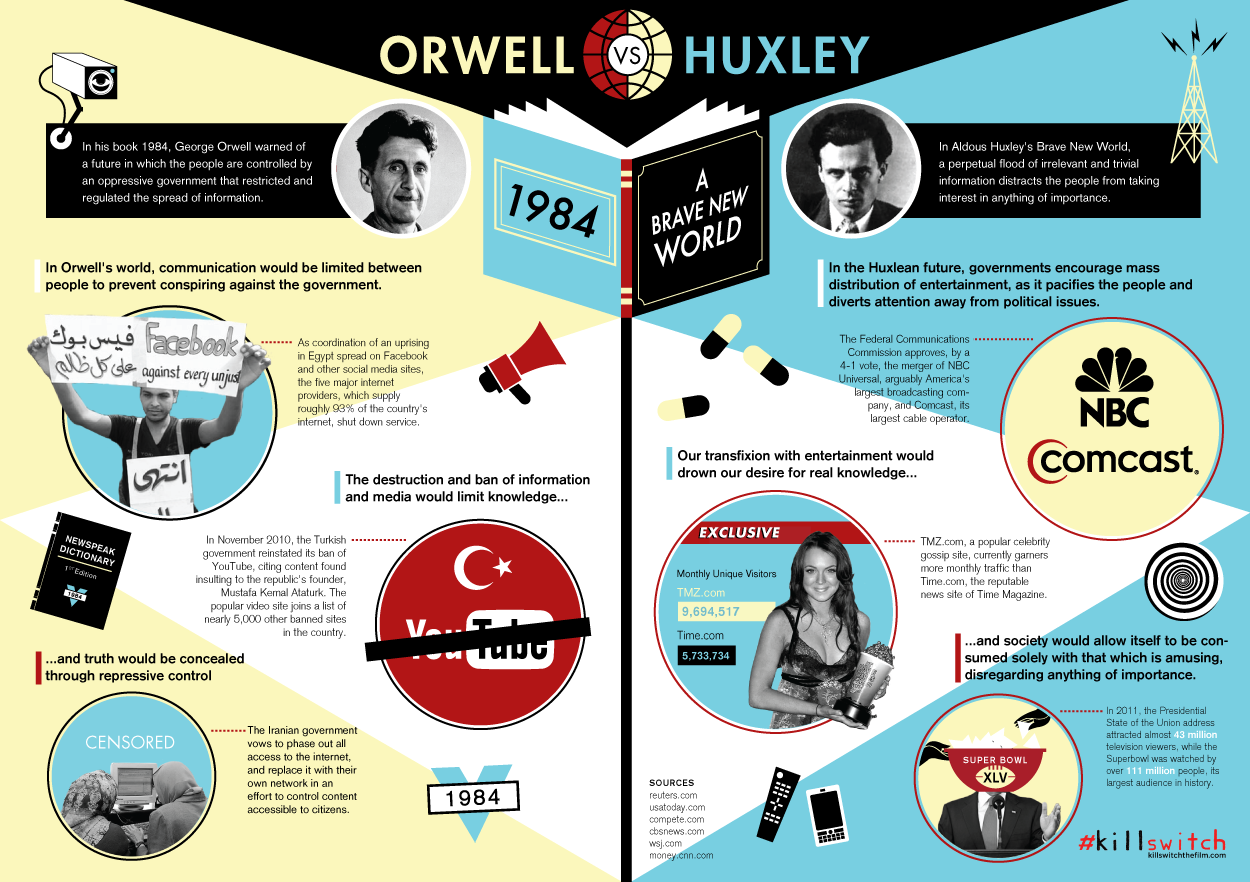
Orwell vs Huxley

Orwell vs Huxley: 1984 vs Brave New World.  
But then, as a comment there points out, we could as well go the whole hog and head to this 1984 speech by Neil Postman: Amusing ourselves to death.

14 Nov 2011

Meritocracy in the USA

America’s meritocratic, watchdog news media.  Baby Bush's daughter joins an NBC show, Bill Clinton's daughter joins NBC's as a full-time special correspondent and John McCain's daughter joins MSNBC.  As Greenwald puts it:
I really don’t understand what those angry, lazy losers in the Occupy movement are so upset about. America is a meritocracy; if you work hard and prove your skills, you get ahead. The winners deserve what they have because they have earned it. And when all else fails, we have a media filled with insurgent outsiders who will be relentless watchdogs over those in power because that’s what our media outlets are: true outsiders there to check the most powerful factions.

1 Nov 2011

‘Media is diverting attention & dividing people’

Former Supreme Court judge and now chairman of the Press Council of India (via churumuri):
Indian media is very often playing an anti-people role. One, it diverts the attention of the people from the real problems, which are basically economic. 80% people are living in horrible poverty, unemployment, facing price rise, healthcare. You divert attention from those problems and instead you parade parade film stars, fashion parades, cricketers, as if they are the problems.

Two, very often the media (deliberately) divides the people (on religious lines). This is a country of great diversity because it is a country broadly of immigrants. We must respect each other and remain united. After every bomb blast, almost every channel report that Indian Mujahidin or Jaish-e-Mohammed or Harkatul-jihad-e-islam have sent e-mails or SMS claiming responsibility. Now an e-mail can be sent by any mischievous person, but by showing this on TV channels and next day in the newspapers the tendency is to demonise all Muslims in the country as terrorists and bomb throwers.

Third, the media must promote scientific ideas to help the country move forward, like the European media did. Here the media promotes superstition, astrology. You know, 90% of the people in the country are mentally very backward, steeped in casteism, communalism, superstition and so on. Should the media help uplift them and bring them up to a higher mental level and make them part of enlightened India, or should it go down to their level and perpetuate their backwardness? Many channels show astrology, which is pure humbug, total superstition.
B..but the competition, invisible hand, free markets?

PS: The full interview here: http://ibnlive.in.com/shows/Devil%27s+Advocate/197593.html. Lots of good ones like 'Cricket is the opium of the masses'.

6 Aug 2010

Paid News: Press Council Ducks

P Sainath writes a powerful piece on how the Press Council of India hid the inconvenient report of the sub-committee that looked into the paid news scam. First the background:
No scandal has rocked the Indian media more in recent decades than that of paid news. Most of all when it emerged during the last Lok Sabha and subsequent Maharashtra polls that hundreds of crores of rupees had been spent to buy “news” in large dailies and television channels. Major parties and candidates overshot poll spending limits many times over on this one expense alone. It was and remains a nauseating form of corruption.

Outrage grew over the idea of the media acting as extortionists — the very term that many a candidate used to describe the practice of “paid news” during the last Lok Sabha polls. Indeed, a few top politicians complained of it in those terms. The political class did not, as some imagine, go out and “seduce” the media. The media went out and sought “package deals” with them whereby they forked out huge sums of money — or were simply blanked out of the coverage of the paper or channel. The “selling” points were: this way, you can spend as much as you like and not get caught by the Election Commission of India for mocking the spending limit. This way, you are able to take your campaign to millions of voters — for millions of rupees. You can also have your opponent blanked out — or trashed, if you pay that little extra. And neither you nor we attract the taxman's knock on this all-cash transaction.
So the Press Council of India set up a sub-committee to look into the matter.
Acting promptly at the time, the Press Council of India suo moto set up a sub-committee to probe the phenomenon of paid news. The two-member sub-committee of Paranjoy Guha Thakurta and K. Sreenivas Reddy produced a devastating report (see The Hindu April 22, 2010). One that observed all the norms and ethics you could demand of such an exercise. It did not carry a single allegation without full attribution. It took no recourse to “sting” journalism, going for a thorough inquiry instead. It spared no effort to obtain the responses of the groups accused of playing the paid news game. Laying the charges squarely before them, it gave them ample right of — and space to — reply. It recorded depositions from scores of individuals. In one instance, a media organisation apologised for what it had done. In another, a candidate from Andhra Pradesh placed on record the results of his own “sting” operation against a major media group. Some of these depositions were in the form of affidavits.
What did they do with the sub-committee's report? They made it disappear completely!
The sub-committee finds passing mention in the “final” report. Its outstanding effort stands reduced to a footnote (yes, a footnote) in that report. The footnote says the sub-committee's report “may remain on the record of the Council as a reference document.” That's right. It goes to the archive. There is no sign of this “reference document” on the website of the Press Council. This is the standard the PCI sets for the Indian media?
Why did they do that?
Over the months since the scandal hit the fan, some members of the PCI — mainly those representing media owners — worked to scuttle the explosive original report. They had two basic issues with it. First: Why name names? Why get into the ugliness of that? Fascinating, at a time when the media are baying for names and blood on the corruption in the Commonwealth Games scam. So firstly, we now have a double standard: exposure for corruption in the Games, privacy for it within the media. Secondly, they fiercely opposed any reference to the Working Journalists Act. In this, they acted as owners and employers. Not as members of the PCI guarding the integrity of the press and its standards.
That's the kind of fourth estate our country needs, indeed.

Update: The draft report of the sub-commitee is here.

27 Jul 2010

Singing Police Officers And The BJP

Rasheeda Bhagat turns a nice phrase:

As the BJP continued its attacks on the CBI and its acts of commission and omission, the investigating agency got a respite on Monday with the Gujarat police officer Mr N.K. Amin, one of the main accused in the encounter, offering to turn approver. This should worry the BJP, because when a police officer sings, one never knows what his refrain will be.

Well done!

23 Jun 2010

Mamata's Ascendancy : Mum's The Word?

Singur and Nandigram seem to have been a turning point in Mamata Banerjee's political ascendancy in West Bengal. Both were basically against the pro-industry and anti-people stance of the Left. How many media outlets have discussed this angle? Not surprisingly, given the general pro-industry slant of the media, not many if Google is anything to go by. With one exception. Rasheeda Bhagat in Business Line:
The question, then, is how Trinamool managed to break the Left's winning streak in West Bengal. Surely, the principal reason is the growing disenchantment of the voter with the Left, and a definitive turning point was the manner in which Didi took up the cause of the farmers and the peasants who were set to lose their land in both Singur and Nandigram, to make way for industrial projects.

As she took on Mr Ratan Tata's Nano project in Singur, and eventually forced its exit to Sanand, Gujarat, the elite and educated Indians, as well as mainstream media, were clearly on the side of India's most admired and trusted corporate icon that Mr Tata certainly is. Some pretty unsavoury stuff was written about how Mamata was stalling the industrial development of West Bengal.

But then came Nandigram, and we saw the unleashing of ugly violence on the protestors who refused to part with the land which either belonged to them or over which they had enjoyed rights for several years. With charges of the Left workers getting into the act, along with the police, to “punish” the protestors, beat up the TMC workers supporting them, and wreak vengeance and violence on the women and children, it no longer seemed right to endorse the government's stand.

After Nandigram, Mamata clearly emerged the definitive political leader who had the spunk to take up the cause of the deprived and the downtrodden, even as the Left leaders continued to be arrogant and indifferent to the real public mood. Suddenly the leader sans frills, who lives an austere lifestyle in a single-storeyed house in Kolkata — here is she as different from Mayawati and Jayalalithaa as cheese from chalk — had become the darling of the Bengali masses and intellectuals alike.

18 Apr 2010

On IPL

Two opinion pieces on the crapola that is IPL. One, a serious one from P Sainath. An excerpt from it highlighting the media's acquiescence on the whole matter:
It was just 10 years ago that cricket was rocked by the game's biggest-ever match-fixing scandal. That too had its centre of gravity in Indian cities, and involved Indian bookies and Indian businessmen. But along comes a new hyper-commercialised version of the game. It has scandal-waiting-to-happen written all over it and the media say “wow! This looks great,” promptly going into the “willing suspension of disbelief” mode. This venture had the right names, high glamour and, above all, big advertising and corporate power. There were obvious conflicts of interest (apart from what it did to cricket, the game) from day one. Here was Big Business in open embrace with its political patrons. There were also those who did not give the public office they held a fraction of the time or importance they gave to the BCCI-IPL. But few serious questions came up in the media.
The other a tongue-in-cheek one from T. C. A. Srinivasa-Raghavan. The defines the problem as follows, before coming up with a theorem, a corollary and a lemma:

To the extent that cricket is the only sport that Indians seem to enjoy, the demand for it far exceeds supply.

The convenience that TV offers, of being able to watch it in the comfort of your home, has enlarged the supply-demand gap disproportionately because even those who would not otherwise watch cricket watch it now.

Add to this the fact that the Board of Cricket Control in India (BCCI) has the monopoly over cricket, and the perils of short supply become very evident. The flies begin to gather.

Top it all off with the terrifying amount of money floating about in the world looking for sure-fire investments, and what you get is an IPL-like phenomenon, namely, super-normal profits caused by a huge demand-supply gap and a monopoly.

Indeed, the IPL is different from other controlled businesses — like mining, for example — only in that it is entertaining and therefore more visible. But it has its share of sleaze balls in the same proportion as Defence deals, road-building contracts, mining and so on. They also get attracted to what in economics are called ‘supernormal profits'.


30 Apr 2009

Our Media

From The Hindu:
Over the last few months, just as the economy entered its current recessionary phase, the mainstream media, which till then had been uniformly unswerving in their antipathy to NREGA (National Rural Employment Guarantee Act), suddenly began to sing its praises.

Because rural people don't really matter till they are required to bail out the economy!

28 Feb 2008

Systemic Banking Crisis In The US?

(via CalculatedRisk): All claws, teeth, and fur (head out to the last paragraph of the PDF)
What will be the consequence of losses of over $1 trillion and, possibly, as high as $2 trillion? That would wipe out most of the capital of most of the US banking system and lead most of US banks and mortgage lenders – that are massively exposed to real estate – to go belly up. You would then have a systemic banking crisis of proportions that would be several orders of magnitude larger than the S&L crisis, a crisis that ended up with a fiscal bailout cost of over $120 billion dollars. And the worrisome part of this scenario is that – with home prices likely to fall by 20% or more – this scenario of systemic banking crisis is becoming increasingly likely.
What impact would that have on Udayan's long bull run?

31 Jan 2008

Brain Dead Cartoon

From TOI:


Update: Adding that ad hominem attacks don't cut it, and nor does deliberately missing the main point. Like those in this counter view. The main point is that kids and youngsters are the ones at most risk - not those who have minds of their own. True, there are other problems with health care, but accept it, this is also a biggish problem.

20 Jan 2008

Leaders Bollywood Style

Nothing less, is what we'll get courtesy TOI. Santosh Desai in Tehelka:
...the TOI’s Lead India campaign is going strong. Among the eminent people who will judge the suitability of candidates for the onerous task of nation building in These Exciting Times are people who have toiled tirelessly for the downtrodden and showed us new ways of punching, kicking and riding motorcycles on screen. Yes, I am talking about Akshay Kumar and Ajay Devgan, the intrepid reformers who we all owe so much to.