23 Mar 2006

Eating Humble Pie

kmp writes in, in response to In Which I Eat Crow:
>>I was supporting England of course

Is it “Sourav Mania” (a la a section of our BB*** )? Or is it just Freddie “Fantastic” Flintoff? ;-) (Mind you Sourav and Flintoff did not get along well either!!!).

Much has been talked about dropping Saurav (and of course treatment meted to him – and me too being a sympathizer). But, what’s the point? He was not performing for a while – and he should be dropped not withstanding the emotions attached. Yes, there is an argument then “why not others”? Of course why not? But, that does not mean bring back Saurav – does it? And, the list of “Why not others” has only Sachin for the time being – but Sachin has an aura which I think nobody else can get (and I don’t want anybody else to get lest we become the prisoners of that again).

And, why is it that people hate Greg – for being antagonistic with Saurav? Just that - come on!
Stern rebuke indeed! Not entirely unjustified for sure. My answers to his (non-rhetorical questions) first. Then I will try to offer my reasons but even I'm not too confident that I can rationalize this away. It straddles the borderline between reason and emotion as kmp has guessed. I put in the effort mainly to get it off my chest. It will be a ragged defence, maybe it will be cathartic too.

The answers to his questions are:
  • Yes
  • No (though the English team grows on one if one is not careful) - and it would be difficult to find anyone who got along well with Ganguly other than Boycott
  • I agree, there is no point
  • No it does not mean backing Sourav
  • I don't know why they hate him
First up is the psychological defence, followed by one or two things that have bothered me about the entire throw-out Ganguly episode.

kmp asks: Is it Sourav Mania?

Yes it is. I made it clear in this post not so long ago. Let me explain. Remember when Chappell came in and Ganguly was thrown out? Though a Ganguly (and Dravid) fan I had admitted to kmp that it was right that he was let go. If all we heard during that time was true - him not playing in Nagpur because of the quicks, being reluctant/frightened to face fast bowling, making VVS insecure by telling him that Chappell did not want him in the test squad, having lost the confidence and trust of the rest of the team - then he had to go. It is all summarized here in Chappell's letter to the BCCI president. Anyway, coming back to him being dropped - I thought it was deserved too, since his batting form was anyway plumbing the depths. But the Karachi test showed that he was trying and succeeding a bit too. Cricinfo analysed the two innings and gave a thumbs up (I wrote about it here). To be dropped after that - that was galling. They were playing with him like a cat plays with a mouse. If they were going to do that, they should not have picked him in the first place at all.

So there it is. I don't think Ganguly is anything more than a pleasure to watch when he is playing well. Not God - even of the off-side - or anything like that. And, no, I'm not saying bring him back. But he deserved to be treated well, even if he was dropped ultimately. I have always had a soft corner for the underdog - or losers if you will. I don't know if psychologists have a name for it, but that is how I am and evidently many others are.

There is one thing in Chappell's criticism of Ganguly which don't ring true. There is the reluctance to open. I seem to remember a particularly heated discussion sometime ago - about Ganguly being reluctant to give up the opening slot in ODIs to Tendulkar. True ODIs are a different ball game altogether - but the ball is equally new and hard and coming down as fast in ODIs too. And Ganguly faced Akhtar and friends quite grittily in the Karachi test didn't he?

There is also the flip-flopping on Ganguly opening/not opening in the first Test in Pakistan culminating in the heated discussion on the morning of the Test. Why was there a rethink on Ganguly opening - after him being picked as a opener? Did it have anything to do with the dead track? Did someone think - well, even Ganguly opening can do well on this track, and if that happens, it will only complicate things?

And what about the 'integral part of the team' as Chappell puts it in his letter, talking about VVS? He has been kept out of the Test side hasn't he? And if this 5 bowler combination works well, where does that leave Laxman? His form has not been anything worse than the 'master-blaster' - if anything, it is a bit better going by Cricinfo. Why the special treatment for Tendulkar? I don't believe in this aura thing, with all due respect to kmp. If it were true then only psychics should be allowed on the selection panel. I never believed the hype surrounding him much beyond the first five years or so. The real thing does not need that much of gloss. And it is not entirely spontaneous. Shekhar Gupta (of Indian Express) on a NDTV chat show mentioned how a critical article was withdrawn at the last minute due to pressure being brought on his newspaper not to print it. Genius does not need such protection. And one needs to only look at the extensive sympathetic coverage of the booing episode compared to the coverage of the incidents of stoning of Dravid's and Ganguly's houses during the last World Cup. It doesn't make sense in cricketing terms too. Are international cricketers kids who get overawed by a big name? And coming to others who have been persisted with, Sehwag too has not been in the best of form in Tests, of course ignoring those big innings on the horrendous batting tracks in Pakistan.

kmp asks: Why is it that people hate Chappell? For being antagonistic with Saurav? Just that - come on?

But I imagined I was being factual here. It is not only me talking about him being concerned only about the 2007 World Cup, but Indian Express too, here. The relevant quote here:
Someone should redraft Greg Chappell’s contract. The focus of Team India and its coach — and, apparently, the entire BCCI — seems to be one-day cricket and its Holy Grail, the World Cup in 2007. The fact that there are a few Tests to be played along the way appears incidental, and has left players unsure over how they should tackle a five-day game.
And in Chappell's letter to the BCCI he says :
I can assure you sir that all my actions in this matter, and all others since my appointment, have been with the aim of improving the team performance toward developing a team that will represent India with distinctions in Test match and one-day cricket.
But in the very next paragraph, he regresses to this:
In fact, it has only served to confirm that it is time for him to move on and let someone else build their team toward the 2007 World Cup.
Will the real mind of Chappell stand up please?

On the other hand, I think I do hate him. For being so confrontationist. For showing his finger. Or maybe just for guts he has shown in taking on the former captain and turning Indian cricket upside-down by all accounts.

*** kmp is referring here to the electronic discussion board in the company we both worked in before I quit, where he still works. In short, discussions get very heated in there, and loyalties to certain cricketing personalities are stronger than steel, and said loyalties are declared constantly to the irritation of people who are loyal to other greats, and endless/pointless debates rage during the cricket season and during the non-cricket season. I left two years ago, and certain controversies are still being discussed, one of them being who is better - Tendulkar, Dravid, or Ganguly. Another peculiarity is that loyalties cannot be shared - a Tendulkar fan almost always is not a Dravid/Ganguly fan, and so on. In fact, he usually hates the the other two. Any praise of Ganguly - even without any reference to any other cricketer, leave alone Tendulkar or Dravid - quickly becomes a discussion of who is better among the three. You get the drift I think. And we used to agree between the two of us that the guys who posted are mostly nuts/idiots - certainly the authors of someof the more stupid arguments. So it is not a compliment at all to be compared to them :-)

NPT, The Nuclear Deal, And The Flat Worlder

Venkat Krishnan (whom I do not know) roasts Tom 'Flat' Friedman on the latter's shabby article opposing the Indo-US nuclear deal.

In Which I Eat Crow

Yes, I take this back. Things do change. The way Dravid summed up yesterday's batting collapse to Dean Jones during the presentation ceremony was a refreshing change on a gloomy day for India fans. I was supporting England of course.

'It was bizarre', he said. Now, I've listened to captains in the recent past talk about humiliating defeats. Azharuddin had taken to mumbling incoherent nothings towards the end of his captaincy. He was probably afraid of mentioning money by mistake. Tendulkar was in and out before one could say 'we played like dumbasses'. Ganguly had just started mastering the art of stating the glaringly obvious, such as, 'we need to play well to win', then, he was captain no more. Yes that is a pun and I intended it, though Boycott would probably call it a joke. But I think no one, not even Dravid talking of the Karachi debacle, has gone beyond words with single syllables and commonly used terms.

With that in mind, bizarre as a word is different. It is exotic. It sets a new standard for captains. Kudos to Dravid. Being the modest man he is, he would, I'm sure, attribute it to 'contributions from the boys' and how he was 'happy with the boys' for suggesting the word to him.

However, I rush in where he has so gingerly tread - like a certain class of humans are supposedly prone to - and suggest another term to describe the defeat. It is called deja vu. Thus, he could have said, 'it was like deja vu all over again'. He has been part of many such defeats - in spite of his good performances - after all. And we the past and current fans of the team have not infrequently watched capitulation after capitulation on pitches that do not bear resemblance to plain glass.

But I don't think he reads me.

PS: Of course, many had thought that things would change drastically since the last captain was thrown out of the team. What with 'performance' being the sole criteria now, and the change in the working of the team, emphasis on discipline and on the process of winning, and other such new and innovative ideas. But I want to point out that they had no reason to assume any such thing. The task before the team management is not to win test matches. The self-described task before Greg Chappell is to win the 2007 world cup. And that contest does not have test matches. So there.

18 Mar 2006

Medi-oh!

This interesting snippet from The Hindu:
Different facets about Rahul Dravid came to the fore at a felicitation function for the Indian captain on the eve of his 100th Test appearance organised by Bank of Baroda.

Hosted by Cricket Club of India on its lawns, club president Raj Singh Dungarpur set the tone with a tale from Pakistan about the former's hands-on leadership...

Dungarpur, team manager on the tour to Pakistan, said: "It was decided prior to the first Test that Sourav Ganguly would be asked to open the batting. I had a word with Ganguly who told me he was ready to do anything the team wants him to do," said the CCI president, adding: "Dravid had made up his mind that he would face the new ball instead of thrusting Ganguly into the situation and convinced the team management to accept his viewpoint."

Well, well, well! So the 'animated discussion' on the morning of the first Test could not have been about Ganguly trying to convince the cap and coach that he did not want to open and that he preferred coming down the order. So why was everyone on TV and some parts of the print media too implying that it was about the former captain refusing to open?

Here is the interesting mix of innuendo and unnamed sources served up by R Kaushik of DH on the front page the day after the incident (from DH, Jan 14 2006). He starts off innocently, planting the idea firmly in the reader's mind:
It will not be prudent to state that Ganguly was making a case for himself in the middle-order once it had been decided that he would play in the first eleven;
However after pointing to Ganguly's reluctance to open and a sprinkling of data on how he fared when he opened (badly), he throws all prudence to the winds and ends with the following:
It is quite possible that the debate in the morning was Dravid insisting that he would open the innings, and Ganguly countering that since he had been drafted into the eleven as an opener, he will discharge that responsibility. A team source, however, said the former captain desired a ‘rearrangement’ to the batting order -- whatever that means.
This is one hack who has sold his soul.

4 Mar 2006

Just Deserts

I'd mentioned this US Congressman's unique approach to raking in the money here. He got his just deserts today. 8 years in the pokey.

And we are still letting all and sundry get away with murder. I'm not even talking of the Jessica thing.

24 Feb 2006

Authority

In which Manmohan Singh gives it back:
It was as if, “we live in some totalitarian system, in some fascist state, where authority has to be visibly asserted to command compliance”, Mr Singh said alluding to the BJP’s unrelenting criticism about his authority in the government.

“Maybe those who raise this issue are unaware of this framework. Maybe they think other parties function like theirs, allowing shadowy organisations to interfere in the work of elected governments,” he said in an obvious reference to BJP-RSS ties during the NDA rule at the Centre.
Encore Dr Singh?

Adios

By all accounts, Ganguly seems to be staring at the end of his international cricketing days. If so, sad and here is one person who won't be rooting much for the Indian side.

19 Feb 2006

Cars Vs Bikes

In this Tripping on Bikes -2 post I said that travelling by car wouldn't be as much fun as going by bike, and let it go at that.

There is a book on my shelf which I bought in December 1994. I gave up after a hundred or so pages since it was a bit heavy on the brain. I started again and completed it a month ago. In it the author explains the difference much better than I did:
You see things vacationing on a motorcycle in a way that is completely different from any other. In a car you're always in a compartment, and because you're used to it you don't realize that through that car window everything you see is more TV. You're a passive observer and it is all moving by you boringly in a frame.

On a cycle the frame is gone. You're completely in contact with it all. You're in the scene, not just watching it anymore, and the sense of presence is overwhelming. That concrete whizzing by five inches below your foot is the real thing, the same stuff you walk on, it's right there, so blurred you can't focus on it, yet you can put your foot down and touch it anytime, and the whole thing, the whole experience, is never removed from immediate consciousness.
Yeah, all that and the fact that I tend to fall asleep much more in a car and that it does tend to become a bit of a social occasion.

He goes on about his attitude to the trip itself and more common ground emerges:
... Plans are deliberately indefinite, more to travel than to arrive anywhere. We are just vacationing. ... We want to make good time, but for us this is measured with emphasis on 'good' rather than 'time'... Twisting hilly roads are long in terms of seconds but are much more enjoyable on a (motor)cycle where you bank into turns and don't get swung from side to side in any compartment. Roads with little traffic are more enjoyable, as well as safer. Roads free of drive-ins and billboards are better, roads where groves and meadows and orchards and lawns come almost to the shoulder, where kids wave to you when you ride by, where people look from their porches to see who it is, where when you stop to ask directions or information the answer tends to be longer than you want rather than short, where people ask where you're from and how long you've been riding.
Couldn't agree more.

Harsh

Words for Bihar from a native. After a list of things that should occur for the state to really change - rather than just the CM - the writer says:
The difference between any two States is not so much because the Chief Minister of one is a lot better than that of the other; it is because people in one have initiative and enterprise, and those in the other don't; people in one have some sense of shame and pride, in the other don't.

Because all those things I listed above are not going to happen in the foreseeable future I am sure Bihar is not going to change for the next few decades at least. Nitish Kumar at the best might be a good joke between bad serials. Call it cynical if you will!

10 Feb 2006

Tripping on Bikes - 2

Another trip, another post.

The previous trip had been confirmed a week or so in advance. This one almost did not happen. It was cancelled once due to personal reasons, and then almost got cancelled because of the threat of rain. Time was when the sound of heavy rain falling outside the window was a clear invitation to take our cycles or mopeds out and ride through the neighbourhood, getting thoroughly drenched. But much water has flowed under the bridge since then. Now the thought of rain on our trip is not a happy one if only because there is no hot water, fresh clothes, or dry socks waiting at the end of it. Hence it was nine-thirty pm on a wet thursday that we - Pradeep and I - finally decided to pack our bags and head out the next morning. Bangalore was wet, and rain was very likely. But going had become inevitable. The sudden catches of memories from prevous rides were haunting. Especially since, after the generous NE monsoon, the entire region would be covered with that beautiful green of paddy fields and of the overgrown trees of the ghats. Probably Pradeep felt the same too.

An small digression here. While discussing the rain issue, we had explored the option of going by car. It wouldn't be as much fun as biking, but at least we would be safe from the rain. Now, it is accepted wisdom that travelling by car is safer than travelling on bikes. We now found out that this need not be always so. Two people were uncomfortable with us going by car - Pradeep's mother and sister. All our trips so far had been by bike and they were happier at the thought of us speeding through the countryside on bikes rather than on cars. We had come back without a scratch from each of them! We all feel more comfortable with familiar things and a known devil is better etc. All the same, it was amusing. Only we knew the various incidents over the various trips.

Day 1, Nov 4

I was wide awake at around four in the morning for no particular reason. More than an hour to fill in, which I spent posting on my blog. Then a bath and the usual quick byes to the kid and wife before I was off. For a change, Pradeep was all set by the time I reached his house. We were short of a watch - mine was at home with a broken strap, he doesn't wear one. A call to his sister resulted in a watch being dug out. It had stopped at 1:30 am/pm - many days ago it looked like. We took it anyway. We'd try to find batteries for it in Tumkur. We'd hoped to rope in the brothers Anand and Sunil again, but Anand was away in Spain on work. Without him it would be difficult for Sunil to get the required clearances to join us.

Since it was a holiday (Ramzan) we were able to get out of the city quickly. Soon we decided that we would aim for Jog Falls. We were hoping that the authorities would've releasesd water from the dam after all that rain over the last month or so, and that we could catch the falls in their full glory. The route would be Tumkur - Gubbi - Tiptur - Arsikere - Kadur - Birur - Terikere - Bhadravati - Shimoga. Lunch at Shimoga and then on to Thirthahalli for the night.

We filled some petrol into the bike and it felt good to get going. As we made out way through the outskirts, we could see people busily travelling to work - some walking, some waiting for buses, all hurrying along. And here we were merrily biking. Pradeep remarked on this. Thus we bounce along each of us, hitting reality every now and then. I had hit it the previous day at the mechanic's garage while getting the engine oil changed. A young boy was at the garage, not more than sixteen or seventeen. It was Ramzan eve. He spoke hindi and I guessed he was muslim. And there he was at eight thirty the night before Ramzan working on my bike. And while I was there a man of around fifty years came along with a pretty run down TVS moped. The chain had fallen from the sprocket. Why still use such an old vehicle?

We got on to the Tumkur toll road which is still the same - smooth and easy to drive on. Since it was november, the sun was mild and and the cool air was refreshing. At around eight, we pulled over at a Kamat restaurant that we'd failed to spot last time, for breakfast. Idlis and vadas and two kesaribhaths - one as an appetiser and one for the road. Washed down by coffeee of course.

We were in Tumkur by ten and looking out for watch-repair shops. We found one quickly. Pradeep walked over to the shop. It was staffed entirely by women, who were forthwith treated by Pradeep to an puzzling exhibition of contortionism. He reached the shop and felt in his trouser pocket for his watch. It wasn't there and he had forgotten where he had put it. He was wearing the rain-proof jacket and it had many pouches and pockets. Add to that the pockets on his shirt and trousers. The watch had originally been in his trouser pocket, but he had shifted it elsewhere sometime later without himself being aware of it. Probably at the restaurant. Now he stood at the entrance of the shop, the only potential customer, without a clue as to where the watch was. He proceeded to check all the pouches and pockets, and as I've mentioned, there were a few of them, not all of them easily reachable. Layers of clothing had to be reached under and around and opened. The young ladies in the shop had nothing else to distract them and they gave him their undivided attention. He finally found the watch. He later told me that he got a feeling they found it funny. Can't think why.

We put in calls home from a nearby phone booth before taking off again. Pradeep took over at Arsikere and continued upto Shimoga. This time he did not take over quite so gingerly as during previous trips. And his driving seemed to have turned the corner. No crowded town street, no pothole, no collapsed road could faze him. He took them all coolly. I stopped worrying about the road and relaxed. Till an incident on the second day.

The road was good thus far except for the Birur - Terikere stretch which was quite bad restricting us to a slowish crawl. It is mystifying - this variance in the road quality within short distances. This, for instance, is a highway, so I suppose the same authority is responsible for the entire stretch. Maybe it is due to different contractors executing different streches. Sometimes the road is good for long distances, but suddenly deteriorates for the space of a few feet - maybe they ran out of materials. We stopped for tea at this place in Kadur.


Shimoga was in sight by three in the afternoon and lunch shortly after that. Thirthahalli next. There was a dam project at Varahi nearby which would be good to visit (thought Pradeep). We checked the route from the hotel owner who seemed a bit unsure and guided us to the nearby bus-stand. Pradeep got hold of a bus driver there, and pointing at a road asked him if it went to Thirthahalli. The bus-driver replied in the affirmative but seemed to favour another road (going in the opposite direction incidentally) and reeled out the names of all the stops on it. A bit confused, Pradeep asked him 'Then where does the first road go?' 'It goes to Thirthalli too, but directly unlike the other one', was the reply from the bus-driver. A bit mixed-up in the mind surely.

Pradeep was handling the steering and doing fine, so I just sat back and soaked up the view. We're going quite fast and the wind makes a whistling sound if the helmet visor is raised a bit. The air is so clean it really doesn't matter if the visor is up or down. The main reason we keep it down is to avoid those pesky flying insects. On one of our previous trips, Pradeep got hit in the eye just as we approached his old college. We naturally stopped for tea at his old joint, Pradeep with tears in his eyes due to the insect-hit. The owner must've thought he was taking the visit extremely emotionally. So, we go on with the visor down mostly. The road comes at us as if out of a tunnel with the trees on either side forming the walls. And it keeps going on and on like that. Narrow in the distance, broadening as it meets us. A paddy field is suddenly illuminated by the sun.

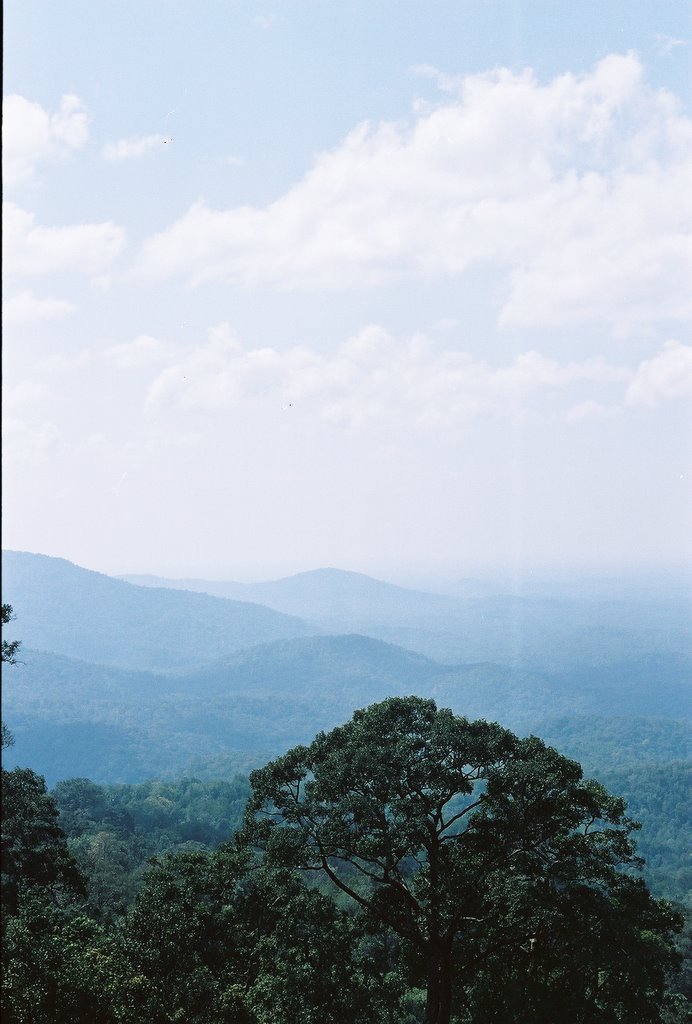
It was too far to the dam and it was already around four. We'd visit it the next day. On to Thirthahalli. As we left Shimoga, the scenery became suffused with green, as we'd imagined. Various hues of green everywhere, not a trace of dry earth. Like this:


On the way, we came across a construction site where they were building a new canal. The area was to be submerged once the water was let in. Here is what the whole thing looked like.

The whole site would have looked heroic a hundred or two years ago, man pitting his will against nature and all that. But not so much now. A bystander came across, seeing us clicking away. After the preliminaries which usually consist of 'Where are you coming from? Are you here just for fun? Where are you going to? How much mileage does the bike give?', Pradeep asked him about the big politician from this area, a well-known person. "To be fair, he has done things for this region. True, he has taken money, but then everyone does. Politicians take money, we too take money. That's how it is." Money being the euphemism for bribes and corruption. The new heroism. What exactly has he done for the region? This dam, is the reply. Very unlikely.

After an hour or so we stopped at this roadside hotel.

A beaming lady, who was in the family way, served us tea. A group of three men sat at the next table, apparently just enjoying a nice tea and talk. All of them had questions for us. "Are you from Bangalore, I heard you got lots of rainfall there, Are you here just for fun? Where are your going?" We asked them about the rain here. Only the beetlenut crops were affected according to them, but overall they were fine with the rain.

We reached Thirthahalli at around six thirty in the evening. Nagarjuna, the Telugu film star, and his crew had reached there before us. They were shooting at Kasaravalli village nearby. So the first hotel we checked, newly constructed and with a unhindered view of the town bus-stand and the weather-beaten buses, was full. Another, a little further down did have a double room. Nagarjuna's crew were booked here too, as we realized sitting in our room. The sound of feminine voices and laughter was unmistakable and Pradeep who was facing the door noticed females in various states of dishabille running hither and thither in the corridor. Extras, those essential elements of south Indian film song and dance sequences? Probably. The room was nice and cosy, there was a TV with cable, and a clean toilet.

Dinner was at seven in a darkly lit restaurant down what looked like main street. It had cubicles for the retiring kind and for those who wanted to indulge in a leisurely sip without distractions. We took the option. It had been a good day of riding, equally split between the two of us, and we were in good spirits. Soon the jokes were falling freely in our cubicle - Pradeep usually has a bagful of them. Loud conversation between a group of friends was taking place in the neigbouring cubicle. Sudden lulls in the conversions occurred now and then, to be replaced by sudden bleating and mooing sounds accompanied by cries of "Sheep!", "Goat!", "Buffalo!". They must have had some reason for this behaviour. Later there was much cursing in colourful language at some person who was not among those present. All perfectly normal and hardly the stuff to cause eyebrows to rise. The food was oily mainly. By the time we returned to our room it was eleven. We talked for some more time before saying good-night. I was asleep in three minutes having slept so little the previous night. Pradeep, he told me next day, had more difficulty drifting off.

Day 2, Nov 5

The next day morning I was up first, around six. Nothing to do. I finished my stuff and waited for Pradeep to wake up and get ready. At breakfast downstairs, a family consisting of three young ladies and their parents, no doubt part of Nagarjuna's entourage was also there. Interesting life people in the film industry led I thought - they got to travel to these out of way places, probably often. Breakfast over, we fill in some petrol and headed out to the dam.

The route would be Kaimara, Yadoor, Varahi. The dam - called Mani dam - was at Varahi. The roads were good for a while.

Soon the roads turned nasty, worse than anything so far. They were more like ruins of bygone roads than anything laid in living memory. On top of it, the rear shock absorber was a bit too tight. We were destined to have a bad case of pain-in-the-backside the second half of the day and the next. I mean really bad. Some of the worst riding in our trips I think. A faint glimpse of the road here:


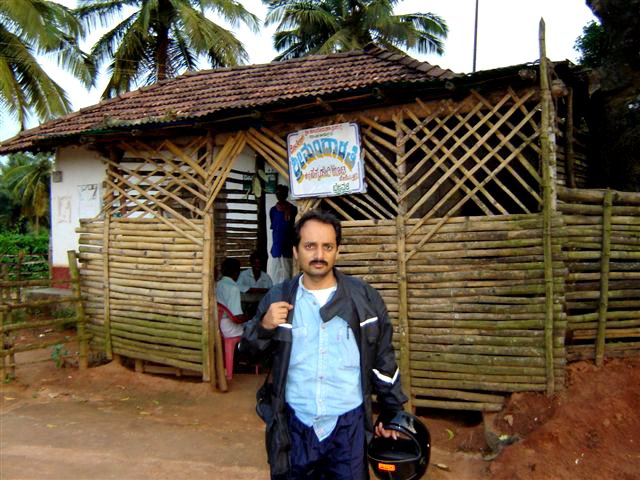
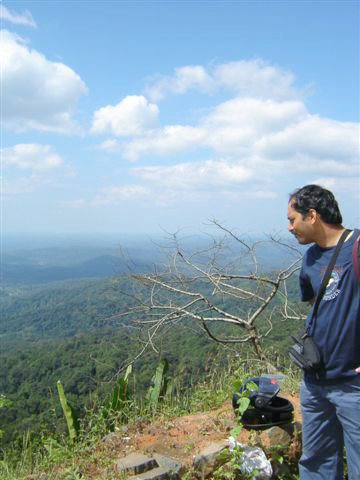
And me, hiding my face from the paparazzi:

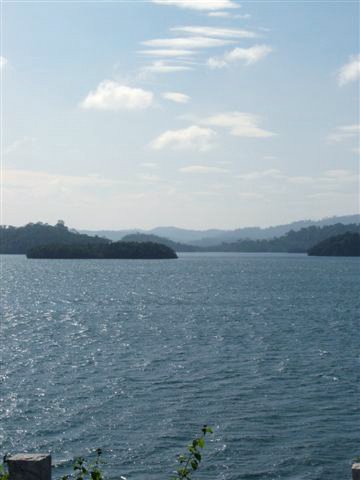
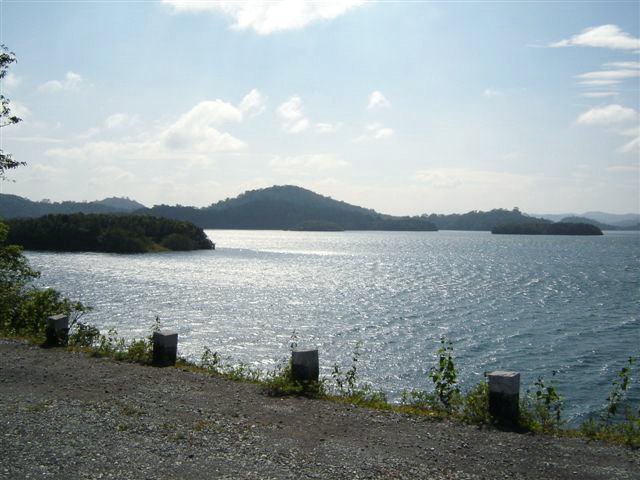
We reached the Mani dam at around ten. The dam was full. The strongish breeze raised mini waves and one could almost imagine it as the sea not a dam. The security guards at the entrance refused to let us in. No photos even. As we stood reading the details about the dam written on a board, the guards came down and told us that an LTTE threat to blow up some the KRS dam in Mysore as the reason for not letting us through. Security at all dams had been tightened. Also, the naxalites. One of them pointed out an area on the other side of the dam where he said naxalites were present. What do they do, we asked. They just stay with the villagers and help them and fight for them against the rich landlords, one of them replied. He was a temporary worker employed by a private firm, the other was a police constable. The former was especially bitter - his house was submerged by the dam, and his salary now was just two thousand rupees. Some people nearby could not even move out of the island created by the dam waters. In other places, water was being hoarded by the landlords. They also told us of contracts for big sums of money for lighting the dam. None of the bulbs worked. All this while they got paid a pittance. And they had to face unfair treatment at the hands of the engineers. One engineer had insisted on his relatives being allowed past the gates, saying the dam had recouped its cost by now and even if it were to be blown away it would not be a big loss. As the police constable said, maybe, but a few towns downstream would be submerged. The amount of water stored was huge. They also told us of how some persons who are now big businessmen started small at this very dam. And now there's no looking back for them. 'Money chases the rich man'. We don't know how much of what they said is true. But they surely had more sympathy for the naxalites than for the authorities. It was hard not to feel pity for them.

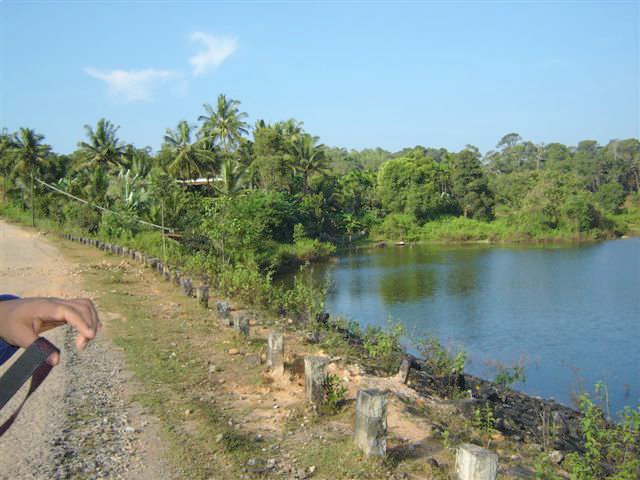
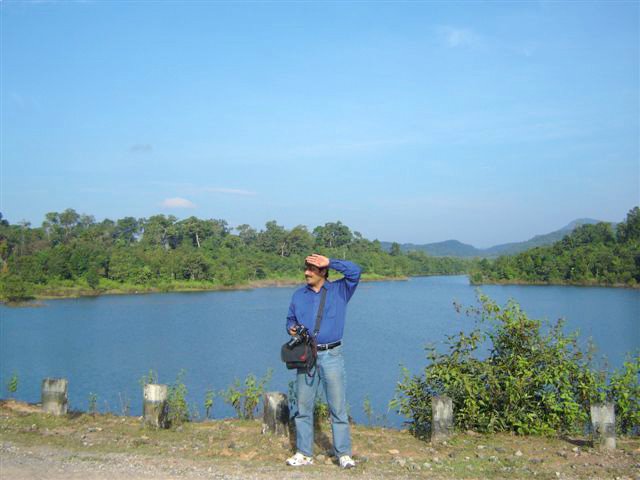
Some snaps from nearby:


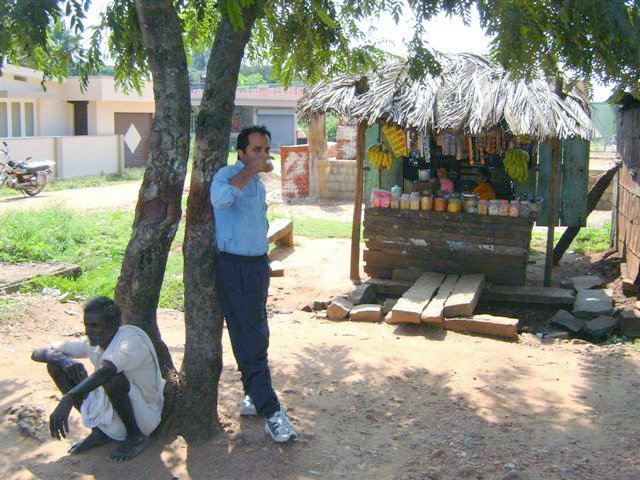
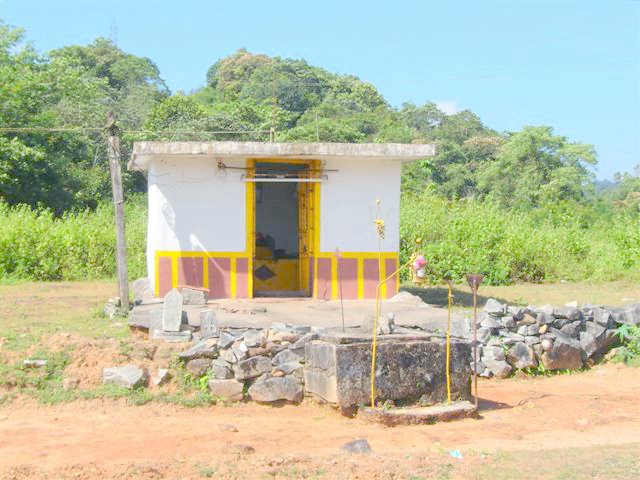
One the way back we stoped to click some snaps of this lonely temple, and other things:

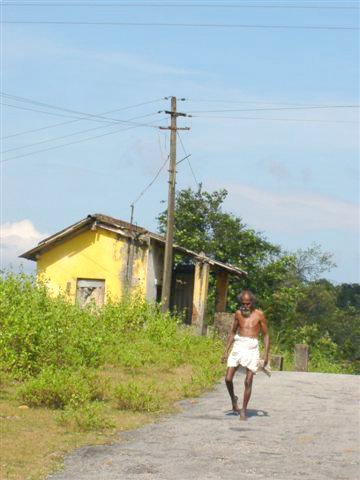
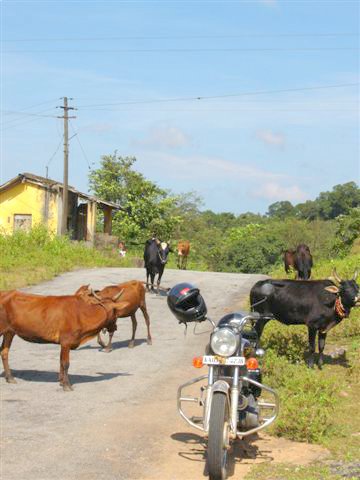
An old cowherd, and his cows checking out the A350:


We stopped for tea at a roadside house-cum-hotel in Yadur, formerly a boom town when the dam was being built, now as charming as any other village. The owner of this hotel who told us of the boom, here:


He keeps a trough of fresh water outside for the cows. A board warns people not to wash their feet or hands in it. And he serves nice idlies. He suggested we aim for lunch at a temple which was about half-way on the way back.

The route was to be Mastikatte - Hulikal Ghat - Balebare Temple - Hosangadi - Thirthahalli.

Lunch would be served at one. Not a bad idea. Though we tought we would be early, the hostile road conditions - Hulikal Ghat was a torture - meant that we were there just in time for things. The puja had started, and lunch would follow immediately. We had to remove our shoes and leave them by the roadside about which I had a few qualms. Without them, we were done for. No way we could change gears with bare feet. Still, there was no other option. Not that there was a serious risk of anyone taking them. All the people were here to visit the temple themselves. They came by car, on private and government buses. The lunch was very hot and very good. Some kids were seated next to us during lunch. By the time we'd finished, I knew how much the kid on my right ate at home, that he did not like curds, and other details. And he was not even talking to me, but to the kid sitting next to him. Kids don't have secrets. Later during the drive, thinking of the incident, I thought if there is a God and it had a smile, children have to be what the smile looks like. And when I say smile, I mean the most sunny, loving, all-encompassing smile ever. Like they say in the US, go figure.

We decided to visit Hosangadi - where the power generation station is. That was a mistake. The devilish roads and we were not even allowed to enter the gates due to security reasons. But we did get to click some snaps:


Then this mini waterfall by the road side.


We returned to our room in Thirthahalli, picked up our stuff and checked out. Jog Falls called . The route: Humcha - Rippanpet - Anandapura - Sagara - Jog Falls.

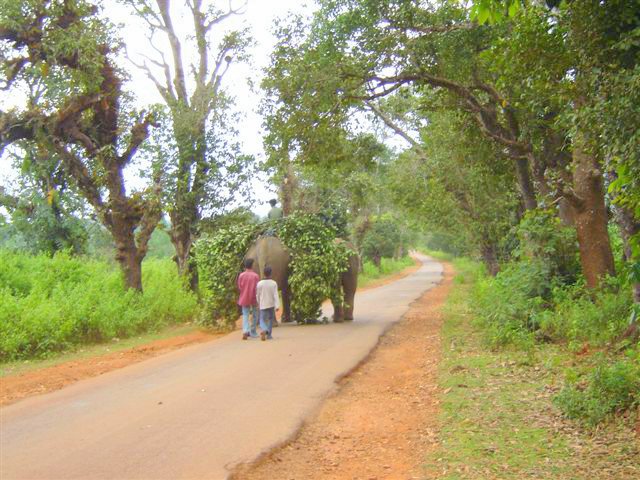
Pradeep took over the handle at Humcha. The roads had improved and he got into the groove quickly. We got some heavy company momentarily on one stretch of road, shown here:
Nearing Sagar Pradeep suffered one lapse of concentration which shook both of us. We were steady at around 70 kmph when I saw a turn which was almost a semi-circle. By now I'd relaxed and wasn't too bothered about how we would make it. When I see a curve I usually try to judge if I need to slow down or have some fun by turning the accelerator up a bit. If there are no vehicles coming from the other direction, if the road is good, if I'm not already going too fast, I generally increase the speed, and an inclination of the bike and its riders while taking the curve does it nicely and feels good. If not, I apply the front brake a few times or both the brakes if I'm going too fast, thus slowing down a bit before the curve starts. Sometimes, reducing the accelerator completely does the trick - the A350 then falls silent except for a subdued beat of the engine which is like a faint hint suggesting that the bike is just biding its time before it breaks out into a powerful roar again. An enjoyable sound - and I realise that I have grown to like the bike a lot.

Soon the curve was nearer and still no response from Pradeep. Now, a silent urgent question in my mind : would he take it properly? We are already in the curve and still no response from him! On the outer side of the curve is a drop - how deep we didn't know and it didn't even matter if we were to go into it. I grab his shoulders, yelling "Slower!". By now, we are going straight at the opposite side of the road - rather like a tangent drawn to the curve from the direction we came from. Then we stop. Luckily no buses or trucks or anything coming from the opposite direction. Narrow escape! Now, it became clear how different people think. While the thing was happening I had been thinking of how he was going to take the curve, whether we would make it and all that. Pradeep apparently was thinking "What is on the other side of the road?". He had by now decided that we would go down anyway and was worried more on where we would land. Once before too this had happened. Both of us were on the ground - my right glove had been completely scraped off by the fall. We had sustained a bit of damage to the bike. I was looking at a bus behind us , thinking, "Wow, thank god that bus was a bit far away". Pradeep was thinking "The headlight is broken". The leg guard was bent and touching the engine block, but he was thinking of the headlight.

As we continued, the milestones seemed to play games with us. Sometimes a place which was 48 km away, became 40 km within a few hundred yards. I guessed that the second distance was as the crow flies, since no road existed anyway. At one point, 45 km became 48 km within a few feet. Pradeep suggested that the crow circled a bit near the first signboard.

Some snaps from the approach road to Jog:


We reached Jog Falls at around six in the evening. We were in for some disappointment. Very little water had been released from the dam and the falls were anaemic. There were some people who had walked down the 300 m to the foot of the falls and were taking photographs. It had become dark and we wondered how they would find their way back. We later saw the three men - all in knickers and banians - looking weary. Pradeep thought they had lost their pants below in the dark.

We got back on our bikes around half past six. Three roads lead out of the area. None of them was labelled. There were no lights anywhere. So much for attracting tourists. We chose one road and had gone about five kilometres before we had doubts - that was not the route we came by. We turned back meaning to ask someone. We did not find anyone till we'd almost returned to the dam. Two students whom we had passed earlier, leaning against a rail, talking, far from anywhere. They didn't fit here. It looked as if they were living hereabouts. Probably doing their project. They gave us directions. But it was still a different route than the one we'd taken coming here. Kargal - Sagara - Shimoga.

We were in Shimoga by ten. We found a hotel, dumped out stuff and headed out for dinner. Trip over.

Day 3, Nov 6

Today it would be our first day's journey in reverse - Shimoga - Bhadravati - Terikere - Birur - Kadur - Banavara - Arasikere - Tiptur - Gubbi - Tumkur - Bangalore. The Indian Express kept us company for breakfast. Then we hit the road. The road upto Terikere was good. Then it was chinese torture till Kadur. Pradeep took over at Kadur.

The nether regions of our bodies were by now showing signs of great wear and tear. One hour of continuous back-seat riding was all we cold handle, but we went for two hours at a time. One needed the support of the driver's shoulders to even get off the bike. That shock absorber! Pradeep was not enjoying his driving much, as far as I could tell. The previous day's incident had tensed him up. He was finding it increasingly difficult to change to the lower gears in time to stop.

We lunched at the Kamat restaurant near Tumkur and were in Bangalore by three. The traffic was slow-moving. Still, we made it to Pradeep's house by four or so. I was home by five. My son had already forgotten me. Well, almost. Looking down from the first floor as I took off my shoes below, he was telling my wife 'some uncle' had come.

Some More Of The Same

Dravid's statement, from The Telegraph:
"In my opinion and the opinion of the umpires and Match Referee, both of whom I have spoken to, the Indian team did not act in any manner that was unsportsmanlike or against the spirit of the game. If that had been the case, the umpires and Match Referee would have taken action.

“We have the option of taking up the issue with the relevant authorities, but keeping in mind the relevance, the importance and the context of the series, we have decided to let the issue pass and set it to rest.”

What will the umpires and Match Referee's be talking about with the players next? If that cover-drive was really nice or just so-so? If Faisal Iqbal looked dumb or just sorry in the replay of that dropped catch in the third test? About the field placements? I think not, for some reason. Just as I feel they would have hazarded an opinion on the sportsmanlike-ness of that appeal. No, they might have confirm or reject the legality of that appeal and decision, but not whether it was sportsmanlike or not. Even if they did, their opinion would count for nothing at all. As The Telegraph itself points out, Dravid would have done well to call the batsman back - unless things happened too fast for him to comprehend it all. But the walk back to the pavilion takes a long time.

2 Feb 2006

More Cow

Two personalities, two answers. Dravid on being asked about Ganguly's performance (link here):
“I think we tend to get too caught up in individuals in India,” he replied tersely. “We tend to attribute losses and wins to individuals rather than focussing on the team. We look at statistics, we discuss numbers and figures a lot in India, and we try to crucify individuals when we should be concentrating on the team. I am not going to be a party to that sitting in a press conference.”
On being asked about Tendulkar's form:
“He tried his very best, he worked very hard. But we look at ourselves as a team. All of us could have done better, and that includes everyone.”
Dravid is being a bit partial here. If nothing else the former captain too seemed to try quite hard - at least as hard as Tendulkar. So the captain could have found some good words for the former captain surely? Here is what cricinfo.com had to say about his knock:
Apart from Yuvraj Singh's century, the one bright spot for India was Sourav Ganguly's fluent form. He only scored 37, but his decisive footwork and fluent strokeplay suggested he would score many more. He had an in-control factor of 93%, and made only four mistakes in 56 deliveries. Unfortunately for him, the fourth one was a decisive error, and ensured that there'll continue to be a question-mark over his place in the side.
Ganguly did get some support. From Dravid's opposite number:
I’m a big supporter of Sourav... He was aggressive and he fought... I hope his innings holds him in good stead.
NDTV reporters seem to suffer from a similar ailment (I'm writing from memory here) :
"Tendulkar walked in and immediately stamped his class on the proceedings ... Ganguly came in and seemed to be in a positive frame of mind. Yuvraj's century went in vain and unfortunately this is the second time he has made a century with India going on to lose the match."
Positive frame of mind? The man batted fluently by all accounts! And why denigrate Yuvraj's century thus? It would be alright if the reporter was spreading the blame around evenly not so selectively.

And I couldn't believe Dravid said this:
India’s batsmen all have impressive averages, but fail to deliver in crunch situations. “That’s why, when you lose, you have to think of collective failure,” he emphasised. “The guys at the top of the order made good contributions in the Faisalabad and Lahore Tests, but we didn’t deliver the goods here.”
Good contributions in the Faisalabad and Lahore tests? On those tracks? I thought Dravid was supposed to have a good cricketing brain and to be a thinking man himself!

Yesterday must have brought back another unpleasant memory for the Indian coach.

1 Feb 2006

Holy Cows

India looking down the barrel at two down for some paltry total on the fourth day of the last test match. The two includes Dravid and Sehwag. And the lunch-time session of Straight Drive hosted by Sanjay Manjrekar:
Manjrekar: What do you think Geoffrey - did Dravid do the right thing by opening? Or should someone else have opened?
Boycott: C'mon Sanjay he's got two centuries opening - of course he should've opened.
Manjrekar: He's been in the field for so long, I'm sure he'd be tired
Boycott: C'mon Sanjay don't make excuses. He's a professional cricketer, he should be prepared for it. No one expected Gavaskar not to open.
Manjrekar: But you didn't have such big innings in those days did you Geoffrey.
Manjrekar: Waqar do you think someone else, say Pathan, should have opened?
Waqar Younis: No I think I agree with Geoffrey..
Manjrekar : I know Geoffrey wants to interrupt
Boycott (laughing) : Pathan has bowled 25 overs and you want him to come in rather than Dravid! Look, the opener's job is a tough one. That is why everyone wants to slide down the batting order in Test cricket. Everyone wants to bat in the middle order because it is easier there. Tendulkar has never wanted to open in Tests.
Manjrekar: I know Geoffrey but that's a point of view. That is a point of view and I have to get it across.
Why does Sanjay Manjrekar have to get the point across? A point so weak that it can be brushed off so lightly by his fellow commentator? But then, it is almost an open secret that there are many tiny wheels within wheels and many unknown forces at play when it comes to Indian media covering Indian cricket and its shooting stars. So it shouldn't really surprise anyone. And I'm not even talking of the thick layers of hype.

27 Jan 2006

Passion

The Karnataka assembly is in session to decide if the CM has the required support to continue in office. It is live on TV. I think one can safely say that such passion is rarely seen in our politicians. The quest for power brings out the best in our leaders. But of course they are doing it for the sake of people - as they never stop claiming.

It is entertaining TV though. Naked hunger for power, passion, intrigue, suspense, comedy - mostly comedy for the watcher, pathos - mostly of the speaker, and a star-studded cast. One can only find fault with one aspect - the lack of love-interest.

When will someone serialise these things and create the next hit reality show?

Update: Kumaraswamy has been made the JDLP president by the Speaker after much debate. Long live the new government.

Update 2: Deve Gowda steps down as the national president of the JD(S). He is 'aghast' and 'pained' by the developments and attributes it all to 'karma'.

23 Jan 2006

In A Spot - 230106

The series goes on. The latest On the Spot by Ms Tavleen Singh is here, in which she shows evidence of sparing no effort to keep up with the times. I won't talk about the Bofors issue itself - who knows whether we will every know what happened alongwith proof of it. I will restrict myself to her column.

Knowing that the readers are immune to any scams involving any amount less than a few thousand crores, she turns up the magnitude of Bofors affair - by a cool thousand times. While others are content with sticking to the Rs 64 crore amount, she reaches greater heights of journalistic standards by rounding it off to a nice-looking Rs 64,000 crores.

And she also comes up with a nice theory about why the NDA government was unable to bring anyone to book for 5 long years:
There is a theory about this doing the rounds in Delhi as well and the theory is that there was an understanding between Sonia and Vajpayee that the skeletons in their respective family cupboards would remain untouched. If the law minister had not rattled the cupboard the Bofors skeleton would not have fallen out.
Well, I too believe that political parties are quite reluctant to hurt each other in scams like these. Who knows, they may be out of power and facing the music next time round - though that consideration has not kept Karunanidhi and Jayalalitha out of each other's hair. But to just restrict it to two individuals? It would be interesting to know where else this theory exists outside of Ms Singh's head.

20 Jan 2006

Give And Take

BMP fires back at the people:
“We do all the work, the public spoils it, and then we get all the blame. Improving the city is a thankless job.”
The BMP is usually at the receiving end of rebuke and abuse from the people and nowadays the courts too. Good to see them at the other end of the line. Such friendly give and take is definitely welcome. Now, if we could only have periodical boxing matches.

I have seen the loads of sand which the first report talks about. It is a bit infuriating. Let me see, which is the best way to somehow wipe everyone off the face of the city and then start all over again.

21 Dec 2005

In A Spot - 211205

The next installment. Seeking to downplay the money-for-questions episode, Ms Tavleen Singh offers this cure:
Systems need to be put in place that would permit legitimate lobbying and more transparency generally in the way our elected representatives and governments function.
Perhaps she would care to go through the travails of a Mr Jack Abramoff in the heaven of legalised lobbying, the US. The New York Times has provided just the concise summary of it here. There are no passionate arguments and denouncements that blogs like this carry. Just the facts. An excerpt:
Prominent party officials, including the former House majority leader, Representative Tom DeLay of Texas, are under scrutiny involving trips and other gifts from Mr. Abramoff and his clients. The case has shaken the Republican establishment, with the threat of testimony from Mr. Abramoff, once a ubiquitous and well-connected Republican star, sowing anxiety throughout the party ranks.
Shaken and not merely stirred? When lobbying is legitimate? How can that be?

Incredible India

Of course, as soon as that alert was out, there had to be a new post immediately.

Looks like the unthinking are at large again. And they have brought the 'India Shining' fiasco back. Only, it is now 'Incredible India'. Agreed, the latter is from the Tourism Ministry. But when an Incredible India ad just shows up on TV, apropos nothing in particular, it is difficult to differentiate between the two.

Still, the adjective is well chosen. One cannot question the incredible'ness of India. A country which has more than half of its people illiterate and suffers from dire poverty, but is still counted as an emerging power. Pretty incredible. And India was shining too. All it needed was the light to fall on the correct places for the shine to appear.

Update: There is a website too.
Sporadic blogging alert, valid for a month or so, as I catch up with some 'work'. Will be posting, but a bit infrequently.

13 Dec 2005

Anirudha Bahal

Now, many more people must be swearing against Bahal, formerly of Tehelka.

Another aspect to this sting is that we seem to be taking the Westminster model too literally. Three British MPs were accused of similar money-for-questions scams in 1994 according to Vijay Times (reg'n required).

Boiled Brains Politicos

It is said about India that we never rejected invaders - we just assimilated them into our society. The British left fifty years ago, we're still assimilating them. U R Ananthamurthy, noted Kannada writer, to NDTV:
We can bring any word from English into Kannada. We just need to add a 'u'. Chair - chairu. Table - Table-u. Bangalore - Bangaluru.
Because that is what it is - taking an English word and adding a Kannada suffix to it. Bangaluru is not the original name for Bangalore. The original word, if one goes by accepted historial accounts, is Bendakaluru - boiled beans grains town. A bit different from Chennai, Mumbai, Thiruvantapuram. Politicos.

9 Dec 2005

Ghost Story

This I just present as something I enjoyed reading though I don't believe in ghosts.

State Of Parliament

DH rues the state of parliament. All this ruckus being raised because someone made some money on the side from a foreign government, with no real implications for the country's policy - they were out of power anyway. And all this from a party that hounded a news website into oblivion for showing its president accepting bribes on TV.

True, it was unethical if public figures accepted oil vouchers from the Iraqi government. But the person named in the report has resigned, though belatedly. Why not wait for the inquiries to be completed? What is the point asking for someone who has not even been named in the report to resign now?

Editors With Coloured Glasses

kmp writes in re Dayal, Pathak, ED:
The “mail-me-comments” is missing in your recent posts. Have the comments subsided?

Anyway, with reference to the above topic – the editor of “The Pioneer” is Chandan Mitra. He is an MP nominated by BJP. Chandan, Swapandas Gupta of India Today (maybe erstwhile I guess) are all BJP folks. Obviously they don’t see eye-to-eye with the Government (I mean the current one) irrespective of the policies.
That explains it.

And no the comments have not subsided - because they weren't too many to start with :-) I have removed the 'Mail me' link from my posts because I have reason to believe evil robots are roaming the web looking for mail-ids to which spam can be sent. And they don't understand that there are only so many 'Sexually-explicit' sites that one can visit given that a day has only 24 hours. And that I don't want any software products.

8 Dec 2005

From ET editorial:
We need not just greater allocations for the social sectors but an integrated agenda of socio-economic development. Its success would, however, ultimately depend on the ability of political parties to conscientise people into citizens, and then mediate between their aspirations and the state.
No denying that. But where are the ideas to accomplish that - to conscientise people into citizens?

Down-side Of Hygiene

A Nobel laureate's opinion from DH:
I know it’s not politically correct, but the biological fact is that the more hygienic conditions you live in, the more you become susceptible to diseases.
So it is true. Mum was right!

7 Dec 2005

Dayal, Pathak, ED

Staying with The Pioneer, it doesn't see eye-to-eye with the government on the issue of sending a separate ED team to Iraq to snoop around:
Looking at all the diversionary tactics being employed, it seems an attempt is being made to expand the ambit of the probe and deflect attention from the political aspects.
I don't see eye-to-eye with The Pioneer. After all, a long list of companies are mentioned in the Volcker report. Other delegations, including at least a NDA delegation, went to Iraq. Why not clear up everything? Of course, easier said than done, clearing up everything. But why not give the ED a chance?

The Editors Are At It Again

I noted how great editors think alike here. It's happened again. Today (7 Dec '05)'s editorial titled 'Diversions, distractions' in Vijay Times (registration req'd), is identical to The Pioneer's editorial of 6 Dec '05.

Do the two papers have some kind of agreement to share editorials? A quick mail is being shot off as we speak, to the editor of VT.

6 Dec 2005

Scapegoats

Natwar to go, which is as it should be if he did take the oil vouchers - either for himself or for his son. His going will not matter much since anyway he was being overridden in many foreign policy decisions. But the bigger question is: what is all this talk about being made scapegoats? His son is very clear that they are being made scapegoats. Scapegoats for whom? Very mysterious indeed.

Update: The Telegraph finds it inexplicable that Mr Singh took so long.

No Mobiles Please

I share my lack of mobile with these people. My reason for not carrying one would be closest to Mr A Ramachandra's. He says :
Humankind has managed all these years without a mobile phone in hand, why is it that we now regard cellphones as indispensable?
In other words, I'm an extreme late-adopter. And a bit too lazy to put in the effort of buying one.

5 Dec 2005

Means Are Important. Too

Not just the ends. From HT:
...should the BJP have brought someone like Uma Bharti into active politics in the first place? Most political observers would have strong reservations on this but then, the BJP used every conceivable method to come to power, whether using sadhvis and religious leaders or bringing in film stars. Having lost power, some of these leaders have become liabilities and the party does not know how to deal with them. If the BJP finds itself unable to stop the creation of political frankensteins, it will realise in due course that the people may find a way of dealing with it in future.
Relatedly, a BJP spokesperson (Javdekar I think) asked rhetorically with regard to Uma Bharti: "The party was good till last week, but then suddenly she says the party became bad. How is that possible?". Maybe it did not occur to him that she could put the same question to the party: "I was a good party leader till last week, suddenly they say I'm bad. Please explain it to me."

Deja Vu

Another flood situation made worse by man-made factors. Encroachments take the blame again as they did in Bangalore, in addition to other factors. From The Hindu:

District authorities and Public Works Department (PWD) engineers single out breaches in rivers, tanks, lakes, ponds, and canals as the major cause of the all-round devastation. While some breaches were natural — owing to excess storage and weakened bunds — many were man-made. Many encroachments have come up all along the Cauvery and its network of tributaries. The well-designed flood plains, called the padugai, have either been widened to form part of the riverbed or have been used up for cultivation and illegal construction. So what was meant to be a natural protective barrier against flooding became the first casualty. With this barrier gone, roads and farmland quickly went under the floodwaters. Even the normally bone-dry river Coleroon carrying well over three lakh cusecs of water!

The PWD engineers say under the old, somewhat rundown irrigation system that still exists in many parts of the composite Thanjavur district, the Cauvery was linked to a network of tanks through feeder channels. During a bountiful monsoon, all the tanks were filled up and the excess water drained into the irrigation system. Over the years — because such floods are not common — encroachments came up on riverbeds, feeder canals, and the draining system. These were not just huts or houses, but sometimes even constructions by the Government and local bodies. They came in the way of water flow and redirected the floodwaters to habitations and paddy fields, causing extensive damage. "When the natural flow of water is obstructed, it finds its level in other ways," explains a retired PWD Chief Engineer.

NURM

Launched. Will it change anything or will it develop snags mid-way and drop out of the sky?

3 Dec 2005

O Tempora

Samosa sans aloo, Bihar sans Laloo, Playboy sans nudity. Changing times. What good would the last be though?

2 Dec 2005

Electoral Reform

Return of the fast unto death, in a good cause. Though I do agree with the Oct 17 editorial that the writer takes such a dim view of in his opening paragraph, his point in the rest of this editorial is worth giving a thought to:
Corruption has become institutionalised over the years, and has crept into the judiciary, executive and legislatures. People have now come to accept it as a way of life. To capture power, and stay in power, all parties appear to be dependent on chargesheeters, criminals and dons.

Is there a way out? For quite a number of years, a group of very concerned citizens has been campaigning to inject probity into public life through electoral reform. Among other measures, they have recommended the compulsory audit of the accounts of political parties, the state funding of elections, the disqualification of tainted politicians from contesting elections, and above all the appointment of a Lok Pal with teeth.
Electoral reform seems to be the core problem crying for a solution if corruption has to go.

Far away from us, electoral reform has taken a first step in a tiny US state (via TPMCafe):
The legislation bans contributions by lobbyists, their spouses, and state contractors, limits political action committees, closes a loophole that permits corporate donations and creates a voluntary system of public financing.

By overhauling campaign laws crafted 30 years ago after the Watergate scandal, the bill upends long-established relationships between power and money, though few would predict precisely what might rise in their place.
Familiar problem, and a straightforward solution. Will the ripple reach and touch us?

Farmers Still Dying

The Hindu highlights the sorry state of the cotton farmers in one of Maharashtra's districts. High input costs, collapsed output prices due to dumping of subsidised cotton by rich countries, no access to bank loans. How will they make money?
Meanwhile, the advance bonus normally paid to cotton farmers has been scrapped. This amount of roughly Rs.500 used to be added on to the minimum support price for cotton declared by the Centre. The State admits it costs around Rs.2200 to produce a quintal of cotton. Yet the scrapping of the advance bonus means farmers will get Rs.1700 a quintal. A price last seen in 1994.
And the government responds like this:
No MP or MLA tried to even meet the NCF [National Commission on Farmers] team led by Dr. M.S. Swaminathan. This, although the team had in tow the young Rana Patil, Maharashtra's Minister of State for Agriculture. It gets worse. The MLAs from the districts most affected are mainly from the Shiv Sena and the BJP. Why help your rivals?
Why indeed.

1 Dec 2005

High Oil Prices

Bush blames India (and China) for the high oil prices. The facts are:
The United States is the world's largest energy consumer, far outstripping China and India. U.S. demand for oil is about 21 million barrels per day, compared with 7.4 million barrels per day projected this year for China, according to the U.S. Energy Department. India's oil consumption was 2.2 million barrels per day in 2003 and is projected to grow to 2.8 million by 2010, according to the department.

The Real Money

While Mr Gowda cribs about a few hundred acres of non-prime land being given (at market rates) to Infosys, the real money is being given out by New York City to Goldman Sachs, about $1.75 billion (via Atrios).

30 Nov 2005

Two Scripts

From The Hindu:
In the Congress party the script is that the MLAs first say they leave the choice of leader to the high command; then an elaborate exercise is done to ascertain the wishes of the MLAs; and finally, a "leader" is elected who then takes office as Chief Minister.

The BJP turned the procedure on its head. The central leadership pronounced its wishes and "anointed" the leader, and then the MLAs went through the motion of electing him. To that extent Ms. Bharti's charge has some merit. But then she did not protest when she was "anointed" in a similar fashion.

A Half-Step Forward

The PMO has tried to disincentivise the adulterers by this step. But why not go the whole distance and remove the difference fully? Sloppy thinking?

Unions In BPO Industry

Union leaders may be dialling the wrong number in trying to unionise BPO workers, says The Telegraph. This is good inspite of the mixed metaphors:
...the unions are on a wild goose chase. Unless, of course, they are able to organize white-collar unions, customized for the BPO sector, with monthly meetings slated in local discotheques to discuss issues such as triple digit increments.
The article also notes that the BPO industry is now more than just call-centres:

The nature of the BPO industry itself is undergoing a radical change. Some of the best Mumbai law firms are now working for swish legal outfits based in New York and getting paid top dollar. European design houses are migrating high-end products to India, while Fortune 500 companies are increasingly relying on Indian firms to do data modelling, gather business intelligence and help them take the next big investment step in Dow using sophisticated software applications.

Would these well-qualified professionals spend their time in forming unions? Unlikely. But are unions needed in the BPO industry? I would say yes. How else would they organize themselves for the fight over that coffee maker that hasn't been working since last night?

Bitter Fruit

Lust for power says Mr Vajpayee. That settles the fruits-of-victory question.

29 Nov 2005

Land Rights For Tribals

The Scheduled Tribes (Recognition of Land Rights) Bill 2005 is attracting passionate criticism. I didn't know what to believe, before I read this in The Hindu. The article prompted me to go through the bill itself - why not see this evil bill with my own eyes, I thought. And the bill gives the lie to much of what the writer writes, in my opinion.

He says:
It may end up as a ploy to get the forestland in the name of the tribal people and then grab it from them.
I say: The bill clearly specifies that the rights are inheritable but not 'alienable or transferable'. Unless the legal meaning of 'alienable or transferable' are different from the dictionary meanings, grabbing the land from the tribals would not be possible. Not much more so than now, when the forest department owns the land.

He provides anecdotal evidence of how the forest tribes' conventional livelihoods may be vanishing, and suggests the tribals may not remain guardians of the forests. In fact they may destroy the very forests:
However, such is the force of technology, industry and development that in a few decades these sections [forest dwelling tribals] have aggressively exploited all the forest they could lay their hands on. They have drilled into the forest to mine for stone or ore. They have logged for wood and bamboo. They have, for their use, pushed for more monoculture plantations like eucalyptus. In short, they have brutally laid the forest low.
He does not specify where the things he mentions happened - are they isolated incidents or widespread? Judging by his citing the Gujjars, this does appear to be isolated. Whatever be the case, the Bill specifically prohibits such activities. It makes it clear that the land is for habitation or self-cultivation only, including use for grazing. Using the land for exclusively commercial purposes is nor allowed. Also, they can use only minor forest produce which is defined as:
all non-timber forest produce of plant origin including bamboo, brush wood, stumps, cane, tussar, cocoons, honey, wax, lac, tendu or kendu leaves, medicinal plants and herbs, roots, tubers and the like;
All other activities are offences and can lead to loss of the right to the land. The tribals also get the additional responsibility of protection, conservation and regeneration of forests, along with the authority of ownership.

Mr Soni admits that forests have been ravaged for development and that the diminishing habitat is the problem. He then surprisingly agrees "that the forest dwellers would not have allowed the pernicious forces of development to pillage the forests." If he believes that then why all the scare-mongering about mining and logging by the tribals?

Mr Soni then goes on to another point:
Reportedly, about seven per cent of India's population is tribal or wilderness based and only 8 per cent of the country's area is left with dense forest cover. If these two are to go together our prime wilderness will have the average population density of the country. By no account is this the definition of a wilderness and by all accounts it is a recipe for disaster.
...
Certainly, tribal people should have a stake in the management of the forests; the Bishnois in Rajasthan with their conservation ethos are some of the most passionate and effective protectors of forests and wildlife, but it is clear that all forest dwellers cannot live in the prime forests.
The Bill differs (9. Checks and Balances):
There is no distribution of land involved at all and Bill will not cover the entire 8.2 % ST population. Only tribes scheduled for the area living in the forests will benefit. A tribal from an outside area/State will not benefit. The Bill in actual terms will only benefit the tribal population on “as is where is basis”.
Who is already there, stays - so the situation won't change due to the bill. They already are in the forested areas. According to this from the Ministry of Tribal Affairs:
More than half the Scheduled Tribe population is concentrated in the States of Madhya Pradesh, Chattisgarh, Maharashtra, Orissa, Jharkhand and Gujarat. The main concentration of tribal population is in central India and in the North-Eastern States.
That taken along with this map, makes that clear. And nowhere does the Bill say that the tribals will be given only prime wilderness. The overall forest cover is around twenty one percent. Presumably some of it may be inhabited currently by the scheduled tribes.

Like he says, giving land rights to the scheduled tribes and cooperative effort by the tribes and the forest department seems to be the way to go. So why exactly is the Bill evil?

Tone It Down

Says The Hindu about the very visible endorsement of Karzai by the Manmohan Singh govt, that has led, it suggests, to the Taliban targeting Indians and hence the Maniappan killing:
It is well within the grasp of Indian diplomacy to tread softly when it treads on other peoples' dreams. India could do well by emulating other regional powers or, better still, by reverting to the traditional policy toward Afghanistan followed by Delhi till the mid-1990s: emphasise people-to-people relations; proceed vigorously with technical and economic cooperation; maintain correct government-to-government relations but on a low key at least till the anarchic conditions change for the better.

26 Nov 2005

More Things Change - 2

More they remain the same. As it is in politics, so it is in sports. From IE:
...the Indian team came across an unusually greenish pitch that favoured the superior South African pace attack. While curator Prabir Mukherjee claimed that it was a ‘‘sporting wicket’’, it’s learnt that Dravid and coach Greg Chappell had wanted the grass to be cut.
One understood Ganguly when he asked for the grass to be cut, which he was reported as asking for many a time and loudly. Now, when He Who Is Afraid Of The Fast'ish Ball is not playing, one fails to understand why the new captain and coach are following in his footmarks.

PS: One worries about the Indian team after reading this in IE. Its members seem to have such fragile minds that they almost seem neurotic. Most of all, one worries for Laxman after reading about his tenuous (thin/dilute/flimsy) psyche.

25 Nov 2005

Numbers Didn't Add Up

For the UPA since they were anything but 'United' says The Telegraph. Link via Amit Varma.

A Life Like Any Other

With a plan for the future and a hope for happier times spent with wife and children:
When Maniappan was posted in Afghanistan he nurtured the hope that he would get that little extra cash as foreign posting allowance and risk allowance. (Even this was a pittance since he was a low-rung employee.) He wanted to build a house, set up an automobile workshop and look after his wife and two little children when his 20-year service with the BRO ended five years from now. In one fell swoop, a machete ended all his dreams in a pool of blood in the wasteland of ethnic conflict.
Why is there so much of a fuss about pre-marital sex but not about this death? Why are we in Afghanistan and Iraq anyway with the security situation as it is in both places?

Better Than Nuclear

Thermonuclear power. But it is at least 25 years away. Meantime, why is it that countries like the US impose such tight restrictions on nuclear power which could solve to a great degree the problems of countries like India?

False Dichotomy

T K Arun in ET, noting that it cannot be empowerment vs development, but both together for either to succeed. Along the way he has points out the short-sightedness of political parties as entities only meant for fighting and winning elections:
If [the Congress] thinks that investing big in health, education and social security, as promised by the Common Minimum Programme, will get it the votes it needs, it is sadly mistaken. Only when political parties actively lead, do sarkari measures deliver on the ground and people make a connection between leaderspeak and the actions of babus.

In other words, salvation lies in resurrection of the political party as an institution and redemption of political practice from the combination of rent-a-crowd and muscular influence-peddling it has been reduced to.Politics as patronage attracts opportunists and those on the make to the party.

Such people cannot perform a political party’s essential job of constantly mediating between the state and the people in a fashion that changes their lives for the better. That calls for people with a sense of public purpose, of commitment to society’s collective welfare. Such party workers can be attracted and retained only when the party stands for a goal over and above power and pelf.

Queer Pitch

I nearly did a delayed double-take after watching Arun Lal prod the pitch pensively. How come so much grass on it? Ravi Shastri had caught on: 'Remember, Ganguly is not playing this match. If the groundsman prepared more of these kind of pitches for the local matches, Bengal would be a far better team". Not much guessing needed as to what was going on in his mind. In another intriguing development, Ntini pulls out after falling down during a friendly football session, just twenty minutes before the toss. Meantime, it is official, NDTV has it straight from the bookies mouth:Indian: 77 paise, SA : 125 paise. India favourites.

24 Nov 2005

Laloo And Saurav

The inevitable comparison in this editorial form Hindustan Times. It also notes the anti-incumbency increasing rearing its head:
the macro picture presents a disconcerting fact that increasingly elections are not being ‘won’ by parties in India; rather they are being ‘lost’ by the incumbent. Barring West Bengal, where the word ‘change’ has become archaic in the context of political choices, most elections in the past decade have been negative votes. Among the handful of ‘positive’ mandates, the BJP’s victory in Gujarat was different to Sheila Dikshit’s return in Delhi because Narendra Modi rode to victory on the combination of the explicit slogan of ‘Gujarati asmita’ and the implicit plea of “vote me because I have taught ‘them’ a lesson”. Be it the case of the UPA at the Centre, the Congress in Andhra Pradesh or the BJP in Madhya Pradesh, all of them came to power because of the negative sentiment against the party in power.
It also notes that political parties become lethargic once they are voted out:
This brings us to the worrisome fact that political parties are increasingly getting struck by paralysis once they are made by the electorate to sit in the opposition benches. When the NDA ruled at the Centre, its best ally was the Congress and for the past year and a half, the BJP has spent more time to exorcise itself of ‘evil spirits’ than trying to combat the UPA government. Opposition parties have also limited their role to rumpus managers in Parliament and state assemblies while the more back-bending job of building mass movements is left to peripheral players — be it the jholawallahs, the anti-dam lobby or even Naxalites. We are thus becoming a nation of lethargic politicians who would rather wait for the adversary to make a mistake than try to take the bull by its horns. That even this strategy is succeeding must be noted by all leaders — especially Mulayam Singh Yadav, as Uttar Pradesh after Bihar might want to cast a ‘no’ against exclusivist politics and demand ‘development’ when polls are next held.
I think they are also struck by paralysis once they are made to sit in the government. Nothing happens for 5 years. Then they are voted out - anti-incumbency.

23 Nov 2005

The Voters Have Spoken

Now the editors have at it. DH and TOI call it a vote for change. DH urges the new government to concentrate on development and genuine social justice. The Economic Times calls it a defeat for identity politics, but add that caste still played a role - I need to think that one over. The Hindu counts the governor's rule and assembly dissolution as the main reasons for the defeat. It rues the decline in voter turnout - a measly 45% this time round. The Telegraph sees the defeat as the failure of a small-time politician - Laloo - who rose to power holding out a huge promise. It points out that law and order and keeping caste clashes in check need to be the top priorities, but hesitates to predict the impact on the centre. Elsewhere it calls the decision to stick with the RJD a fatal shift for the Congress, and notes that the poor also look for an alternative. Ashok Desai Malik of the Indian Express vents his anger against the Congress here, but for a more balanced view IE also carries an editorial from someone from the state itself, Prakash Jha, here.

More Things Change

More they remain the same. Tucked away in the corner of page 8 in DH, this nugget:
‘Criminals’ come up trumps
Patna, ians

Barring a few exceptions, most known criminal-politicians who contested the Bihar assembly polls emerged winners on Tuesday.

The JD (U), which is set to become the state’s ruling party, tops the list of parties with poll winners who have a criminal background.

Laloo Prasad’s RJD, Ram Vilas Paswan’s LJP and the BJP follow JD (U). These criminal-politicians are locally called “bahubalis” for their combination of political and muscle power.
Italics, of course, mine. A political party does not arise out of nowhere, nor does it exist in a vacuum. It draws on the conditions surrounding it if it wants to contest and win elections. What is needed is a person who can change the conditions. Will Nitish Kumar be that person? Maybe. Will we shortly start hearing excuses like "It is difficult to change in five years what was in place for 15 years"? Again, maybe.

22 Nov 2005

Great Editors Think Alike

I read an editorial today in the Vijay Times dated 22 Nov 2005, which started off like this:
Day after tomorrowTomorrow, when Parliament's Winter Session begins, Prime Minister Manmohan Singh and his Ministers will discover just how wrong things have gone for the UPA Government and, consequently, for the country in the past couple of months.

The Congress has managed to paint itself into a corner over issues ranging from corruption at high places to compromising India's national security and conceding ground to terrorists.
And it goes on. It is not very difficult to discern which way this paper leans politically - even before the owner joined the JD(S) - so the editorial was not very surprising. But what was surprising was what happened later. Deccan Herald has a 'What others say' column in its Panorama section. Today it had this extract:
When Parliament's Winter Session begins, Prime Minister Manmohan Singh and his Ministers will discover just how wrong things have gone for the UPA Government and, consequently, for the country in the past couple of months. The Congress has managed to paint itself into a corner over issues ranging from corruption at high places to compromising India's national security and conceding ground to terrorists.
Yes, it is the same as the Vijay Times editorial. But wait! DH attributes this to The Pioneer! And truth be told, The Pioneer almost the same editorial. Here. I said "almost" because there is a difference. Day after tomorrow in The Pioneer editorial has become Tomorrow in the Vijay Times editorial. Makes sense, since The Pioneer's editorial appeared on November 21. Also, the Vijay Times editorial appears to be truncated and some passages from the original left out - at least in the epaper version. I'm not sure it is not so in the hard copy.

So what is happening? Editors thinking alike to the exact words? Someone handing out editorials to selected newspapers? Or plagiarism?

NDA Ahead

Trends in 155 seats, NDA combine ahead in 95, Laloo in just 38.

Update: Laloo routed comprehensively.

20 Nov 2005

Information, Propaganda

Via Poorman.
A recent congressional report suggests that the Pentagon may be relying on “covert psychological operations affecting audiences within friendly nations.” In a “secret amendment” to Pentagon policy, the report warns, “psyops funds might be used to publish stories favorable to American policies, or hire outside contractors without obvious ties to the Pentagon to organize rallies in support of administration policies.” The report also concludes that military planners are shifting away from the Cold War view that power comes from superior weapons systems. Instead, the Pentagon now believes that “combat power can be enhanced by communications networks and technologies that control access to, and directly manipulate, information. As a result, information itself is now both a tool and a target of warfare.”
Italics added. Truly the Information Age has dawned. Or maybe afternoon'ed. Or whatever, like Sania says.

19 Nov 2005

Why Would They Do That?

Add Natwar Singh's name to the list? Curious. The Duelfer report is here if anyone's interested.

14 Nov 2005

School Interviews

Back from an interview at a school for my son's admission. Phew! Hope that's the last one. Won't know till mid-December though.