13 May 2005

Mira Nair's Gangsta Movie

Remember I pointed out a bizarre TOI link about Munnabhai being made in English by Mira Nair in this post? At that time, I thought: the people at TOI anyway think that the Net contains pearls, pebbles, and dung - they just decided to add some more, ummm, pebbles to it, so what? They would surely not sully the pristine pages of the hardcopy so carelessly? It turns out that they would. Today's copy has the story proudly staring out at the reader from its own pretty box. It is difficult to know where to start.

I'll start with the timeline of the story. What on earth took them so long? This story was broken by this website on December 1, 2004. This blog refers to it on January 18th, 2005. A flurry of activity erupts on April 14th, 2005, like here and here and here. And for heaven's sake the venerable sister Economic Times carries this news under a suitably sober headline "Will the next decade of entertainment belong to India?" here.

OK they were not quick on the uptake. Not a big deal. They were probably busy chasing other stories like 14-year-olds topping NASA entrance tests. Anyway, lets move on. An excerpt from the Economic Times article:
It took six months of negotiating with Hollywood’s Twentieth Century Fox for Chopra to close the deal. “It took so long because I insisted that the movie carry a line saying that it had been adapted from ‘an Indian film Munnabhai MBBS written by Vidhu Vinod Chopra, Raju Hirani and Abbas Tyrewala’. “That was crucial for me. And that is going global. Now Hollywood will be inspired by us,” says Chopra.
It really doesn't matter if Mr Chopra is having ET or ET is having us. Shouldn't TOI have checked why searches on the movie name bring back no results on the 20th Century Fox site, nor searches on Mira Nair?

OK that is just sloppy journalism. But why Mira Nair as the director? Did they see a thread of suppressed dumbed-down comic flair running through all her movies made till now? Wait, that could be it. I have seen three of her movies. All of them had the same inane air. And her bio here seem to justify her choice as director of another senseless comedy. Who cares about all those international awards anyway? Lastly, why Munnabhai? A Hollywood version of a Hindi movie inspired by various other Hollywood movies - Patch Adams being one?

OK they are just morons out there. Wait, did I really say that? Got carried away. Of course, if it turns out that the movie happens as described, the mud would be on me. But I would wager a biggish amount against that happening. Takers welcome.

Paranoid, Depressed About 9/11

Funny with a underlying base of seriousness. Read it here.

Spinning Wars

We shot prisoners in cold blood, wiped out hospitals ... killed or mistreated enemy civilians, finished off the enemy wounded, tossed the dying into a hole with the dead
Iraq? No, World War II. Who are 'we'? The Allied forces. Read more about it here.

12 May 2005

Right To Information Bull

The Right To Information Bill was passed today. Could this be the answer to the request in this post of mine? Can I just request Mr Saptharishi to mail me his report?

I thought reading the bill itself might give some clue. So I went searching for it. I am still doing so. I got a pdf of the original bill. But there were 146 amendments to that according to reports including The Hindu's - most of the amendments diluting the provisions of the bill apparently. I got a version from the National Advisory Council site containing the amendments proposed by it. But those are just 32 amendments. So where is the final bill as it was passed? Someone I hope is keying it in even as I type this post.

Meantime I ended up at this site of the Ministry responsible for the bill. Not finding anything much there I clicked on this - the website of the Department of Administrative Reforms & Public Grievances. Desperate by now for some kind of silver lining I clicked on the "Ideas that have worked" link there. I mean, who wouldn't? This is what I found:
Ideas that have Worked
  • Events
  • Have you noticed any ideas that have worked?
  • Have you got any idea / suggestion that may work?
I don't know what I was looking for, but this was not remotely like anything I had expected. True the Events link contained links to lectures given by eminent people on their ideas which clicked - including APJ Kalam, NR Narayanmurthy, Azim Premji and others - but nothing connected to the department or its ideas. Even ideas that failed would have been OK by me. Failure is the stepping stone etc... But no. Nothing.

As for the question at the beginning of the post: apparently yes, Mr S has to mail me the report if I ask him. After all, the Bill's objective is to:
to provide for setting out the practical regime of right to information for people to secure access to information under the control of public authorities, in order to promotetransparency and accountability in the working of every public authority
Or maybe I really need to get hold of the right Bill.

TOI's Views On The Internet

In this editorial. The theme is that the Internet has lots of information floating around. Unfortuntely lots of misinformation too, so beware, and someone needs to do something about it, now. Beginning thus:
The Internet no doubt challenges ignorance, but it is also a purveyor of false information. It is decentralised and anarchic, since nobody controls or owns it. To borrow a phrase from al Biruni, it is a mixture of pearls, pebbles and dung. Yet, many people utterly believe what is posted on the Net. Newspapers tap the Net for background information.
the article goes on to quote specific instances of bad information. For example,
A newspaper described Aryabhata as "a scholar at the Nalanda university" ... Some speculate that Aryabhata was head of Nalanda university. Even if this were true, it does not necessarily mean that he was a student there...
Hate to split hairs, but the word scholar has at least two meanings : 1. a learned person 2. a student. So the newspaper could have been right you know. But then I got the two meanings from dictionary.com - another piece of bad information? Have to check that one with TOI.

Touching though the editorial is in its concern for exposing the Internet for what it is, one would expect TOI not to be misled. So what is this (via India Uncut - a blog by Amit Varma) all about? A spoof reported as a news item by the very same TOI?

If you do follow the above link, you will see that the TOI link no longer points to the Aishwarya story but an equally bizarre Munnabhai story! Mira Nair to direct an English version of Munnabhai MBBS? Is TOI spreading misinformation itself? Whom do we turn to now!

And the solution offered is as ludicrous as the spoof-as-news:
Indian newspapers should form a consortium to set up an online Indipaedia or encyclopaedia Indica. A committed band of editors and contributors should prepare entries. This might seem like an ambitious and long-drawn affair but may be worth the effort.
I agree with the "long-drawn" but not so much with the "may be worth the effort". Who gave Indian newspapers the right to the "Indian perspective" anyway!

10 May 2005

Second Thoughts - 2

There are two parts to the Saptharishi story. His
  • allegations of 'casteist' remarks against Mr Tandon and Mr Gopalaswamy
  • allegations of 'extraneous grounds' factors in countermanding elections in Chapra
The second is more easily dealt with - make Mr Saptharishi's report public. Which brings me to a question - why doesn't the government use the net better - why doesn't it put all the information about the decisions they take out there? Let people know. But easier said than done.

As for the first, it is hardly inconceivable that such remarks were made. Our country is large, its people are diverse, and divisions between them are many. I'm sure such remarks, and remarks based on regional divides, religion, language and other individual peculiarities are made everyday in many a public office in the country - in jest, in seriousness, in malice, in good-humour. But while it is not inconceivable that two top officials whose essential quality should have been an indifference to such things made such remarks, it would be surprising if they aired such thoughs in an official meeting. They would have better sense that that I think. If such feelings influenced anything they did in their official capacity then it is sad. Whatever Lalloo has done, the EC is hardly the body to try to remove him from Parliament. Leave it to the people I say. But the people, oh, they keep putting him back. Again and again. And again.

9 May 2005

Second Thoughts

And two men who are having them. Pramod Mahajan in re Godhra and L V Saptharishi in re Chapra. Why so late - several years in Mr Mahajan's case and a year in the latter's case? The wheels of politics grind slowly but surely I suppose. Or do they? What exactly is Mr Mahajan saying that has got the Indian Express so worked up - here and here? He is blaming civilised society (of Gujarat, presumably) for the riots: the people did it and they should be ashamed of themselves. He notes that the BJP was in power both at the centre and the state - but he hands out no blame to it, only a feeling of regret. Or maybe he blaming the party too but in a careful and suitably vague manner that will allow a bit of wriggle room on the talk shows. Who knows!

And only three regrets? And one of them not being able to build the Ram temple? He is writing for the party faithful - in BJP Today. That explains it.

As for Mr Saptharishi - he is very late. However, there is a way out to check if he in fact did not recommend "countermanding elections in the entire constituency" in his report. Make it public so people can read and judge for themselves.

6 May 2005

Pollsters Continue To Grope In The Dark

They're all over the place in the British elections too - here and here. Though every opinion poll predicted a Labour win correctly, the actual size of the majority for Labour seems to have eluded most. The number ranged from just under 100 to 158. The actual majority is around 70 with some 9 seats yet to be declared (most sites are calling the majority around 60 though, for instance here and here - don't know what I'm missing).

The BBC exit poll seems to have done a lot better predicting a majority of 66.

5 May 2005

Polls Apart

A friend wrote in, in response to this post of mine, asking if I still believed in polls after the last general election fiasco. No, I don't believe in them too much. So what was I thinking of? I included it just because it was out there I think - a link to an article I mostly agreed with. On checking further it apparently refers to the online poll in the Indian Express homepage. This is what Indian Express calls the people's verdict. Hmm.

And it turns out 74% are now blaming the UPA!

Blogs A Hidden Tech Boom?

This idea proposed here, link via Instapundit.

I think now is the time, when the talk of a tech boom is starting, for all bloggers to shut shop and leave. Save a lot of pain for investors. All except the Amazons, Yahoos, eBays and such.

Humiliated Opposition

The NDA says that its leaders are being humiliated. "If we are not allowed to raise the issues, what's the point in remaining inside (parliament)." I think they have it backwards. They are not allowing the issues to be raised - since they remain outside the two houses of parliament. Even if they were shouted down earlier, I just saw today on TV the Speaker guarantee a hearing for all issues if the prodigals return and Pranab Mukherjee do the same. Will the rest of the opposition go back - the TDP has.

And a poll by Indian Express seems to suggest that 55% of people feel the NDA boycott is not justified. A poll about which not many details are provided though and a very funny kind of poll - no margin of error, no other issues raised, no details on who did the poll, what methodology was used.

More Delays Down The Road

Instead of deciding to help NICE complete the work expeditiously - as the High Court has implicitly ordered - the Karnataka government decides to appeal to the Supreme Court! Makes one wish almost that there were no Supreme Court.

4 May 2005

Chargesheets And Ministers

So the argument goes on. Laloo won't go because he is not yet proven guilty. The NDA justifies Advani's own continuation as Dy Prime Minister in the previous government in spite of a chargesheet against him, by saying 'Ayodhya was a "political movement"'.

As The Hindu calls it here, the argument is specious. It was not a harmless movement. People died as a result of the political movement. As one journalist writes
For a month, the subcontinent was plunged into another communal bloodbath, which took around 1,500 lives, with worse aftershocks to follow, in Mumbai and elsewhere.
There were other consequences too. As this article says, it
made minority-bashing and the expression of religious prejudice respectable, even in educated, middle-class society.
And what was the political movement all about? Using the emotive issue of a place of worship to divide the country into 'them' and 'us'? Causing a large group of people to feel that they were not true Indians because of their religion? And for what? Political gain, as this article (via BBC) notes?
The internal contradictions of the Hindu nationalist project are obvious whenever caste becomes an issue in Indian politics, with the BJP's appeal limited largely to the upper castes.

As a result, communal feelings were deliberately encouraged in order to avoid any divisions among Hindus on the basis of caste.

Rather than the image of a tolerant, secular nation, attempts began to portray India using the Hindu symbols of the trident and crown.

And Mark Tully, an Indophile without doubt, says this, recalling the incident on its tenth anniversary:
I witnessed those and many other tragedies often involving people whose names will not be recorded in history, but, asked to recollect one incident I reported for the BBC, I've chosen Ayodhya because it was a denial of something which I regard as quintessentially Indian.

The culture of India is by its very nature accommodating, and for centuries it has allowed all the great religions of the world to make their homes here.

Hindus traditionally accept there are many ways to god and, as one 20th Century Western scholar has put it, "for the dogmatic certainty that has racked the religions of semitic origin Hindus feel nothing but shocked incomprehension."

So India with its Hindu majority should be the last place to find religious fanaticism. It should be an outstanding example of religious pluralism in a world where people of different faiths still so often find it difficult to live with each other.
As he also notes: "... Lal Krishan Advani ... (was) ... then in the opposition and the leader of the campaign to pull down the mosque and build a temple".

If intangibles are, well, too intangible, we could even probably put a rupee figure on the cost of this political movement to India - then we would see if it is actually higher than what Laloo took away by his corruption. The cost of lost lives, of energies misdirected, of the shift of focus away from the real needs of the country. If the BJP had its priorities right - say, highlighting the prevalent corruption, lack of development of a majority of people over fifty years since independence - which is a pretty strong argument anyway - it would have probably taken a bit longer for it to come to power, but it would have eventually I think.

However that may be, I for one would rather not hear any more about this distinction between chargesheets for political movements and those for corruption.

Birds Of The Same Feather

Are flocking together at Tony Blair's campaign stops. And they are all birds hired and 'bussed in' by the Labour Party. Mysterious because no one knows where the next campaign stop will be - apart from the party cogs. Read about how Blair is using a trick from His Master's bag here (via Deccan Herald). More generally, the article illustrates how politicians, the wily lot, are busy sharing tricks and techniques in politics and electioneering.

The trick - apart from vote fraud which in its different forms is fairly well entrenched in all great and not so great nations by now - which Bush has handed over to his good friend Blair is this: only those people who will cheer for him should be present at his public meetings. All those nitwits who are likely to pose tough, uncomfortable questions are to be excluded.

Relevant excerpt from the article :
Prime Minister Blair ensures that he does not come face to face with the electorate or the politicians. He achieves this by refusing to advertise in advance where he will be campaigning on any given day. Like all great dictators he hides behind the excuse that his security is the issue, and that he is not trying to avoid questions from hostile voters or acerbic members of the Press.
...
When Mr Blair turns up at some pre-arranged meeting place, the party makes sure that the crowd consists exclusively of loyal supporters who have been bussed in specially. For the most part they consist of canvassers in a particular constituency who are told not to bother putting leaflets through doors, but to turn up at the local town hall for a special event. From there they are taken to where Mr Blair will be present.

Labour's successful pre-election tactics are now being copied by Conservative opposition leader Michael Howard. What neither Mr Blair nor Mr Howard want is for their appearance at a school or a factory to be hijacked by the Press asking uncomfortable questions about the issue of the day.
...
Analysts believe Mr Blair's tactics are modelled on those of US President George Bush whose own pre-election strategy was to avoid any possible ambush by hostile voters. Each audience before whom he appeared was allowed to be filmed, but no reporters were allowed to ask questions.
The part about people being 'bussed in' rings a faint bell - could Blair have got this idea from the land of snakes and elephants?

The article fails to mention one thing though. Bush has apparently found this technique so successful that he is still using it to sell his ideas to his countrymen. And it consists not just in denying reporters the chance to ask questions, but in actually throwing out anyone who could be expected to do so - ask questions I mean. Read about it here!

I think part of the problem is television. It wouldn't look good - the PM being asked tiresome questions again and again and not having a really good answer. What about the WMD, Mr Prime Minister? And the postal vote fraud down in Birmingham? Anyone who has seen the White House press conferences would have noticed it. The choice of who asks the next question is with Bush, or the White House official, or whoever is taking the questions. And thus a tough one could be followed by a friendly one which allows the spin to be put right back in. The whole thing rings hollow.

Blair and the Labour Party have a good enough lead over their rivals so they would have probably won even if the muzzle was not on. They just could "not resist the temptation" I guess.

How long before our politicians stop taking tough questions?

29 Apr 2005

Done Deal

The AI-Boeing deal is done, via Indian Express. This has been followed by Airbus complaints. But why did Bush call the Prime Minister to back Boeing before the decision? Cannot Boeing stand on its own? Is this how the free market works? Bush should know I believe he is a ardent admirer.

27 Apr 2005

Left Gets It Right Quietly?

Read a very pleasantly surprising editorial, in TOI, today. About a state which is normally roundly denounced in articles like one which I'm going to link to below. But the numbers in the editorial surprised me pleasantly.
  • for the last 10 years, the state's domestic product has jumped 7.1 per cent every year, ahead of Karnataka's 6.4 per cent, Gujarat's 6.1 per cent or Haryana's 5.8 per cent.
  • the average person's income in the state has grown 5.5 per cent, the fastest in India.
  • rural people of the state spent Rs 17,000 crore last year on non-farm goods and services.
  • over the last 13 years, according to the Planning Commission, the state has got a staggering Rs 27,000 crore worth of private industrial investment, second only to Gujarat, ahead of Maharashtra.
What I found most heartening was this (emphasis added)
...farm tenancy reforms implemented in 1978 — the same year China allowed farmers to sell their produce — have paid off. In India, people who actually work 85 per cent of all farmland own only 33 per cent land. In Bengal, tillers own 80 per cent of farmland. Unsurprisingly, holdings are hugely productive, churning out four crops a year. For about 10 years, farm output has jumped more than 5 per cent annually, the fastest clip in the country. Long India's biggest rice producer, Bengal is now the largest grower of pineapples and vegetables, the second-largest producer of potatoes and a big grower of quality mangoes.
If India lives in her villages, the state seems to have done well by her - better than the country as a whole has done at least. Kudos are in order I think.

The name of the state? Left-ruled West Bengal. Here is a cry of despair about the Left driving WB poor to suicide and here is the editorial from TOI from which the above figures and quotes are taken. As the editorial notes, there are problems - below-par job creation, worker militancy among other things. And there is a rare opportunity too as it points out.

25 Apr 2005

Tavleen Goes To Bollywood

And discovers a "wonderfully indegenous form of entertainment"!

Not really, but almost. Here is the column from Sunday's DH. In her words
He led me towards the door from behind which the music was coming and when he opened it I felt as if I had been suddenly transported onto a Hindi film set in the middle of the dream sequence.
It's not really Bollywood but a dance bar. He is the owner of the dance bar which will remain unnamed due to his "fear of repercussions". The gist of the column is that Ms Tavleen Singh goes to a dance bar and meets the owner. She tells him upfront that she
... wanted to write a story that supported the cause of the dancers because I believed that their right to livelihood was being violated by the Maharashtra government.
He "relaxes visibly" - and why not? It would've hardly surprised me if he had done a quick jive - and orders juice as well as buttermilk for the inquiring journalist in search of the truth irrespective of her convictions.

He tells her how "these girls come from the poorest families" and how "nearly, every girl here has a story to tell that is so sad it makes you cry." He also appraises her of their dire situation: "they earn barely enough to keep body and soul together." The writer even meets a few of the "girls" who explain how they are supporting large families. In a touching conclusion the writer sings a paean to the dance bars - "wonderfully indigenous form of entertainment" - and calls for the government to promote them instead of banning them.

Ignorant me. I"d thought dance bars were ever so slightly disrespectable, no doubt by lines like this from a column by a columnist named - wait - Tavleen Singh!
If a girl is over the age of consent she has a right to earn a living any way she chooses...why should she want to be a maid servant for less than Rs 3000 a month? ...Besides, can a government ban on dance bars really work? ... Will there not develop the speakeasy situation that existed in Maharashtra when there was prohibition?
Dance bars and prohibition mentioned in the same breath? Both must be bad, bad vices! But no, Ms Tavleen says dance bars are wonderful.

I'd also thought the dance girls were making a tidy sum every night because the same columnist wrote this in the same column :
... if a dancing girl can earn between Rs 500 and Rs 25,000 a night why should she want to be a maid servant for less than Rs 3000 a month?
Where did she come up with those figures when all the time they are living hand to mouth?

Why does she work the visit to the dance bar into the column anyway? She has made her main point - let the dance bars be - in her previous column quoted above without the visit - except for how wonderful entertainment it is.

If she wanted to be "On The Spot" she should have given more points of view. One dance bar is not a good sample size for "1300 bars in the state" and one dance bar owner's view is not the complete picture. Did she expect him moreover to tell her that he is in it just for the money, and the sad backgrounds of the girls are a convenient backdrop to the whole thing?

Where is the interview with the police and government? We hear nothing from them apart from "his excuse for the ban is that the bars encourage corruption and criminality." Why does he think so?

The latest issue of Tehelka has some answers. We learn that the CM "cites a high crime rate and complaints from neighbourhoods where dance bars exist for the closure". We also learn that the prosperity of the dance bars is supported by the police "who allow bars to stay open after the 1.30 am deadline, and ignore trafficking, conducted in a few bars, for a fee". Further, "policemen collect bribes equivalent to the amount of annual tax the owner pays. Forty percent of the bars are owned by the police, and by Patil (Dy CM)'s own admission, policemen ask to be posted in dance bars neighbourhoods". So there is some truth, after all, to the "excuse" that the "bars encourage corruption and criminality". True the deputy CM is putting a morality spin to it for political gain. But why lose the big picture?

As to the sad stories behind every girl and large families that they support, I know of a big retail store where the same situation prevails and the owner overworks his employees like hell. I think exploitation thrives on these sad stories and large families - especially where women are concerned. What will the women do after they are forced to quit, a question raised here?

Last word to Tehelka:
If it (the government) really cares about exploitation of women, it should regularise and legalise not just bargirl dancing, but prostitution. What will follow will be issues of governance : health care, state support, right to work and life.
And as to the complaining neighbours - who wouldn't complain in their place - they could be made happy by moving all the dance bars to the outskirts of the city. Maybe the crime would go down too.

23 Apr 2005

Another View

So where have the 4,00,000 homeless people gone? Difficult to know sitting in Bangalore. And no one writes about that aspect.
"exiled in cremation grounds among the remains of dead, near garbage dumps,"
from the Tehelka article doesn't really account for that huge number. I ask my nephew from Bombay who is here for the holidays. A 16 year old boy. He says the poorest must have gone back to their villages - about half of the total. He also says the people living in the slums are not all that poor. Why? They have bank accounts. His logic must be if they have bank accounts they must have enough money in them. I too have heard tell of cable TV in each home. So why don't they move out of the slums? They don't want to pay anything for it, he says.

So does some of the blame fall on them? Who knows.

A Nice Middle

Found this great story in today's DH edit page middle section.

Another Promise Being Kept

By the UPA. Details from IE
In the name of ‘‘suppressing’’ communal violence, the UPA Government has drafted a controversial Bill that not only gives the Centre unprecedented powers over states but also equips the armed forces with draconian powers of arrest, search and seizure. It calls for special courts to try cases and arms them with the power to order externment of people ‘‘likely to commit a scheduled offence.’’
...

According to the preamble to the Communal Violence (Suppression) Bill 2005—a promise made by the UPA in its Common Minimum Programme—the Bill is in exercise of the constitutional ‘‘duty of the Union to protect States against external aggression and internal disturbance.’’

However, it turns established constitutional principle on its head by allowing the Centre to ‘‘prevail’’ over the state in declaring any area as ‘‘communally disturbed.’’

Will it work?

It is obviously a response to the Gujarat episode. So would it have helped if the bill was in place then? Let's see. A PM unable even to criticize the CM of the state where it all happened beyond asking him to maintain raj dharma and then taking all the sting out of it the next day. No one in the CM's party - also the party ruling at the centre along with sundry others - seeing it fit to issue a firm criticism as far as I can recollect. These people using the provisions of the bill to declare parts of Gujarat 'communally disturbed', restoring order and trying the guilty in special courts? Very unlikely.

And what would happen if, say, the whole thing happened in Gujarat now? Can you imagine the scale of the political mess that would then ensue? Would decisions take place fast enough to actually help the affected people? I don't think so.

And see this:
... Clause 7 to Clause 10 ... reads like a virtual reprint of the Armed Forces Special Powers Act, an act which, ironically, the Centre—after the Manipur protests—has committed to reviewing.
Will sense prevail and the bill be buried?

22 Apr 2005

Greed

How greedy can people be. You dig a borewell in your house for your personal use. Then you realise that there are people in other areas of the city who are ready to pay for water. So you sell the borewell water to private water tanker firms. Pump water out from the early hours of day to late night intothe tankers. The water may not be potable - at least our borewell water is not, and we live just a few metres from these people. But either they don't know or don't care. They are people who are comfortably off, living in a well-off area of the city. But they know there is nothing in the law to stop them - everything under their land is theirs for the taking. Related article from DH.

Did She Really Say That?

A warning before the link. The link points to a pretty gory story. Threats of slaying kin, of making someone lie on a bed of arrows. Hints about dead bodies lying around unattended, attracting vultures and dogs. Best avoided. But if you decide to go ahead, pay attention to this excerpt from the article
"...I even risked my life to ensure BJP’s victory and now when it is time to enjoy the fruits of victory, I have been sidelined”, she said.
Uma Bharti. Enjoy the fruits of victory? What are the fruits of victory? The ability to serve the people who elected her? To change the lives of any stray disadvantaged people still left in the country/state? Hope that is what she is referring to, though I'm not too optimistic about it. The statement has a certain air to it that does not inspire, and the word 'enjoy' is a cause of acute worry.

21 Apr 2005

Could I Encash My IOU Now, Please

From Tehelka, 23 April issue.
2005. Bombay. ... More than 90,000 homes bulldozed by the Congress-NCP regime, under pressure by the big builders' lobby, tacitly backed by the BJP/Shiv Sena. Almost 4,00,000 people homeless, the living, exiled in cremation grounds among the remains of dead, near garbage dumps, scorched by the sun.
This by a government supposedly elected on a pro-poor plank. It is a callous act. There must have been a better way of doing it, even if it was absolutely essential that it be done. Like providing sufficient time and alternate housing. But that would be too much to expect I suppose.

Reading the above column I was struck by the number of homeless - four lakhs. And I was reminded of another recent tragedy - the tsunami. The latter was marked by the large amounts of aid that ordinary people from all round the world contributed. So why not start a relief fund for the displaced? Why depend on the government, why not take humanity into our own hands? The money from the relief fund could be used to construct low-cost flats for the people who lost their homes. The Indian middle class is widely estimated to be 200 million strong - 20 crore. If each person contributes ten rupees, that would be 200 crore rupees. That is a big amount. I'm sure the government would at least donate land on the outskirts from where it would still be easy to commute into the city. And I'm sure there would be NGOs ready to take up the task of overseeing the construction.

That would be much better than turning a dairy farm and a blind school into more luxury apartments as suggested here. Even New York City has its green patches.

As for the government, it would not be too surprising if it had in fact buckled under pressure from the builders. IOUs being cashed, that's all. The demolitions were stopped by the UPA chairperson eventually. But it was too late by then, at least for the 4,00,000 homeless.

19 Apr 2005

India Rising

Yes, India is no longer shining. It is on the rise. See this editorial from The Times of India by a McKinsey mind. It argues that it is time India came up with few great companies. OK, I'm sure India Inc is listening. But why open the article with this?
Everywhere, India is on the rise. Our economy is among the fastest-growing in the world, with foreign money pouring into the Indian stock market. We are bidding for a permanent Security Council seat as a full-blown nuclear power. India is an aid provider, not a recipient. Bollywood is charming the world and Indian novelists are capturing shelf space in every bookstore. Now the time has come for India to produce a few truly great companies.
So upbeat. So with the spirit of the new India. So like TOI itself.

One of the fastest-growing economies in the world - with the bulk of people still out of the loop. Foreign money pouring into the Indian stock market - making a fast buck and pouring promptly out. And the bid for a permanent Secuity Council seat. Without the vote, supported by precious few other countries.

Then we have Bollywood charming the world. Really? I know Japanese are keen on Rajnikant movies, and our close neighbours are keen on Bollywood movies, and Indian expatriates all round the world are keen on Hindi movies set in foreign locales. But the world? I don't think so. Not when all we have is a Lagaan to send to the Oscars. Or is he talking about the ice-maiden Rai? Tehelka questions if she is 'Indian Cinema's Biggest PR Trick' in its April 23 issue. The conclusion is a yes, unless the writer was hiding his real feelings.

Indian novelists are capturing shelf space in every bookstore. That's wise. He does not go overboard and say how much shelf space exactly or even enter that area at all.

Why is it necessary to hype things up even for a serious article like the above?

Damned If He Plays

No link, since it is only on TOI's today's hardcopy, but it now turns out that the writing was on the wall for Ganguly all along! An extract from the article "Sourav had it coming; ban holds" on the front page:
To be honest, just about everyone in the BCCI was convinced that Sourav had it coming. “If Pakistan can complete their overs in time, why not our bowlers?
Our bowlers cannot complete their overs in time, so Sourav had it coming. The only ways that makes sense is a) if he had instructed them to go slow or b) they were going slow on their own and he either carelessly or wilfully allowed them.

Why would he instruct his players to go slow or let them do it without intervening? So that he could be banned for six matches and he'd been wanting a rest for some time now? Or because he did not want to play since he knew beforehand the team would lose the remaining two matches pathetically and the coming four matches against SL and he wanted no part of it? Or he because he wanted to regain his batting form in the rough and tumble of his living room? Seems farfetched.

On the other hand, if he let it happen carelessly, then he deserves to be banned, and the entire team. Also just about everyone in the BCCI. For knowing he had it coming but not warning him - as the article notes. Admittedly, it would be difficult to ban the entire Indian team. Who would actually play the banned matches then? But it would be fun to watch how they do it at least.


Inzy has some thoughts on penalising the whole team for slow over rates. He badly needs some talking to from someone in the BCCI.

Then there is an inset in the same article; it discusses What's in store for Ganguly. It's main point is that Ganguly will return but very probably not as captain. The article ends with a nice sting in its tail:
That India failed miserably in the last two ODIs under Dravid has only queered the pitch for Sourav. For, it is a team that Dravid has inherited from Sourav.
So, when Ganguly is in the team, he is single-handedly responsible for failure - poor batting, which also impairs his ability to lead. When he is out of the team and it still fails, it is because of the team that he handed over. Damned if he plays, damned if he doesn't! It is a neat way of explaining the two losses without him!

Finally, here's one for the road. Just before leaving India, Woolmer repays our hospitality by calling the Kotla pitch "terrible" and "not fit for cricket". The pitch on which Pakistan made more than 300 runs. One which the commentators kept praising for 'holding up well' contrary to what everyone had expected. Forget all that, now we know why India lost. The rotten pitch.

The General's Visit and the People's Voice

Rajdeep Sardesai, on NDTV, as Shahid Afridi blasts away in the nearby stadium : "The Delhi crowd is cheering as Afridi hits fours and sixes. The popular mood has changed!". He is putting the General's visit in the context of the changed atmosphere of Indo-Pak relations. The point he is making is that it is all friendliness and love between the two countries now, and not in the least at the level of the common people of India and Pakistan. The cheers for Afridi are one more sign of this.

Later in the day, around late afternoon. The General and the PM have left the ground. The Indian batting is wobbling at the knees. The crowd is enraged. Bottles are hurled at a Pakistani fielder by the same crowd. The popular mood has changed once again.

To be fair to Rajdeep, maybe the crowd was genuinely applauding Afridi as a member of a loved neighbour, and the bottle may not mean much. Dravid's and Ganguly's families have got worse treatment in their cities of birth. But again, they might have been cheering out of pure joie de vivre - it is a Sunday morning, the first hour of a Indo-Pak odi, the sun is not that hot, runs are flowing - it promises to be a run-filled day. The crowd would have cheered for a martian if he - or she - had been playing.

Barkha Dutt, covering the joint declaration at 11 am, on the other hand avoided the cliche. She was pressed repeatedly and earnestly by the anchor, Amitabh, on the issue. He seemed to be getting really desperate to know if the people's voice was the cause of all this bonhomie and if the leaders were acknowledging it. But he got no joy from her.

Then there was this fleeting NDTV headline: "Musharraf: Peace not possible without solving issues" - and the core issue, of course, is Kashmir. What, inspite of the people being so well-disposed towards each other? What would Tavleen Singh think?

The headline was probably referring to this. The relevant part here :
Musharraf asserted that unless the Kashmir dispute was resolved it can erupt in the future under "different leadership and different environment" in the two countries.

"Right now, we are having a very good relationship with Prime Minister Manmohan Singh. But nobody is permanent in this world," said Musharraf.

"We have to reflect forward 10 years from now...we have to resolve the issue acceptable to India, Pakistan and the people of Kashmir."

25 Mar 2005

Miscellaneous Corrections

To the Tripping on Bikes post, and the one on the Italian ad featuring Gandhiji - just an alternative link for the latter. Many changes to the former, thanks to Pradeep. Somethings which I'd not mentioned. A snake on the Yana dirt track stretch, prohibition dogging us - like in Sirsi this time, how Pradeep deprived a few villager people of goat chops and kidney pie. He did drive upto Tiptur on the return trip, not Kadur - hundred kilometres more, and it's Banakal Falls not Bhatkal falls where the waterfall was unspectacular. Plus some minor text fixes.

24 Mar 2005

So Many Sticks To Beat Us With

The Economic Times warns that the US may slap sanctions on India " for neglecting effective action to stop trafficking in children and women." The US State Department comes out with an annual report based on the Victims of Trafficking and Violence Protection Act, 2000. The 2004 report is here for the interested. It places India on the Tier 2 Watchlist. Tiers 1, 2, 3 are the good, the bad, and the ugly of trafficking respectively.

One cannot overstate the plight of the trafficked women and children, and the blight that hangs over their lives. One feels thankful that one is not in their shoes. But it sometimes feels like these are just so many sticks to keep countries in line. A Chinese official said as much - on an episode in the special "China Series" which BBC recently broadcast.

And when will the US come up with a "Victims of Poverty Act"? The CIA describes Pakistan, for example, as an "impoverished" country. Why doesn't the US then say, "Pakistan is an impoverished country. Yet it is not taking care of its impoverished. It is spending millions and more on the latest military equipment (which incidentally it buys from us). We will NOT SELL THEM THE STUFF till they reduce poverty substantially". They could add, "So too their neighbour India. And WE WILL NOT SELL THEM THE STUFF TOO".

Opposing for opposition sake

An editorial from Deccan Herald which notes how parties disown their own babies when they are no longer in the driver's seat. Goes a bit further into recent history than I have here and here. Also discussues how some parties suddenly claim paternity of others' babies.

Clean Dictatorships, Messy Democracy

An interesting editorial from Larry Pressler, a former Republican senator, in which he argues that "the US should have a robust pro-India stance." Maybe so. But what's interesting is this:
America’s military-industrial complex, which I believe dominates the US foreign policy, favours Pakistan not only because it can sell it arms, but also because the Pentagon would often rather deal with dictatorships than democracies. When a top Pentagon official goes to Pakistan, he can meet with one general and get everything settled. On the other hand, if he goes to India, he has to talk to the Prime Minister, Parliament, the courts and, God forbid, the free press.
Italics mine. So one more person who believes that the military-industrial complex dominates the US foreign policy.

Would the world be a much safer place if there were no military-industrial complex? Specifially - if there were no military-industrial complex anywhere in the world, would there be fewer conflicts of the Kashmir, Iraq kind? Then, no one would have an financial interest in starting or keeping these conflicts going would they? Maybe. Iraq though would have happened anyway. On account of the oil-industrial complex. See this from the BBC.

And yes, dictatorships are so convenient for business aren't they. No wonder the US government likes them. Democracies are all right too, but ever so messy. They involve French manufacturers of Mirages, British Hawks, German HDWs, and then as Mr Pressler mentions - the number of people you need to meet!

'Desh Ki Dharti' lures IIM-A grads

That's the headline for a report in Wednesday's TOI hardcopy. The same report gets this headline in the online version
GenX IIM graduates choose desh over dollars
So based on all that, you thought quite a few IIM-A graduates opted to stay on in India rejecting offers from abroad. I don't blame you. With that headline I thought a huge majority of the batch had decided to stick it out here this year. Maybe not, but at least thirty to forty percent? Let's go to the numbers.

The batch had 250 students. And a whopping 10 of them 'spurned offers for foreign postings'. 10 for godsakes! 4 percent!
'IIM-A graduates HATE working in India'
would have been a much more accurate headline, wouldn't it? And what of the ten - where did they go? One of the ten rejected an offer from the top global consultancy firm Bains and Co ( I must do something about my memory - Bains and Co just does not ring a bell) and joined a top Indian consultancy firm - Boston Consulting Group. One more joined the top Indian consumer goods giant Procter and Gamble.
'IIM-A graduates HATE working for foreign firms'.
Three of them opted out of the placement game completely. Based on that fact, TOI planned but rejected (though it was touch and go till the end) this following headline
'Campus placement losing its charm for IIM-A grads'
No, they didn't. But who knows?

And what are the three who opted out going to do?
"Sharath Chandra and Praveen Yedla say they say they would work independently in various fields like management education for children and management consulting for SSIs who do not generally get professional help".
Sounds good.

PS: I've noticed that newspaper and online versions of at least TOI vary sometimes. For example, Bains and Co is no longer a 'top global consultancy firm' in the online version of above report.

Times Of India Shuts Down Blog

Mediaah! ("The Media's Media. No-holds-barred news and commentary on the Indian media") ceases after Bennett, Coleman & Co, owners of TOI, serves legal notice over some posts on the blog. The posts have been deleted, but an anonymous well-wisher seems to be hosting it here.

23 Mar 2005

VAT a farce

There was another editorial along with the column mentioned in my previous post in yesterdays' Economic Times hardcopy, but the Economic Times website - which along with TOI's has to be one of the worst designed ones - seemed to be missing it. Some bits from it below. It takes a bigger hammer to the BJP. For instance:
The decision of the five BJP-ruled states to not join the rest of the country in switching over to a system of value-added taxes at the state level is yet another example of the political rot that holds up India's development.
How times change - from architects of a effulgent India to stubborn obstructionists. Not everyone is going along though - Naveen Patnaik seems to have decided, according to the article, 'not to join his allies in thwarting this key tax reform". What seems so sad is that it was the previous government which set the ball rolling.
...it was Mr Yashwant Sinha of the BJP who set up the empowered committee of state finance ministers to prepare the groundwork for a nation-wide switchover to VAT ... Marxist-ruled West Bengal's Dr Ashim Dasgupta was chosen to head that committee set up at a BJP Union Finance Minister's instance and comprising ministers of states ruled by the Congress and other political parties ...the empowered committee of state finance ministers did bring out a viable roadmap but the BJP leadership chickened out at the last moment and deferred implementation...
I confess to not knowing much about VAT except what I have read in the papers. But I do know that a significant reason for traders not paying taxes currently is apparently the cascading effect of taxes at various points leading to ridiculous tax rates. This problem will be solved by introduction of VAT, again going by the papers. So the traders can now start paying taxes and still not be hurt too badly. When the governments are so strapped for cash, it is only commonsense that everyone do their bit to help things along. But the name of the game is politics.

I also confess to not being a big fan of Mr Modi. But this is a bit thick. He could have at least given a better reason to skip his party's chief ministers' meeting on VAT. From this report, here is the relevant extract:
Gujarat Chief Minister Narendra Modi could not attend the meeting as he was busy preparing for Sunday’s ‘Swabhiman Rally’ in Ahmedabad to protest cancellation of his visa by the USA.
He could have said "Hell, nothing new is going to come out of this meet, I already knew the BJP states are not going to implement VAT now, so to hell with the meeting" - that would have been acceptable. But to protest cancellation of a visa by the US? Not good.

22 Mar 2005

Disciplining Techniques That Work

From What to Expect : the toddler years
2. Make the punishment fit the crime
It's virtually impossible for a young toddler to understand that television privileges are being revoked because of a crayon masterpiece drawn on the living-room wall. Your child is much more likely to get your point if you take the crayons away immediately and don't return them until after lunch (and then don't forget to include a pad of drawing paper). There is almost always a way to fit the punishment to the crime...

Sounds like reasonable advice. But who will carry it to Mr L K Advani? He needs it. Look at this column in the Economic Times. The relevant part is here:
L K Advani told a television interviewer that BJP will oppose VAT despite not having any fundamental problems with it.

Advani said his party will have no option but to oppose such reforms initiative if the Congress party behaves the way it did in Goa or Jharkhand. After this statement, the BJP-ruled states have decided not to implement VAT from April 1.

Even if one assumes for a moment that the Congress had badly goofed up in Goa and Jharkhand, on what basis do you link these events with the implementation of VAT?
I'm not hinting that Mr Chidambaram or Mr Manmohan Singh or anyone in the government is a toddler going through the "Terrible Two's", but the principle is good enough for adults too I imagine.

Could it be that the sudden aloofness over VAT is not due to political cussedness, and the traders, who are a traditional base of the party, are responsible? If yes, this could be just another free electricity scheme for the traders.

Kalam forgets the children

For a short while and worries, instead, about how governments are being cobbled together nowadays. He should do this sort of thing more often. He does not name names, but he doesn't need to. Jharkhand is still fresh in everyone's memory I suppose. The way the BJP grappled the independents to its heart, almost with hoops of steel, was indeed not very edifying. I hasten to add, I don't think the Congress would have done anything less, many think it already did worse by inviting Mr Soren. But coming back to the safe-keeping of the independents, that is not how it is supposed to be, is it? The independents are supposed to come to a decision on their own, after reflecting on the issues on which they ran their campaigns and then going with whichever of the two combinations (BJP+/Congress+) they felt presented the best possibility of addressing the issues. The roles of the two combinations should have been to simply be open to discussions with the independents. Holding them in a firm grip in the case of one, and trying to pry them out in the case of the other was opportunistic at a minimum and cynical at best. Both the sides have people who seem to be above these things - but they seem to be sleeping - or in the midst of a pregnant pause.

20 Mar 2005

Poor Tavleen

I am not very sure why Deccan Herald suddenly chose to include the Tavleen Singh column "On the Spot" in the Sunday edition. Probably because of its lucid reasoning and objective analysis.

Take the latest onein which she writes about the signs of peace descending on our 'benighted sub-continent'. In fact, peace and love have already broken out between the Indian and Pakistani halves of the Punjab. It's only a matter of time before the whole region is engulfed - she stops short of writing 'and they all lived happily ever after', but that is all one can say. Why now? I present the following as an example of her lucid reasoning, paraphrased from her article.
It has become easier for people to travel to travel across the border due to a easy availability of visas for ordinary people. Since travel between the two contries is easier now, ordinary people in India and Pakistan will discover that 'the bogeymen they thought dwelt on the other side do not exist'. The newly enlightened public opinion in India, being more powerful here than in Pakistan, will somehow ensure permanent peace in our benighted s-c. The average Pakistani will realise that apart from North India, no one cares little for Kashmir or enmity with Pakistan. The average Pakistani will also realize that India is economically better able to afford permanent hostilities than their side. They will convey this to the Generals who will then realize that they can never hope for Kashmir to be handed over to them.
How on earth does all this lead to harmony prevailing over our wretched (why not!) sub-continent? How many ordinary people will suddenly start travelling across the borders because of the easy visas and the many buses plying merrily? How many Pakistanis who travel thus will also visit south India and accurately gauge the lack of interest in Kashmir and enmity with our neighbour? Who are these 'ordinary' people anyway who are going to travel from Kanyakumari to Lahore because it is easy to get a visa? Can we hope for a re-unification of the two countries once these 'ordinary' people realize the bogeymen do not exist?

The very basis of her argument seems a bit flawed. When fifty years of living side by side in the same country has not driven away the bogeyman from a substantial swathe of Indian minds, it is difficult to imagine that a five-day (say) trip with the wife and kids will succeed in doing something similar. Simply put, when many Indian Muslims and Indian Hindus are still suspicious of each other after five decades, how can one hope that pure love will break out between the 'ordinary' people of the two countries? Or is it that excessive familiarity breeds only distrust, thus short acquaintances are better?

Even if complete love and understanding prevails - does it mean each side will force Kashmir on the other? Who will win then - when winning would mean actually losing Kashmir. Or probably the lady believes that Kashmir is just a minor side issue which does not matter in the bigger scheme of things.

The Pakistani Generals' general lack of information seems very surprising - theyseem to be really benighted, waiting for ordinary people who are on holiday (presumably) to get them news of the outside world. Has not General Musharraf updated them that India is better off economically and can sustain permanent hostilities better. He has been here - and now his family is here too. Is he secretive by nature? Don't these other Generals read the newspapers and international magazines or watch TV - all these media are calling India the next big thing on the world stage. Way behind China of course. The CIA has the straight stuff on both the countries - the Generals just need to read this and this for a simple comparison of the two economies.

Without belabouring the point further, one simply throws up one's hands and asks : when will our great columnists stop pushing such meaningless generalizations about 'ordinary' people realizing this and that and something else because the writer thinks some important watershed change occurred; and about these realizations having a profound impact on a country (or two)'s policies?

Now as an example of her objective analysis there is the following passage:
...since no Indian government, leave alone one controlled by a lady of Italian descent, can hand over Kashmir how can there be all this peace and love breaking out in Punjab? What has changed?
Italics mine. What does she mean? Is this how things work? Forget the assumption about who controls the Indian government. Consider the hand over itself. Why cannot the government controlled by the lady of Italian descent (I'll refer to her as the Italian lady henceforth - much shorter and closer to what Ms Tavleen Singh thinks). Presumably since it would be branded as a treacherous deed done by the same Italian lady who does not care enough about Indian sentiments and the pride of place occupied by Kashmir therein, since she is, after all, Italian.

I'm amazed that the writer thinks this is how big policy changes are carried out. The Italian lady orders the PM to hand over Kashmir, and the latter obliges, and one fine day Kashmir is gone. The opposition, the 'powerful public opinion', the media - no one is taken into confidence, no discussion, nothing. For crying out loud!

Ms Singh may have laughed once, but she is bitter now. Very bitter. They took away the bone from her. Poor Tavleen indeed.

So that brings us to the question again - why did Deccan Herald do it?

I would have much preferred another Khushwant Singh column.

10 Mar 2005

Tripping on Bikes

And it was a perfect trip. No frills, no spills, no rain. Thousand kilometers, three days. Mostly great roads. Clean air, lush greenery. The right kind and amount of company. A bike at the top of its form. Some surprise stretches where riding got rough enough. Some surprise treks for jaded bodies. One awesome waterfall. And to top it all we made it back into the city by early evening thus just beating the rush hour traffic.

First day

Not knowing where you're going when you've planned a trip of three days leaves you looking a bit sheepish in front of your loved ones if they are not used to it. More so when you no longer have the excuse of extreme youth on your side. And like all our past trips we did not know where exactly this one was headed to. Shimoga was mentioned, sometimes, and Yana. That was fine with us since all we wanted was to keep on keeping on with some stops for sleep and food and of course the life-giving cups of tea by the roadside. And if there was a gleam in our eyes it must have been a reflection of the long stretches of highway where one could go miles without seeing people or other vehicles and of some enchanting roads winding through the ghats. Yet, it was a bit disheartening to be compared to a school boy by my better half over dinner.

So I left a bit quietly at six in the morning the next day, with a peck apiece for the better half and our sleeping nineteen-month-old. I badly wanted to wake the latter up for a good-bye since he goes a bit off-balance if he finds me missing suddenly, but the school-marm vetoed the idea a bit sleepily yet firmly. This was the first time I had gone AWOL for more than a few hours. However, as I found out a few hours later he barely noticed - good, my mind could go comfortably blank.

First stop was at my friend Pradeep's place to pick him up. I have to mention his new house - a eco-friendly house bootstrapped from the ground it stands on - the bricks were made from excavations from there. It has lots of other features like a fully mobile compound wall - made of easily transportable stone slabs. The architect, Chitra Vishwanath, is here. After a cup of hot tea and some discussion of whether I should take his rain-jacket for the trip we were on our way to pick up two of his friends. He wearing the rain-proof trousers and me the rain-proof jacket. I think we were just eager to get on the highway. Can't account for that strange mix-up any other way. It was around seven-thirty. Next , to pick up two of his friends from their house. Brothers, Sunil - the younger one who'd been forced to drop out at the last minute from our previous trip - and Anand. Around eight we were all set to get out of Bangalore. We got caught in some light outbound traffic, but it wasn't too bad and we got out of the city quickly. Somewhere along the way we confirmed that Shimoga and then Yana was to be the destination. So onwards to Tumkur, Kadur, Shimoga. There we would have to find out the best route to Yana.

The last time round, Bangalore-Tumkur section was bad since the Golden Quadrilateral project work was underway and the road had been understandably non-existant. They had dug up the two sides of the road alternately and the traffic was crawling. Now the work was complete and was it out of this world! Wide, black and blemishless it went on and on and we let the bikes go a bit too. The quality of work seemed to be extremely good and once the entire project is done, road transport should get a big boost. There are other problems which will come into focus then of course, as we noticed when entering Bangalore, but things should be better overall as the above article mentions. It reminds one of the US highways but with at least one difference - the planners/builders had to address the problem of people crossing the highway on foot - probably unheard of in the US. And they had done it by providing tunnels under the road from one side to the other. Not good since we did see people ignore them and walk right across our path. What other way? Don't know. Driving on such highways does get a bit boring though - which is why Yahoo Maps has a 'Scenic route' option I guess.

We were in Tumkur by ten - good going - and sitting inside the first hotel in a flash. We overindulged at the breakfast table. Which meant a drowsy ride up to Arsikere where Pradeep took over the handle - till Kadur - around a hundred kilometers. He usually takes over a bit gingerly since he's always a bit new to my A350, our trips being the only time he gets to take one out. But this time he did a good job. The gears fell into place smoothly and at the right times, the brake was applied promptly when required, and most importantly the speed was within the comfort zone of around sixty-seventy kmph. The latter is usually the biggest issue with driving the A350 - the road is smooth and empty, the engine is thudding along nicely, you keep going without incident inching the speedometer ever higher and you think you can take that curve or make that stop easily - but when it comes time to do it the A350 is hurtling down like a recalcitrant bull weighing a hundred and sixty kilograms. Before you know it you are on the other side of the road right in the way of oncoming traffic - but lucky since there is no oncoming traffic. Or you have some shaky moments before you manage to barely miss the vehicle you are trying to overtake. That slows you down for some time. It's happened to me and to him too. This time round, his new car and twin drives to Mangalore in it seems to have had a good effect. And the A350 was nice to us too.

Sunil and Anand too were doing good - though they were also in the throes of a drowsy numbness as they told us on our next pit-stop. Also, unfortunately they were having a more uncomfortable time on their bike which was not meant for long rides. They opted for a more frequent switching of roles to make things better. My bike meantime had developed a sore-throat so to say - the horn had steadily worsened till it now sounded more a painful croak than the usual clarion-call. We decided to get it fixed in Shimoga. Pradeep liked the going enough to decide to drive upto Shimoga.

We were there around two o'clock. Lunch took the form of a Special Thali washed down with fruit juice and butter milk. It was lunch time at the Enfield dealers'. A phone call from their office to the lunching mechanic met with resistance at the other end. He suggested that we take the bike to another place nearby that specialised in horn-related problems. Something told me it was a wild-goose chase. Moreover we needed to get going soon if we were to avoid driving at night. There was a lone mechanic now who came out and started working on the problem. He did not inspire confidence though his heart was in the right place. And he was doing the right thing - but at the wrong time - it was normally done when the horn is old and has taken a lot of rain and shine. This however was a new horn. Anyway he shortly silenced the horn completely and there was no option but to try the other place. The person there fixed the problem and the cause of the problem in a short ten minutes. A fuse blown due to the spare spark plug I'd kept in one of the side compartment which also had some electrical wiring. Thus this chronic problem which my dealer's mechanics in the great capital city of Bangalore were unable to fix for months together due to laziness more than ignorance was corrected in Shimoga. And they did a thorough job.

Now on to Sirsi. The route was Shimoga-Sagar-Sirsi. We'd gone a short distance when we saw a signboard announcing hundred and ninety kilometers to it - at least fifty kilometers more than we had expected, and we were not sure if the roads were good. Even if the roads were good, it would mean driving at least till nine-ten in the night. To go or not to go? None of us were too convinced either way. So we chose to go. Ten minutes or so later we had started feeling a bit uneasy - we seemed to be off track, at Shiralakoppa. We asked some villagers and they consistently told us we were on the scenic route not the short one. But the distance according to them was still far less than the offical signboard one. One man in particular, who apparently thought that distances between places belonged rightly to the realm of personal beliefs, was very sure about it : 'If you ask me, it is under hundred kilometres'. We'd asked him. It was too late to turn back to the short route, so we decided to stick with their advice. So Savalanga - Soraba - Banavasi - Sirsi it was! And it did work out to far less than the official hundred and ninety kilometres - closer to hundred and fifty. And the names of these places - magic. No boring nagars here.

By around seven it was dark. Driving at night in the country is fun and exciting. There is no one else but you, the other riders and the darkness. Switch off your headlights and you can't see the back of your hand. Even with them on, you can never see enough distance ahead to make you feel secure. There may be a gentle curve or a hairpin bend - with a drop into oblivion on the other side. The road could suddenly become just a strip of gravel or there could be lurking potholes. You need to take care not to slip and slide. Every curve makes you suddenly extra alert to the minor adjustments to handle it - a gentle slanting of the bike, a sudden braking to avoid overshooting the road, an extra wide turn, sometimes a quick acceleration when you are confident that you can do it without ending up on the tar. And then there is the kinship you feel with the others sharing the road. Especially the professionals like state bus drivers as they ply their big vehicles - everyone in the bus is probably asleep. Sometimes you just keep behind one of those and let them take care of the road. Danger from other vehicles is also reduced since you can see them coming from a long way off - from the light from their headlights which is visible long before the vehicles some into view. Of course, on some routes, the trucks and other private buses seem to positively want to mow you down, taking up the entire width of the road.

We reached our destination at around nine. Sirsi is a small town;
a cosy, comfortable town, at peace with itself. Everything fits in. The narrow lanes, old houses, the general cleanliness of the place, decent hotels. There is little discrepancy between what was imagined and what exists. We put up at the Hotel Madhuvana and soon were out looking for a place to eat. Some people might not have been at peace with the town on that particular night - prohibition was in effect after nine on account of the Gram Panchayat elections next day. Which is not entirely unexpected - circumstances usually conspire to ensure that prohibition is always in place when we trip - it's either Gandhiji's birthday, or the hour is late, or as in this case elections. Strange, but true.

Second day

Not too much driving today - just some semi-random meandering. Unchalli Falls and the rocks of Yana. Then back to Shimoga for the night. That was the plan. Breakfast of hot idlis and sira - more commonly known as kesaribath and more commonly experienced as pure bliss, at least by me - and some ordinary coffee. Then on to Unchalli Falls. Would it be another Bhanakal Falls? This latter was a waterfall we were once recommended in Agumbe. It turned out to be nothing more than a small squirt of water out of a hill side viewed from a platform a kilometer away. Getting there and back however made up for it and is why we will remember it always - our first experience of driving over a plain mud path strewn with all sizes and shapes of gravel, stones and small boulders. We did it at a steady and exhilarating forty kmph and got away easy with just a dent on the silencer. Not very sensible, but it was fun.

The falls lay beyond Aminalli, Heggarne. We passed Aminalli at a fast clip. How to get to Heggarne? "Keep going straight"! With that advice, how long could it be before we ended up with a road like this?


Which is the way? Posted by Hello

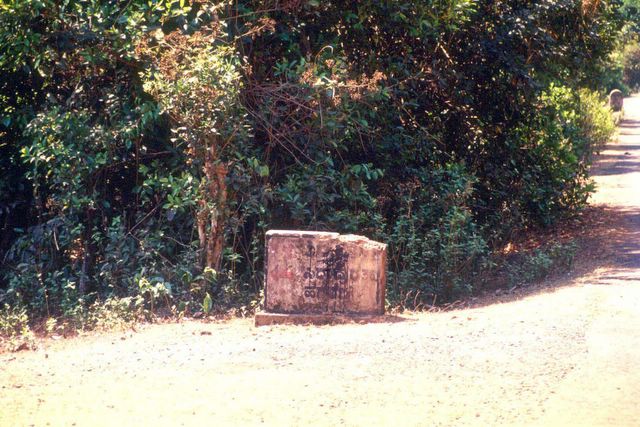
Soon enough, as we found out. We cleaned the signboard (faintly visible in the right of the photo) carefully and catch a glimmer of the truth


Under the layers of dirt - the truth Posted by Hello

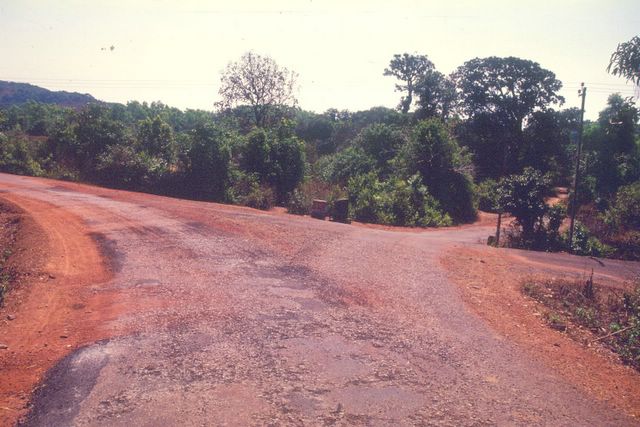
Then we come across this, a three-way fork:
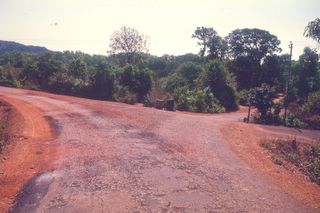

Help! Posted by Hello

My friend who is a deep thinker beneath his easy ways draws my attention to the relevance of these two-way and three-way forks. A piquant symbol of the dilemma facing mid-level managers and middle-aged men. Which way do I go from here? Which is the right way?

Anyway, we finally found the gate that would lead us to the fall itself. Then the road abruptly gave up and the dirt track began. Another Bhanakal stretch! Only, on top of the gravel, stones, minor boulders this had two other challenges - sudden drops/inclines of upto forty five degrees, deep ruts formed by jeeps/other fourwheelers that we had to avoid. It basically was like a roller-coaster ride except we weren't upended. We took the inclines whereever we could in third and took the middle path when the ruts were too deep. The last few meters were too steep and would have been a problem on the way back so we stopped and walked. The falls were awesome. A few months ago, with that copious rainfall, it would have been even more so. This photo does not do full justice to it, still it is all I have.


Unchalli Falls Posted by Hello

Someone had build a small viewing platform, the walls bearing testimony to various affairs of the heart and some documentary data of people who had visited here. The falls were quite high and from the platform we could just see where they emptied into a small sleepy lake. There were some steps leading down and we allowed them to lead us down. The view from there was better . There was a path going down further where the steps ended - probably went all the way to the foot of the falls. It would be a long climb down and back up. We desisted - probably next time. As we recounted the 240 steps - the gluteous maximus muscles were fully worked. And we were bathed in sweat. And the uneasy thought in my head - could my A350 make it back up without stalling?

It did and so we turned ourselves to Yana. Pradeep took over the handle. We were going smoothly when we hit the Devimane ghats. Actually, the ghat started much before the board announced it. Driving in the ghats on a bike has got to be one of the most enjoyable things for the kind of person that loves that kind of a thing. Undulating roads - you get the feeling you are riding a succession of waves, only it's much more gentle. Hair-pin bends which you want to take at fifty or sixty, but you never know if another vehicle is coming your way and if you will be able to stick to your side. If you aren't you will end up on the gravel by the side or in the middle of any oncoming vehicle which may be doing break-neck speeds and it's sticky going for a moment or over the side of the hill! Then those bends with steep climbs thrown in - you need ample room to make the long loop to take the steepness out a bit and then your bike must be able to make it without spluttering to a halt! Also, the evergreen trees on both sides and above you - making things pleasantly cool during hot days and mornings into a prayer time for nature.

All day we saw villagers taking part in the GP elections. At some centres there were queues too. Later we learnt that the turnout was fifty five percent. It was nice to see grass root democracy at work. Bush would have become delirious with happiness if he had seen it. On the other hand maybe they were afraid he would send in the F16s if no one turned up. We stopped at a 'hotel' run by Sharda N Pai - as the board on the wall outside announced - before taking the turning for Yana. On Yana itself there is aught to be had for eating. There a local man mentioned that these elections were being fought with much more whim than the MLAs (Assembly) elections. There were nine candidates contesting in his particular ward for instance. Though parties were banned from contesting here, he said unofficially each party backed one or the other candidate. What about prohibition - were things under control? A laugh, and well, those things will always happen whatever is done! Lots of women seemed to be contesting - more than the reservation allows for I think, which is good. Of course I believe some women are just a front for their husbands/relatives. Still. Also, not all of candidates were in it for the sake of service - some would be in it for the money too. Probably making money would be more difficult at this level probably the elected officials would be known more closely.

The hotel itself consisted of a small room with a long bench behind a long table. There was one private room further on inside which had identical furnishing. There seemed to be some confusion as to whether 'vegetable food' was available - they had not heard of 'vegetarian' food. The waiter, a grumpy man, insisted it wasn't everytime he came out to serve. The woman of the house kept reassuring us with a guilty smile that it was. We didn't blame the waiter - he just couldn't move about on account of the crowd inside - four of us, then the voters who really had nowhere else to go either, there being two 'hotel's in all including this one. He probably hadn't eaten as well. Finally we were able to sit down and fill up.

The turning to Yana signalled the start of sixteen kilometers of full body vibrations. It wasn't like any other dirt track I'd done. Horrible and grotesque. There was no choosing the best path out of the width of that monstrous road since there was no such thing as the best path. Whatever speed we went there was no avoiding the awful shaking. A uniform cover of small stones somehow firmly stuck in the ground and other loose stones lying freely also uniformly spread. Soon Pradeep's abdominal muscles started getting a good workout and since they had been idle for many a month they soon started aching. As for the gluteus m. - that must have long ago gone numb. Thus for twelve to thirteen kilometers.

Then the character of the track changes to resemble the earlier Unchalli Falls stretch. Only, the inclines are bigger and there's this dry, finely ground mud - almost like water - lying inches thick. Little pools of this - around eight or ten of them dotted in the most difficult of places - like the steep inclines. How can a bike go up there? But it does. I feel like Moses as it parts below our wheels. Sometimes we skid sideways but still hold upright - the weight of the bike saving us! I feel it slipping away ... slipping away. Taking some descents too fast - no point braking that would only mean a certain fall. Next time use a lower gear. And suddenly a long - at least six feet - snake slithers fast across the path and we almost run over its tail. It makes a rasping sound and the blue shiny thing vanishes into the thicket on the right. A dog has been bothering it. My second trip to Yana and my second snake. The first time, a golden cobra, hood raised proudly, lay right in the middle of another road - probably warming itself - before sliding away fast. Finally we make it though. We park our bikes. From here we need to walk up to the rocks. Water's gushing out of a pipe probably from some stream higher up. We drink with thanks.

Then we headed up. More steps. Finally we were there dead tired and this is what we saw.


Yana Rocks Posted by Hello

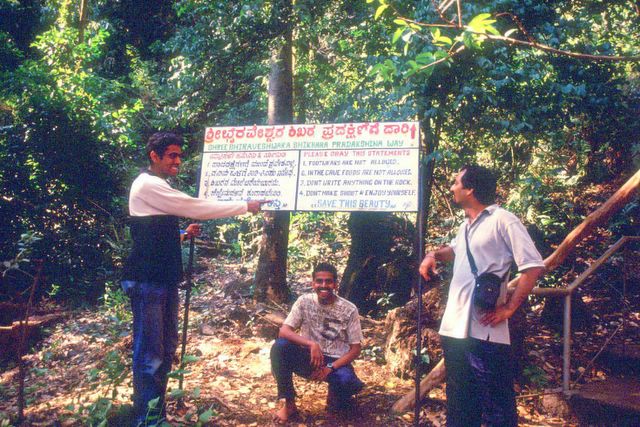
This is just one of the rocks there are twenty four or sixty two of them. How did they come to be here? As the priest in the rock temple told us, not even the scientists agreed. Some said it was volcanic in origin, others said it was washed in by the sea, and yet others said something else. So the priest gave his side of the story - and there were three sides, which was ok I guess. One was something to do with Shiva and his 'gana's, and one other was about Vishnu, I don't remember the third. The priest was a sad man. Apparently his family has been serving here from generations. And the government pays a paltry sixty rupees per year. No bus access for several months during the rainy season - they had to walk eight to ten kilometers for rations. He also strongly disapproved of the kannada film director Sunil Kumar Desai who had shown a completely blown up version of this place in his film. Waterfalls and echoing rocks. So now people came here shouting all the time. Spoiling the atmosphere of the place completely. There is a board now to warn such people :
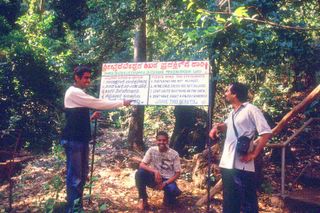

Don't make shout. Posted by Hello

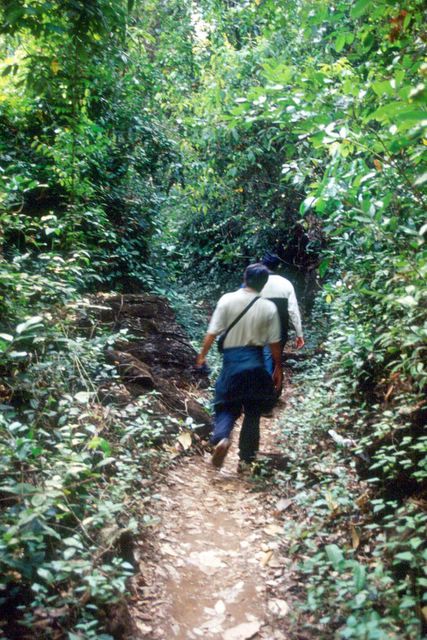
Finally we left. The walk back was better.


Heading into the greenery Posted by Hello

That sixteen k stretch again. As we stopped later and took stock, we saw that it was all over us too - the mud. I had not seen my shoes that colour ever. Nor my jeans. As S and A swam into view S punched the air. That was a well-deserved punch!

It was five in the evening and the evening. On the way back we stopped just above the ghats for a refreshing cup of tea, bananas, and kokum - a local drink make allegedly from the kokum fruit which I have not set eyes till date. The sunset gave a great view and I clicked some snaps.
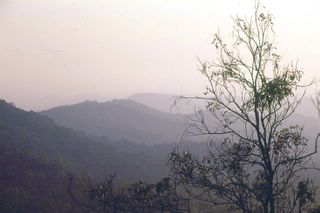

A view from Devimane Ghat -1 Posted by Hello


A view from Devimane Ghat - 2 Posted by Hello

Back to the hotel in Sirsi to pick our things up and then on to Shimoga, or at the least to Sagar. We reached Sagar around nine. This biggish town seemed to lack hotels. We ended up in a new one on the outskirts. The manager gave us a room with six beds. There was nothing else available. When we went up there were actually eight. We used two to hold our backpacks and slept in four. That basically marked the end of the trip. The next day was just reaching Bangalore.

Third day

We were to do 350 km in 8 hours today - including the breaks for breakfast, lunch, switches and other minor stops. Amazing going at least in my book. But at seven in the morning there's no hot water. The manager is mystified. We ask him to send up some buckets of hot water. He does. We're behind by one and a half hours. When we do get going we make seventy kilometers in an hour before stopping at Shimoga at round ten. That sets the tone for the rest of the journey. Pradeep takes over at Shimoga and mostly lets his hair down a bit.

We make Tiptur in quick time where we stop for lunch. But not before Pradeep tries to make goat chops and kidney pie out of a herd of goats who decide to cross the road at that precise moment. He has kavorka (also here - see reply # 6) - we've known this for sometime now. We are going fast and he tries to stop but it's too late - we slice through them miraculously, not touching a single one. Sunil claims that one startled goat jumped up a bit - probably a faint touch there. Some onlookers, sitting under a big banyan tree, probably feel let down - no chops and pie today. We joke over it during lunch, Pradeep is getting over it. The ice cream machine at the hotel works not and the ice cream man stands up on a chair and scrapes it out for us. Anand gets the last and a bit watery scoop. Arsikere and I get back the control. Soon we're past Tumkur and on the Golden Quadilateral road. As we approach Bangalore we see the funny sight of two tortoises overtaking each other. Not literally. The trucks transporting their heavy cargoes do crawl very slowly. Sometimes they barely appear to move. So when one of them tries to overtake the other the golden highway is as good as a village road. No one can pass these two behemoths who block both the lanes between themselves. Even if there were four lanes I can easily imagine four of them overtaking each other simultaneously. No solution for this very Indian problem. Get better trucks? Who has the money. And who cares anyway. Or maybe it is time to put some money in Ashok Leyland stock.

The traffic in Bangalore is not bad as it goes but bad enough after our pampered three days. Sunil and Anand depart at around four. I drop off Pradeep at around five. I'm home by six fifteen. I've been looking forward to seeing the little bundle of joy since yesterday and all day today. Not so he. No clinging, screams of joy or anything. A very adaptible kid - good.

4 Mar 2005

People's mandate and football

Apparently, some parties take their duty of respecting the people's mandate very seriously. They never let it out of their sight even for a minute for fear that it would walk away. Quoting from the report which is about the journey of the five 'independent' MLAs to Rastrapathi Bhavan:
... the BJP leaders surrounded each MLA to ensure that they would not go missing.
The headline of the report appears justified by the rest of the report, but a comparision to football would not have been amiss either. After all, in football defenders constantly shadow or 'mark' attacking players of the other team till the game is done.