12 May 2006

Painting The Town Red

June 20 2004:
In neighbouring West Bengal we see the even more scary spectacle of the Marxist government managing to stay in power for nearly thirty years despite doing so little for the poor that starvation deaths were reported from some districts last week. Marxist ideologues, ever ready with their talk of the ‘poorest of the poor’, dismissed the deaths as a localised problem.

Starvation deaths maybe, but poverty is not. West Bengal used to be, in that long ago time before the Marxists came, our most industrialised state. Our biggest industrialists were based there before Marxist trade unions forced them to move to Maharashtra. Even this would be fine if the Marxists had succeeded in providing ordinary Bengalis with schools, hospitals, clean drinking water but not only did this not happen but West Bengal’s ranking fell from being one of India’s richest states to being among today among its poorest.
May 11 2006:
The .. L[eft] F[ront] won a three-fourths’ majority in the 294-member state Assembly. It is the seventh successive term for the LF.
Now, will Tavleen Singh be so scared that she stops writing her columns or will she yet come up with a good explanation. Rigging seems to be readily at-hand, as it was in Bihar.

7 May 2006

Doctors

I asked in this post who (it should've been whom though) the doctors who get subsidised education serve once they're done with their degrees. I found the answer unexpectedly in this column by a novelist and surgeon in today's The Hindu:
Of the 4,70,000 doctors (of allopathy) in the country, 85 per cent are in private practice. Barring a few exceptions, they are busy making money and have no time for what they consider the dreary routine of prevention of disease, and health at the village level. Even professional bodies like the IMA and the various medical fraternities have ignored this larger problem.
Why should my money go towards subsidizing these people?

The column itself is a look at the prospects of the National Rual Health Mission which seeks to, among other things, train nearly five lakh health workers for the rural areas.

6 May 2006

Interesting Times In The US

The ruling party seems to be partying hard. Via digby:
From shoplifiting to accidentally shooting people in the face, to graft, corruption, perjury, gay hookers, straight hookers, illegal wiretaps, dirty tricks and more, the list of crimes is getting so long that it would be easier to identify the Republican politicians who aren't crooks, than try to name all the ones who are.
Indian politicians are more focussed going by the press coverage: all they want is to see and tuck away the money.

3 May 2006

Ramesh Ramanathan In Defence of Government

Ramesh Ramanathan of Janaagraha and now an advisor to JNURM writes in Financial Express (don't have thelink though - I get these in my mail):

In defence of Government

On a recent trip to Delhi, I visited an IAS officer acquaintance who had just begun a stint in a Ministry with the Government of India. I enjoy these occasional visits, learning about the challenges that those in government are facing - the intellectual debates, the public policy choices, the genuine political divides. My friend waved me in warmly as he completed his conversation on the telephone. It was my first visit to his new office, and as I gazed around I spotted a photograph of a cricket team. I recognised many officers from the same state cadre, all dressed in white, enjoying what had clearly been a pleasant weekend afternoon. I smiled and told my host, “I didn’t know you played cricket, when did this start?” He laughed at the photograph, and replied, “Oh, this began about a year ago. We had a ragtag team until one officer said we needed to get our act together and stop being such an apology - some of us were so out of shape, we would have had to pass a government order to stop the ball before it got to the boundary. He cracked the whip, and quite amazingly we actually started to come together quite well. Our first match was against the forestry team who fancied themselves and we beat the daylight out of them!”

He smiled at the memory of the event, and said, “We’ve gone from strength to strength, and along with it, an interesting bond has formed among us.”

“So which match was this photo taken at?” I asked.

“This was against the CFOs of the corporate sector. We lost, but by barely a whisker”, he said, adding in his self-deprecating style, “Government nowadays loses to the market, you know.”

I was intrigued by what the dynamics of this cricket team among the officers had done to the functioning of government. I inquired about this and he said, “It’s quite extraordinary - interdepartmental files that involve us get processed a lot quicker, not because we are doing someone a favour, but because so much of the context can be provided by just a phone call. It is almost as if this group has a special wireless connection.”

Indians disagree with each other on many issues, but there is one topic on which we have complete unanimity: our low opinion of government, both politicians and bureaucrats. I am frequently astonished at the sweeping generalisations that articulate and educated people make when it comes to describing what is wrong with our government. I find that this tendency is especially true among those in the corporate sector, and indeed rises with the level of accomplishment: an almost inverse relationship between private success and public disdain. Our general ignorance about the institutional design and constraints of government would be disturbing enough, but what is worse is our unwillingness to even acknowledge this fact or seek more information. In my continuing journey of learning about government, I have been struck by how almost every aspect of the institutional arrangement that we take for granted in the private sector is missing in government: the ability to specialise, the recognition for a job well done, the space to speak freely in front of a superior… the list is endless. These constraints are not just for bureaucrats, but are true for politicians as well.

This does not mean that government is filled only with well-intentioned, hard-working individuals; there are large numbers of corrupt people, those who misuse the power and position that their offices offer them. Even more frustrating than these blatantly corrupt are the seemingly well-intentioned ones who are adamantly closed-minded, refusing to allow the spark of new ideas to percolate in. But despite this, we need to avoid the blithe broad brushes that we so carelessly apply when criticising government. Because we do disservice to those champions within the system, the ones who are catalysing change every day. Every institutional arrangement has its own particular ethos; government is no exception. The relationship that exists between various layers of the bureaucracy, and more importantly, between the administration and elected representatives is a complex one. Political compulsions place many pressures on those inside government, forcing an almost daily examination of right and wrong. The Lakshman Rekha is drawn at different places by different actors; sometimes, the level of compromise is greater, sometimes less. Invariably, every individual has a personal threshold, beyond which compromise is not allowed.

For myself, the more I learn about government, the less willing I am to criticise it. This is despite the deep frustration that I feel about many of the shortcomings of government. But I sense an equal, if not greater, degree of frustration on the part of those who are within government. We have vast challenges in our society; many of the answers will have to come from government, and it must change the way it works on many fronts. With Indian democracy maturing, we cannot let up the pressure for change, but we definitely need a more sophisticated articulation of what is wrong, going beyond the black-and-white barcodes to see the shades of grey in our government.

As I walked out of my friend’s office, I couldn’t help wondering how many such people there were, scattered across union and state and local governments. Senior officers to second division assistants, Members of Parliament to municipal councillors, all chipping away, playing their role, bearing the burden of public cynicism every day, being indicted by people who have little understanding of the extent and scope of the constraints under which they operate, while they quietly clear files, sometimes faster because of a special bond of camaraderie formed by a cricket team.

28 Apr 2006

A Different View Of L'affaire Kaavya

Here from an American blogger. Notice the title of post : Meritocracy. And note this:
...she was able to pay $20,000 for a college counselor who put her into contact with a publisher. In short, she was lucky enough to be able to pay for connections.
I will let this commenter balance that out:
Wait a damn minute - we have nothing to go on except the story and the money to say she or anyone else did not work hard. You don't know that she didn't and to assume she didn't because she has parents with money is - well, - prejudiced.

I don't know what happened except what I've read and the girl could not be more apologetic over the purported plagiarism.
But it still doesn't make a bee in my bonnet go away, a bee that sneaked in as I watcheda news segment on CNN-IBN about the student protests against reservation. One student had this to say, paraphrasing completely:
a person who gets into an medical course through the reservation quota will not be able to learn all that well, since he will not have the skills for it. So what kind of doctors will we produce with this policy of reservation?
Fair point. But the same argument could be made against the system of getting seats in private engineering and medical colleges based on paying power. So why is it not made so vigorously? And isn't it also true that the student who fails to measure up won't pass his exams and thus will not be able to practice?

On a different note, how many of these students who get subsidised education and free experience in government institutions end up serving in the villages where the real need is? And how many end up with fat practices in the cities or abroad? We already know where the IIM graduates end up. Who do the doctors serve?

Update: Read the other side of the story, strongly put, here. Why indeed?

24 Apr 2006

Human Trafficking

By US contractors in Iraq. Shoe is on the wrong foot I think. Via Juan Cole, who in fact calls it the revival of slavery.

Update: And that after their government and President lied to start a war on the same country, and hoodwinked their own people into supporting the war. If this is what democracy is in the greatest democracy in the world, god help us. Via TPM.

22 Apr 2006

Adivasis And Forests

Found this on the net - the website of a group called Jharkhand Mines Area Coordination Committee. This group seems to be fighting for the adivasis' land rights. The site itself is a bit quirky requiring some working around/URL manipulation to get to where you want to go. But it gives an idea of the things happening in the area, mostly far away from the TV screens and newspaper headlines. They have a report on the Kalinga killings which recently spurted across the news horizons of the rest of the country. Factual, not very heavy on emotions, and eye-opening. It also touches on the forest protection and destruction issue and why it would not be welcome in some quarters that the Adivasis get legal ownership of their lands. It reflects on how well governments take care of forest lands. An excerpt:
Kalinga Nagar core zone comprises of 13,000 acres where the industries are situated. The remaining 17,000 acres are earmarked for the townships and civic amenities [pk: i.e.,a total of 121 sq km]. Sourrounding this is a greenbelt of dense forests spread over an additional area of 75 sq k.m.s. The flora includes sal, kurum, vandan, ashan and piasal. The forests of Nakasa, Natimara, Barsuli etc, all within ten kilometers of the project area, are also home to rich and diverse wildlife like leopard, deer, scaly ant-eater, python, cobra etc. This is also an elephant corridor zone as it comes within the larger Saranda Sal Forest area.

What is noteworthy is that the people in these forty Adivasi villages have been protecting this forest zone even prior to 1946. Their protection plan included what we call today ‘Community vigilant groups’. It is for this reason that the forest and wild animals stayed protected from forest mafia, poachers’ et al. Interestingly the practice of these community vigilant groups is older than our present day environmental NGO’s claiming to protect the forest.

The Bone of Contention
A known fact is that the first and last land survey was undertaken in 1928 under the then British Raj. That land survey did not include the Adivasi areas, thus, a majority of the Adivasi population in Orissa was never given land papers. Despite a Supreme Court ruling in favour of the Adivasi, the government has not moved a finger to grant papers to the Adivasis. The advantage of maintaining the status quo by the upper dominant caste and class is manifold. One such advantage is seen here in Duburi where only those who had land papers were given compensation in 1994. The rest of the land the government got for free.

The Tata Factor
The Tata Steel Ltd (TSL), a late-comer in the project, has been allotted 2400 acres in Kalinga Nagar, for the construction of a six million tonne plant. The land that the government purchased at the rate of Rs. 37,000/- per acre in 1994, was sold to the Tata Co. for Rs. 3,35,000/- thus making a net profit of Rs 715,200,000 and at the same time giving the Tata Company a savings of over Rs. 87,600,000 over the market price. The market price is between Rs. 5,00,000 to 7,00,000 per acre.

It was this dispute over compensation that was on the negotiation table till 2nd January and was the reason why the people had assembled to prevent the bull-dozers from destroying their houses and taking over their lands that fatal day.

There were other reasons for this dispute. The Government had paid only for those lands for which the people had ownership papers; amounting to 13,000 acres, For the remaining 17,000 acres, which were in part common land and in part lands belonging to the Adivasis --though the papers due to them by the Supreme court ruling had never materialized-- the government did not pay any money. Within the category of common lands comes forest land. Traditionally the Khunkhatidars also had large amounts of forest lands and hence the ownership of these forest lands, and the question as to whether they belonged to the Forest Department (Government) or to the Khunkhatidars, or how much belonged to each, had been in dispute. While this amounts to another staggering mathematical figure, in terms of blood, it has taken the lives of the twelve killed, injured dozens, and the trauma of the repression that has followed and the burden of collective memory is going to linger on.

In A Spot - 220406

The next one in the series, though it her Fifth Column in IE - not the usual On The Spot in DH - which I discuss here. She tackles the Naxalite problem taking some time out to bash the Rural Employment Guarantee Act(REGA) along the way. First, the latter:
On account of the deletrious influence of Leftist NGOs on the UPA Government, all we have had by way of rural development are madcap schemes like the Rural Employment Guarantee Scheme. Thousands and thousands of crores will be spent on setting up a massive bureaucracy that seeks to provide a hundred days of employment a year to the destitute. A hundred days, if they can be provided, will continue to leave them destitute.

If those who invent these grandiose schemes travelled in rural India, they would have noticed that even those who have 200 days of employment a year are destitute. I have met whole families who live on less than Rs 10 a day when the breadwinner has 15 days of work a month.

It is not a 'Scheme'. It is an Act. There are differences between the two I believe. And nix on the deletrious effect of leftist NGOs on the UPA - the 100 day guarantee is part of the CMP based on which the UPA came to power. But why should keeping up electoral promises matter in this brave new world of rightist opinion-makers.

Now for some maths. How much would each of the families that she mentions earn in a year? 10*15*12= Rs 1800. How much does 100 days of work under the act give? Remember that the workers need to be given at least the minimum agricultural wage per day as per the act. That is around Rs 60. So, 100 * 60 = Rs 6000. More than three times what they would earn otherwise. If those who columnise their opinions weekly had a ready grasp of elementary mathematical calculations, we would get better informed reading material on weekends.

Then Ms Singh writes:
What we need in the Naxalite districts is investment in real development. Roads, schools, clean water, electricity, irrigation and above all jobs.
'Above all jobs'? Is she by any chance asking for employment for the rural people? Probably even a guarantee for a certain number of days of employment?`Like the Act under discussion here? No, that can't be. Must be she is asking for regular 9-5 jobs for everyone. And I'm not sure what kind of work she thinks will get done. Probably digging up a hole in the morning and filling it up in the afternoon following by the rustling of newly-minted notes before everyone says bye to each other? That need not necessarily be it as these folks mention:
Second, it must be remembered that such a programme does not involve an expenditure of resources for the sole purpose of creating employment. Rather, the idea is to use the workers productively in activities which will build or maintain assets in the countryside, or provide important social or economic services. So such expenditure will yield dividends not only in terms of higher levels of economic activity in the present but also through improving the conditions of production in rural areas. There are many such potential activities which can have important effects on supply conditions, productivity and sustainability of rural economic activities, in both agriculture and non-agriculture.

For example, constructing and maintaining roads and other connectivity (which has thus far been the most popular form of activity in such schemes) has direct and indirect effects in agricultural marketing and a whole range of other economic activities, besides generally improving the conditions of rural residents. But other activities, which are often far less captial-intensive, such as building and maintaining bundhs, minor irrigation works, clearing out and desilting ponds and rivers, also have very positive short run and long run effects on production conditions and can also improve the sustainability of cultivation patterns generally, implying important social gains.
It would be worthwhile for Ms Singh to read the thing in full.

The act is surely not a silver bullet, but it can't be all bad and needs to be given a chance.

Now to the Naxalite issue about which she is talking all along
If the Prime Minister were serious about dealing with our single biggest internal security challenge, he needs to put his money where his mouth is. Policemen in Naxalite districts need the sort of weapons that are used to protect VIPs in Delhi and they need to be trained along with the commandos responsible for VIP security.
I think it is clear. The Naxalite problem is not going to be solved by firepower. Else the US would be done in Iraq and subjugating Iran or even Syria by now. The police in the rural areas are always going to be outnumbered. And outnumbered, they are practically at the mercy of the Naxalites. Short of guarding each police chowki with one or two armoured tanks, I don't see how the policemen can be protected. And even the tanks will not guarantee anything.

So we move on to the socio-economic problem underlying the Naxalite problem. We've already seen how providing food in the mouths of the rural needy is not going to help. Next the lady notes that the tribals and adivasis are mostly the people being recruited by the Naxalites. But she does not think it would be a good idea to allow them to legally own the land that they live on. You might think it is a good idea - make them feel a little more like they belong and a little more secure, maybe even put the land to good use. But no, Tavleen Singh does not agree. She think the forests will vanish. This apprehension is ill-founded according to me, as I noted in this post. But the hypocrisy is killing. Mr Mittal can take 32 square kilometres (8000 acres) of land for his steel plant in Jharkhand - which has some of the best forest cover in the country - without harming the forests, but not the adivasis and dalits who have been there all along. Break please.

16 Apr 2006

The South As Foreign Country

From an opinion piece in The Telegraph:
There was bloodshed and loss of life as the inexplicable violence continued for nearly two days. The word “inexplicable” is used advisedly since the occasion was that of mourning. Sorrow-driven violence is not a common cultural phenomenon. Rajkumar had died of natural causes at a ripe old age. Yet there was a bizarre exhibition of popular anger. What were the people angry with? With death, the one thing that is certain in life? Did they expect that the matinee idol would never die? What triggered off the violence? These questions will continue to haunt sociologists and cultural anthropologists who study popular behaviour.
It was inevitable that sociologists and anthropologists were dragged into it. I am surprised that psychiatrists, psychoanalists, historians and others were not.

They need not be. The questions - at least the main question : What triggered off the violence? - can be equally well-addressed by the police and the authorities who were in charge of law and order. As I noted in this post, and as local opinion is stressing, the violence was most probably not the work of fans - at least not to a major extent. To the extent that it was - which could be said of the violence in and around Kanteerava Stadium where the body was kept for public viewing - it was possible to explain it by the ineptitude displayed by the authorities, as this report from DH notes, though troublemakers were probably at work there too. As for the rest, the latter were most likely to be blamed. Deccan Herald - Karnataka's daily - notes as much in this editorial:
Rajkumar held sway over the minds and hearts of the people of the state, and it was only natural that thousands of them turned up to pay their homage to him. The state government and the police should have anticipated the crowd control problems and deployed police personnel in sufficient strength.
...
It is a known fact that rowdy-sheeters and other anti-social elements take advantage of crowds to kill people, loot shops and houses, and set fire to vehicles and shops. As soon as the government received information about the death of Rajkumar, the police ought to have rounded up all rowdy-sheeters in Bangalore. But they did not as they failed to realise the gravity of the situation, though they have in the past — particularly during the period Rajkumar was a hostage of Veerappan — faced trouble from a section of fans and anti-social elements.
I'm not justifying violence by the fans - if it indeed occurred - whatever the pretext, but point it out as a possible explanation of what happened.

It is not surprising though that The Telegraph takes the view that it does. As it notes at the beginning of the article itself:
The past is a foreign country, they do things differently there. Many north Indians feel that the statement would lose none of its significance, if the word “past” were to be substituted by “south”. Such prejudices have perhaps been fortified by what has happened in Bangalore in the aftermath of the death of the famous film star, Rajkumar.
In other words: those crazy southerners.

Dispensable Citizens?

From The Hindu:
Every time a rehabilitation policy is mooted by the state, it is in fact an admission that the process of development has got too lopsided and cannot do without a correction. But as should need no reiteration, it is not policy alone, but its practice that makes the difference. Those strident in their condemnation of the dam-affected resisters are demanding that they, the dam-affected, accept their status as dispensable citizens. There is no call for the state to perform according to standards that the state has itself set. There is instead an anger that the indefinite fast has prevented the wishing away of the non-performance on rehabilitation and misrepresentation in official documents. In other words, along with the dispensability of the displaced, impunity is being advocated when the state breaches the dictum of the law — that the state has itself made! This is not then merely about whether the dam should be constructed or not. It is about creating the dispensable citizen, condoning state inaction, and then blaming the victim.
More from The Hindu on the same here.

14 Apr 2006

State Honours

Raj Kumar was buried with full state honours but neither state nor honour was present. There were all of five or six policemen apparently playing the role of spectators, representing the state. The Deputy Chief Minister and some of his party colleagues scurried to and from the burial scene in undue haste. Not a word to the sons who were left quite alone. As for the gun salute it might have happened in Mysore for all one could discern in the commotion. Honour too was absent. What honour when the sons of the man had to cry and plead to be allowed to finish the burial rites before sundown. They were completely helpless. The crowd was thick and deep till the very edge of the pit.

As for the place where the actor's body was kept in state for public viewing earlier in the day - there was hardly any dignity or grace in that. It was a sordid, harsh and dispiriting scene. Only the line of people silently trailing past the barricades gave an indication that here was a man who was not ordinary. Surely this man who had earned the love of so many deserved more?

Once again the difference between the common people and the rest was shown up. The real fans - who had bought the tickets to their hero's movies these many days - were left outside the gates everywhere. If they were not following the cortege so closely they would have been far from the actual burial too. The politicians who were looking for photo-ops and to doing the right thing more than anything else - I saw Mr Deve Gowda even smile as he got out of his car - walked right in and out.

Why did the violence happen? I think there must be more than one reason. Miscreants who were not fans, fans who were angry, and poor management by the authorities.

There were people who were not fans in the crowd. They couldn't be fans - they were dancing into the cameras with wide grins. What kind of fans could they be? As to the people who caused the trouble - how could they be fans of the gentle star (as Deccan Herald put it somewhere)? They had to be rowdy elements waiting for such events to do their handiwork. And our current political culture thrives on these kind of people. Every political party cultivates them. And they all pay for the culture when they are in power. How many miscreants does it take to cause damage by throwing stones and setting vehicles ablaze?

Fans had probably sufficient reasons to feel angry. There was enough mismanagement going around. One has to look at a map of Bangalore to see how stupid the choice of place for public viewing was. Palace grounds would have been far nearer and more convenient from the hospital, and to the final resting place too. Maybe the police had other objections like difficulty in monitoring access, but with the size of the crowd, anyplace would have been a problem.

And the police exacerbate things. They needed to treat the people who came to the Kanteerava stadium with decency. They should have been informed and managed better. Hitting out indiscriminately with lathis was no way to handle the situation. Again dignity was lacking - it was beaten up with canes. And if it is true that many fans couldn't have a last glimpse of their hero, then that's one more reason for feeling aggrieved. But did angry fans do any damage? Maybe the police will confirm in the days ahead. I too like many others think they didn't.

NB: I was not at the scene, but at home watching the live TV coverage.

Populism

Works. I'd remarked on Friedman's flat-out confused rationale for the title of his book 'The World is Flat', here. However, the book deserved more apparently. It gets a 55-page review by a qualified economist here. Via Atrios who sets the scene up thus:
Ed Leamer (.pdf) has some fun reviewing Friedman's tripe for the Journal of Economic Literature. It's long and veers between snark and substance, so pick and choose the bits you like...
I'll give the conclusion here to save you the trouble of wading through some heavy waters:
Here are titles of three books. Based on the titles alone, which do you think would sell a lot of copies?
The World is Flat
The End of Poverty
In Defense of Globalization
Globalization and Its Discontents
The startling reality is that The World is Flat has been on the New York Times best-seller list forever and is ranked #1 on Amazon on February 21, 2006. Meanwhile, Jeffrey Sachs’ The End of Poverty: Economic Possibilities for Our Time is ranked number 515, which seems like a big number compared with the number 1, but Jagdish Bhagwati’s In Defense of Globalization is ranked 20,602, and Joseph Stiglitz’ Globalization and Its Discontents is ranked 52,196.

We economists have great ideas but not great ways of expressing ourselves. It starts with bad titles. This raises the philosophical question: When economists speak, but no one listens, did we say anything?

Thus I understand that it doesn’t much really matter what I think. The market has said that The World is Flat is a great book. But just for my own personal amusement, here comes the summary.

First of all, metaphorical titles as powerful as The World is Flat really matter. With that title, readers have their fears reinforced, needlessly. The debate about how to handle our economic relations with other countries has already been harmed enough by misleading metaphors. Those who favor high tariffs call it “protection” as if a wolf were lurking beyond our borders ready to devour our jobs. And those who favor low tariffs call it “free” trade as if paying a couple of more dollars for the shirts and jeans we buy at Wal-Mart amounted to a period of incarceration.

Other than the metaphorical mischief, this book is long on anecdotes, interpretations and insight. It’s an eye-opener methodologically because of the clear progress Friedman makes without benefit of the union card we call the Ph.D. in Economics. But he doesn’t get “there”, because, I think, he has no knowledge or interest in the vast amount of work that has been done by economists on these topics.

Friedman does get the policy response (education and infrastructure) right, though there isn’t much debate on this:
“And it requires a Great Society that commits our government to building the infrastructure, safety nets, and institutions that will help every American become more employable in an age when no one can be guaranteed lifetime employment” p. 277

“My vision is to put every American man or woman on a campus” p. 290
But when he calls this program “compassionate flatism” that is the flat that broke this camel’s back. Worse still, this nonsense metaphor is becoming altogether commonplace, filtering into classrooms and boardrooms. We should take better care of our language.

The final third of Friedman’s book is an insightful and lucid discussion of the stress points between the Muslim and the Judeo-Christian world. (You are free to object that I am not competent to review that material.)

But: Physically, culturally, and economically the world is not flat. Never has been, never will be. There may be vast flat plains inhabited by indistinguishable hoi polloi doing mundane tasks, but there will also be hills and mountains from which the favored will look down on the masses. Our most important gifts to our offspring are firm footholds on those hills and mountains, far from the flat part of the competitive landscape. Living in the United States helps a lot, and will continue to. But those footholds will increasingly require natural talent. Though personal pleasure is our real goal, as a byproduct, we provide our children highly loaded dice to roll at the genetic craps table. Beyond the all- important luck of the draw, it takes the kind of education that releases rather than constrains their natural talent. We send our children to good private schools and then on to UCLA. The rest is up to them.

I am sorry to say it that flat way. It’s not an apt metaphor, even though it is a powerful one.
'When I use a word,' Humpty Dumpty said in rather a scornful tone, 'it means just what I choose it to mean--neither more nor less.'

'The question is,' said Alice, 'whether you CAN make words mean so many different things.'

'The question is,' said Humpty Dumpty, 'which is to be master— that's all.'

Lewis Carroll, Through the Looking Glass, Chapter 6

13 Apr 2006

Incompetence

On a scale that is difficult to imagine.

Update: OK the scale is not all that large, but the incompetence is still difficult to understand. Did no one expect it or have a plan in place for this?

Exit Of A Legend

Says DH. For the entire day today and yesterday the Kannada channels have been carrying nothing but programmes related to him. Lots of songs from his movies and such stuff - it still feels like they have touched extremely lightly on the topic. I couldn't get enough of it. Truly, every Kannadiga carries a bit of the actor in him somewhere.

23 Mar 2006

Eating Humble Pie

kmp writes in, in response to In Which I Eat Crow:
>>I was supporting England of course

Is it “Sourav Mania” (a la a section of our BB*** )? Or is it just Freddie “Fantastic” Flintoff? ;-) (Mind you Sourav and Flintoff did not get along well either!!!).

Much has been talked about dropping Saurav (and of course treatment meted to him – and me too being a sympathizer). But, what’s the point? He was not performing for a while – and he should be dropped not withstanding the emotions attached. Yes, there is an argument then “why not others”? Of course why not? But, that does not mean bring back Saurav – does it? And, the list of “Why not others” has only Sachin for the time being – but Sachin has an aura which I think nobody else can get (and I don’t want anybody else to get lest we become the prisoners of that again).

And, why is it that people hate Greg – for being antagonistic with Saurav? Just that - come on!
Stern rebuke indeed! Not entirely unjustified for sure. My answers to his (non-rhetorical questions) first. Then I will try to offer my reasons but even I'm not too confident that I can rationalize this away. It straddles the borderline between reason and emotion as kmp has guessed. I put in the effort mainly to get it off my chest. It will be a ragged defence, maybe it will be cathartic too.

The answers to his questions are:
  • Yes
  • No (though the English team grows on one if one is not careful) - and it would be difficult to find anyone who got along well with Ganguly other than Boycott
  • I agree, there is no point
  • No it does not mean backing Sourav
  • I don't know why they hate him
First up is the psychological defence, followed by one or two things that have bothered me about the entire throw-out Ganguly episode.

kmp asks: Is it Sourav Mania?

Yes it is. I made it clear in this post not so long ago. Let me explain. Remember when Chappell came in and Ganguly was thrown out? Though a Ganguly (and Dravid) fan I had admitted to kmp that it was right that he was let go. If all we heard during that time was true - him not playing in Nagpur because of the quicks, being reluctant/frightened to face fast bowling, making VVS insecure by telling him that Chappell did not want him in the test squad, having lost the confidence and trust of the rest of the team - then he had to go. It is all summarized here in Chappell's letter to the BCCI president. Anyway, coming back to him being dropped - I thought it was deserved too, since his batting form was anyway plumbing the depths. But the Karachi test showed that he was trying and succeeding a bit too. Cricinfo analysed the two innings and gave a thumbs up (I wrote about it here). To be dropped after that - that was galling. They were playing with him like a cat plays with a mouse. If they were going to do that, they should not have picked him in the first place at all.

So there it is. I don't think Ganguly is anything more than a pleasure to watch when he is playing well. Not God - even of the off-side - or anything like that. And, no, I'm not saying bring him back. But he deserved to be treated well, even if he was dropped ultimately. I have always had a soft corner for the underdog - or losers if you will. I don't know if psychologists have a name for it, but that is how I am and evidently many others are.

There is one thing in Chappell's criticism of Ganguly which don't ring true. There is the reluctance to open. I seem to remember a particularly heated discussion sometime ago - about Ganguly being reluctant to give up the opening slot in ODIs to Tendulkar. True ODIs are a different ball game altogether - but the ball is equally new and hard and coming down as fast in ODIs too. And Ganguly faced Akhtar and friends quite grittily in the Karachi test didn't he?

There is also the flip-flopping on Ganguly opening/not opening in the first Test in Pakistan culminating in the heated discussion on the morning of the Test. Why was there a rethink on Ganguly opening - after him being picked as a opener? Did it have anything to do with the dead track? Did someone think - well, even Ganguly opening can do well on this track, and if that happens, it will only complicate things?

And what about the 'integral part of the team' as Chappell puts it in his letter, talking about VVS? He has been kept out of the Test side hasn't he? And if this 5 bowler combination works well, where does that leave Laxman? His form has not been anything worse than the 'master-blaster' - if anything, it is a bit better going by Cricinfo. Why the special treatment for Tendulkar? I don't believe in this aura thing, with all due respect to kmp. If it were true then only psychics should be allowed on the selection panel. I never believed the hype surrounding him much beyond the first five years or so. The real thing does not need that much of gloss. And it is not entirely spontaneous. Shekhar Gupta (of Indian Express) on a NDTV chat show mentioned how a critical article was withdrawn at the last minute due to pressure being brought on his newspaper not to print it. Genius does not need such protection. And one needs to only look at the extensive sympathetic coverage of the booing episode compared to the coverage of the incidents of stoning of Dravid's and Ganguly's houses during the last World Cup. It doesn't make sense in cricketing terms too. Are international cricketers kids who get overawed by a big name? And coming to others who have been persisted with, Sehwag too has not been in the best of form in Tests, of course ignoring those big innings on the horrendous batting tracks in Pakistan.

kmp asks: Why is it that people hate Chappell? For being antagonistic with Saurav? Just that - come on?

But I imagined I was being factual here. It is not only me talking about him being concerned only about the 2007 World Cup, but Indian Express too, here. The relevant quote here:
Someone should redraft Greg Chappell’s contract. The focus of Team India and its coach — and, apparently, the entire BCCI — seems to be one-day cricket and its Holy Grail, the World Cup in 2007. The fact that there are a few Tests to be played along the way appears incidental, and has left players unsure over how they should tackle a five-day game.
And in Chappell's letter to the BCCI he says :
I can assure you sir that all my actions in this matter, and all others since my appointment, have been with the aim of improving the team performance toward developing a team that will represent India with distinctions in Test match and one-day cricket.
But in the very next paragraph, he regresses to this:
In fact, it has only served to confirm that it is time for him to move on and let someone else build their team toward the 2007 World Cup.
Will the real mind of Chappell stand up please?

On the other hand, I think I do hate him. For being so confrontationist. For showing his finger. Or maybe just for guts he has shown in taking on the former captain and turning Indian cricket upside-down by all accounts.

*** kmp is referring here to the electronic discussion board in the company we both worked in before I quit, where he still works. In short, discussions get very heated in there, and loyalties to certain cricketing personalities are stronger than steel, and said loyalties are declared constantly to the irritation of people who are loyal to other greats, and endless/pointless debates rage during the cricket season and during the non-cricket season. I left two years ago, and certain controversies are still being discussed, one of them being who is better - Tendulkar, Dravid, or Ganguly. Another peculiarity is that loyalties cannot be shared - a Tendulkar fan almost always is not a Dravid/Ganguly fan, and so on. In fact, he usually hates the the other two. Any praise of Ganguly - even without any reference to any other cricketer, leave alone Tendulkar or Dravid - quickly becomes a discussion of who is better among the three. You get the drift I think. And we used to agree between the two of us that the guys who posted are mostly nuts/idiots - certainly the authors of someof the more stupid arguments. So it is not a compliment at all to be compared to them :-)

NPT, The Nuclear Deal, And The Flat Worlder

Venkat Krishnan (whom I do not know) roasts Tom 'Flat' Friedman on the latter's shabby article opposing the Indo-US nuclear deal.

In Which I Eat Crow

Yes, I take this back. Things do change. The way Dravid summed up yesterday's batting collapse to Dean Jones during the presentation ceremony was a refreshing change on a gloomy day for India fans. I was supporting England of course.

'It was bizarre', he said. Now, I've listened to captains in the recent past talk about humiliating defeats. Azharuddin had taken to mumbling incoherent nothings towards the end of his captaincy. He was probably afraid of mentioning money by mistake. Tendulkar was in and out before one could say 'we played like dumbasses'. Ganguly had just started mastering the art of stating the glaringly obvious, such as, 'we need to play well to win', then, he was captain no more. Yes that is a pun and I intended it, though Boycott would probably call it a joke. But I think no one, not even Dravid talking of the Karachi debacle, has gone beyond words with single syllables and commonly used terms.

With that in mind, bizarre as a word is different. It is exotic. It sets a new standard for captains. Kudos to Dravid. Being the modest man he is, he would, I'm sure, attribute it to 'contributions from the boys' and how he was 'happy with the boys' for suggesting the word to him.

However, I rush in where he has so gingerly tread - like a certain class of humans are supposedly prone to - and suggest another term to describe the defeat. It is called deja vu. Thus, he could have said, 'it was like deja vu all over again'. He has been part of many such defeats - in spite of his good performances - after all. And we the past and current fans of the team have not infrequently watched capitulation after capitulation on pitches that do not bear resemblance to plain glass.

But I don't think he reads me.

PS: Of course, many had thought that things would change drastically since the last captain was thrown out of the team. What with 'performance' being the sole criteria now, and the change in the working of the team, emphasis on discipline and on the process of winning, and other such new and innovative ideas. But I want to point out that they had no reason to assume any such thing. The task before the team management is not to win test matches. The self-described task before Greg Chappell is to win the 2007 world cup. And that contest does not have test matches. So there.

18 Mar 2006

Medi-oh!

This interesting snippet from The Hindu:
Different facets about Rahul Dravid came to the fore at a felicitation function for the Indian captain on the eve of his 100th Test appearance organised by Bank of Baroda.

Hosted by Cricket Club of India on its lawns, club president Raj Singh Dungarpur set the tone with a tale from Pakistan about the former's hands-on leadership...

Dungarpur, team manager on the tour to Pakistan, said: "It was decided prior to the first Test that Sourav Ganguly would be asked to open the batting. I had a word with Ganguly who told me he was ready to do anything the team wants him to do," said the CCI president, adding: "Dravid had made up his mind that he would face the new ball instead of thrusting Ganguly into the situation and convinced the team management to accept his viewpoint."

Well, well, well! So the 'animated discussion' on the morning of the first Test could not have been about Ganguly trying to convince the cap and coach that he did not want to open and that he preferred coming down the order. So why was everyone on TV and some parts of the print media too implying that it was about the former captain refusing to open?

Here is the interesting mix of innuendo and unnamed sources served up by R Kaushik of DH on the front page the day after the incident (from DH, Jan 14 2006). He starts off innocently, planting the idea firmly in the reader's mind:
It will not be prudent to state that Ganguly was making a case for himself in the middle-order once it had been decided that he would play in the first eleven;
However after pointing to Ganguly's reluctance to open and a sprinkling of data on how he fared when he opened (badly), he throws all prudence to the winds and ends with the following:
It is quite possible that the debate in the morning was Dravid insisting that he would open the innings, and Ganguly countering that since he had been drafted into the eleven as an opener, he will discharge that responsibility. A team source, however, said the former captain desired a ‘rearrangement’ to the batting order -- whatever that means.
This is one hack who has sold his soul.

4 Mar 2006

Just Deserts

I'd mentioned this US Congressman's unique approach to raking in the money here. He got his just deserts today. 8 years in the pokey.

And we are still letting all and sundry get away with murder. I'm not even talking of the Jessica thing.

24 Feb 2006

Authority

In which Manmohan Singh gives it back:
It was as if, “we live in some totalitarian system, in some fascist state, where authority has to be visibly asserted to command compliance”, Mr Singh said alluding to the BJP’s unrelenting criticism about his authority in the government.

“Maybe those who raise this issue are unaware of this framework. Maybe they think other parties function like theirs, allowing shadowy organisations to interfere in the work of elected governments,” he said in an obvious reference to BJP-RSS ties during the NDA rule at the Centre.
Encore Dr Singh?

Adios

By all accounts, Ganguly seems to be staring at the end of his international cricketing days. If so, sad and here is one person who won't be rooting much for the Indian side.

19 Feb 2006

Cars Vs Bikes

In this Tripping on Bikes -2 post I said that travelling by car wouldn't be as much fun as going by bike, and let it go at that.

There is a book on my shelf which I bought in December 1994. I gave up after a hundred or so pages since it was a bit heavy on the brain. I started again and completed it a month ago. In it the author explains the difference much better than I did:
You see things vacationing on a motorcycle in a way that is completely different from any other. In a car you're always in a compartment, and because you're used to it you don't realize that through that car window everything you see is more TV. You're a passive observer and it is all moving by you boringly in a frame.

On a cycle the frame is gone. You're completely in contact with it all. You're in the scene, not just watching it anymore, and the sense of presence is overwhelming. That concrete whizzing by five inches below your foot is the real thing, the same stuff you walk on, it's right there, so blurred you can't focus on it, yet you can put your foot down and touch it anytime, and the whole thing, the whole experience, is never removed from immediate consciousness.
Yeah, all that and the fact that I tend to fall asleep much more in a car and that it does tend to become a bit of a social occasion.

He goes on about his attitude to the trip itself and more common ground emerges:
... Plans are deliberately indefinite, more to travel than to arrive anywhere. We are just vacationing. ... We want to make good time, but for us this is measured with emphasis on 'good' rather than 'time'... Twisting hilly roads are long in terms of seconds but are much more enjoyable on a (motor)cycle where you bank into turns and don't get swung from side to side in any compartment. Roads with little traffic are more enjoyable, as well as safer. Roads free of drive-ins and billboards are better, roads where groves and meadows and orchards and lawns come almost to the shoulder, where kids wave to you when you ride by, where people look from their porches to see who it is, where when you stop to ask directions or information the answer tends to be longer than you want rather than short, where people ask where you're from and how long you've been riding.
Couldn't agree more.

Harsh

Words for Bihar from a native. After a list of things that should occur for the state to really change - rather than just the CM - the writer says:
The difference between any two States is not so much because the Chief Minister of one is a lot better than that of the other; it is because people in one have initiative and enterprise, and those in the other don't; people in one have some sense of shame and pride, in the other don't.

Because all those things I listed above are not going to happen in the foreseeable future I am sure Bihar is not going to change for the next few decades at least. Nitish Kumar at the best might be a good joke between bad serials. Call it cynical if you will!

10 Feb 2006

Tripping on Bikes - 2

Another trip, another post.

The previous trip had been confirmed a week or so in advance. This one almost did not happen. It was cancelled once due to personal reasons, and then almost got cancelled because of the threat of rain. Time was when the sound of heavy rain falling outside the window was a clear invitation to take our cycles or mopeds out and ride through the neighbourhood, getting thoroughly drenched. But much water has flowed under the bridge since then. Now the thought of rain on our trip is not a happy one if only because there is no hot water, fresh clothes, or dry socks waiting at the end of it. Hence it was nine-thirty pm on a wet thursday that we - Pradeep and I - finally decided to pack our bags and head out the next morning. Bangalore was wet, and rain was very likely. But going had become inevitable. The sudden catches of memories from prevous rides were haunting. Especially since, after the generous NE monsoon, the entire region would be covered with that beautiful green of paddy fields and of the overgrown trees of the ghats. Probably Pradeep felt the same too.

An small digression here. While discussing the rain issue, we had explored the option of going by car. It wouldn't be as much fun as biking, but at least we would be safe from the rain. Now, it is accepted wisdom that travelling by car is safer than travelling on bikes. We now found out that this need not be always so. Two people were uncomfortable with us going by car - Pradeep's mother and sister. All our trips so far had been by bike and they were happier at the thought of us speeding through the countryside on bikes rather than on cars. We had come back without a scratch from each of them! We all feel more comfortable with familiar things and a known devil is better etc. All the same, it was amusing. Only we knew the various incidents over the various trips.

Day 1, Nov 4

I was wide awake at around four in the morning for no particular reason. More than an hour to fill in, which I spent posting on my blog. Then a bath and the usual quick byes to the kid and wife before I was off. For a change, Pradeep was all set by the time I reached his house. We were short of a watch - mine was at home with a broken strap, he doesn't wear one. A call to his sister resulted in a watch being dug out. It had stopped at 1:30 am/pm - many days ago it looked like. We took it anyway. We'd try to find batteries for it in Tumkur. We'd hoped to rope in the brothers Anand and Sunil again, but Anand was away in Spain on work. Without him it would be difficult for Sunil to get the required clearances to join us.

Since it was a holiday (Ramzan) we were able to get out of the city quickly. Soon we decided that we would aim for Jog Falls. We were hoping that the authorities would've releasesd water from the dam after all that rain over the last month or so, and that we could catch the falls in their full glory. The route would be Tumkur - Gubbi - Tiptur - Arsikere - Kadur - Birur - Terikere - Bhadravati - Shimoga. Lunch at Shimoga and then on to Thirthahalli for the night.

We filled some petrol into the bike and it felt good to get going. As we made out way through the outskirts, we could see people busily travelling to work - some walking, some waiting for buses, all hurrying along. And here we were merrily biking. Pradeep remarked on this. Thus we bounce along each of us, hitting reality every now and then. I had hit it the previous day at the mechanic's garage while getting the engine oil changed. A young boy was at the garage, not more than sixteen or seventeen. It was Ramzan eve. He spoke hindi and I guessed he was muslim. And there he was at eight thirty the night before Ramzan working on my bike. And while I was there a man of around fifty years came along with a pretty run down TVS moped. The chain had fallen from the sprocket. Why still use such an old vehicle?

We got on to the Tumkur toll road which is still the same - smooth and easy to drive on. Since it was november, the sun was mild and and the cool air was refreshing. At around eight, we pulled over at a Kamat restaurant that we'd failed to spot last time, for breakfast. Idlis and vadas and two kesaribhaths - one as an appetiser and one for the road. Washed down by coffeee of course.

We were in Tumkur by ten and looking out for watch-repair shops. We found one quickly. Pradeep walked over to the shop. It was staffed entirely by women, who were forthwith treated by Pradeep to an puzzling exhibition of contortionism. He reached the shop and felt in his trouser pocket for his watch. It wasn't there and he had forgotten where he had put it. He was wearing the rain-proof jacket and it had many pouches and pockets. Add to that the pockets on his shirt and trousers. The watch had originally been in his trouser pocket, but he had shifted it elsewhere sometime later without himself being aware of it. Probably at the restaurant. Now he stood at the entrance of the shop, the only potential customer, without a clue as to where the watch was. He proceeded to check all the pouches and pockets, and as I've mentioned, there were a few of them, not all of them easily reachable. Layers of clothing had to be reached under and around and opened. The young ladies in the shop had nothing else to distract them and they gave him their undivided attention. He finally found the watch. He later told me that he got a feeling they found it funny. Can't think why.

We put in calls home from a nearby phone booth before taking off again. Pradeep took over at Arsikere and continued upto Shimoga. This time he did not take over quite so gingerly as during previous trips. And his driving seemed to have turned the corner. No crowded town street, no pothole, no collapsed road could faze him. He took them all coolly. I stopped worrying about the road and relaxed. Till an incident on the second day.

The road was good thus far except for the Birur - Terikere stretch which was quite bad restricting us to a slowish crawl. It is mystifying - this variance in the road quality within short distances. This, for instance, is a highway, so I suppose the same authority is responsible for the entire stretch. Maybe it is due to different contractors executing different streches. Sometimes the road is good for long distances, but suddenly deteriorates for the space of a few feet - maybe they ran out of materials. We stopped for tea at this place in Kadur.
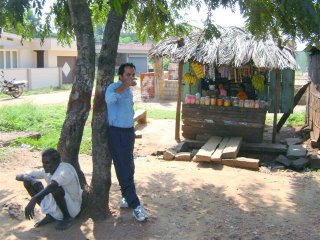

Shimoga was in sight by three in the afternoon and lunch shortly after that. Thirthahalli next. There was a dam project at Varahi nearby which would be good to visit (thought Pradeep). We checked the route from the hotel owner who seemed a bit unsure and guided us to the nearby bus-stand. Pradeep got hold of a bus driver there, and pointing at a road asked him if it went to Thirthahalli. The bus-driver replied in the affirmative but seemed to favour another road (going in the opposite direction incidentally) and reeled out the names of all the stops on it. A bit confused, Pradeep asked him 'Then where does the first road go?' 'It goes to Thirthalli too, but directly unlike the other one', was the reply from the bus-driver. A bit mixed-up in the mind surely.

Pradeep was handling the steering and doing fine, so I just sat back and soaked up the view. We're going quite fast and the wind makes a whistling sound if the helmet visor is raised a bit. The air is so clean it really doesn't matter if the visor is up or down. The main reason we keep it down is to avoid those pesky flying insects. On one of our previous trips, Pradeep got hit in the eye just as we approached his old college. We naturally stopped for tea at his old joint, Pradeep with tears in his eyes due to the insect-hit. The owner must've thought he was taking the visit extremely emotionally. So, we go on with the visor down mostly. The road comes at us as if out of a tunnel with the trees on either side forming the walls. And it keeps going on and on like that. Narrow in the distance, broadening as it meets us. A paddy field is suddenly illuminated by the sun.

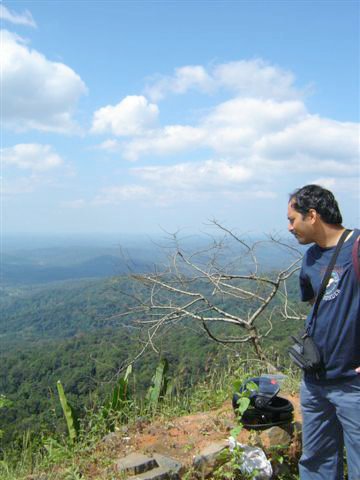
It was too far to the dam and it was already around four. We'd visit it the next day. On to Thirthahalli. As we left Shimoga, the scenery became suffused with green, as we'd imagined. Various hues of green everywhere, not a trace of dry earth. Like this:
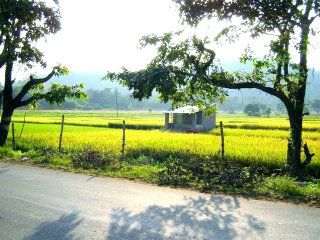
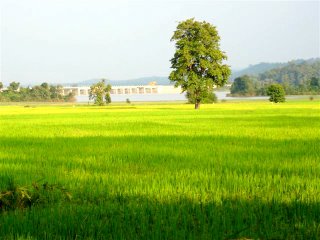

On the way, we came across a construction site where they were building a new canal. The area was to be submerged once the water was let in. Here is what the whole thing looked like.
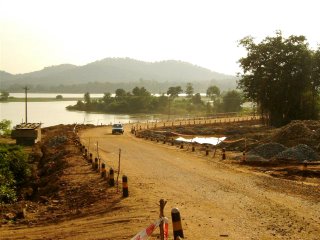
The whole site would have looked heroic a hundred or two years ago, man pitting his will against nature and all that. But not so much now. A bystander came across, seeing us clicking away. After the preliminaries which usually consist of 'Where are you coming from? Are you here just for fun? Where are you going to? How much mileage does the bike give?', Pradeep asked him about the big politician from this area, a well-known person. "To be fair, he has done things for this region. True, he has taken money, but then everyone does. Politicians take money, we too take money. That's how it is." Money being the euphemism for bribes and corruption. The new heroism. What exactly has he done for the region? This dam, is the reply. Very unlikely.

After an hour or so we stopped at this roadside hotel.
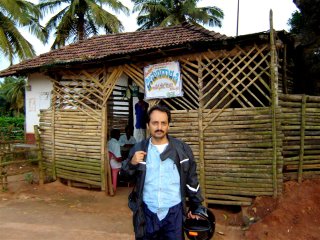
A beaming lady, who was in the family way, served us tea. A group of three men sat at the next table, apparently just enjoying a nice tea and talk. All of them had questions for us. "Are you from Bangalore, I heard you got lots of rainfall there, Are you here just for fun? Where are your going?" We asked them about the rain here. Only the beetlenut crops were affected according to them, but overall they were fine with the rain.

We reached Thirthahalli at around six thirty in the evening. Nagarjuna, the Telugu film star, and his crew had reached there before us. They were shooting at Kasaravalli village nearby. So the first hotel we checked, newly constructed and with a unhindered view of the town bus-stand and the weather-beaten buses, was full. Another, a little further down did have a double room. Nagarjuna's crew were booked here too, as we realized sitting in our room. The sound of feminine voices and laughter was unmistakable and Pradeep who was facing the door noticed females in various states of dishabille running hither and thither in the corridor. Extras, those essential elements of south Indian film song and dance sequences? Probably. The room was nice and cosy, there was a TV with cable, and a clean toilet.

Dinner was at seven in a darkly lit restaurant down what looked like main street. It had cubicles for the retiring kind and for those who wanted to indulge in a leisurely sip without distractions. We took the option. It had been a good day of riding, equally split between the two of us, and we were in good spirits. Soon the jokes were falling freely in our cubicle - Pradeep usually has a bagful of them. Loud conversation between a group of friends was taking place in the neigbouring cubicle. Sudden lulls in the conversions occurred now and then, to be replaced by sudden bleating and mooing sounds accompanied by cries of "Sheep!", "Goat!", "Buffalo!". They must have had some reason for this behaviour. Later there was much cursing in colourful language at some person who was not among those present. All perfectly normal and hardly the stuff to cause eyebrows to rise. The food was oily mainly. By the time we returned to our room it was eleven. We talked for some more time before saying good-night. I was asleep in three minutes having slept so little the previous night. Pradeep, he told me next day, had more difficulty drifting off.

Day 2, Nov 5

The next day morning I was up first, around six. Nothing to do. I finished my stuff and waited for Pradeep to wake up and get ready. At breakfast downstairs, a family consisting of three young ladies and their parents, no doubt part of Nagarjuna's entourage was also there. Interesting life people in the film industry led I thought - they got to travel to these out of way places, probably often. Breakfast over, we fill in some petrol and headed out to the dam.

The route would be Kaimara, Yadoor, Varahi. The dam - called Mani dam - was at Varahi. The roads were good for a while.

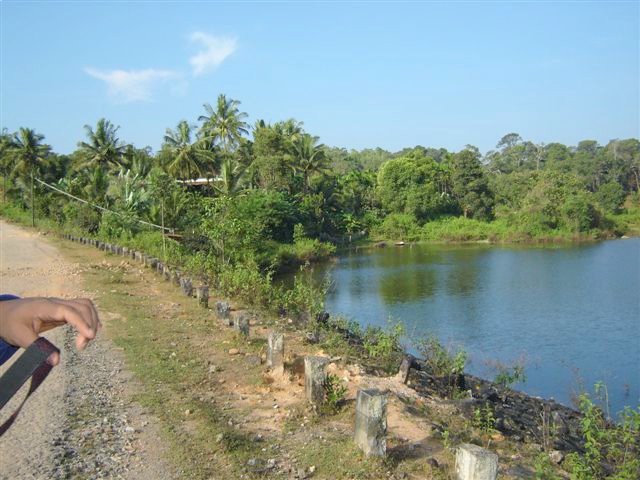
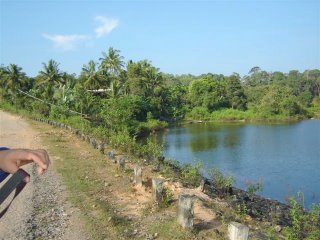
Soon the roads turned nasty, worse than anything so far. They were more like ruins of bygone roads than anything laid in living memory. On top of it, the rear shock absorber was a bit too tight. We were destined to have a bad case of pain-in-the-backside the second half of the day and the next. I mean really bad. Some of the worst riding in our trips I think. A faint glimpse of the road here:

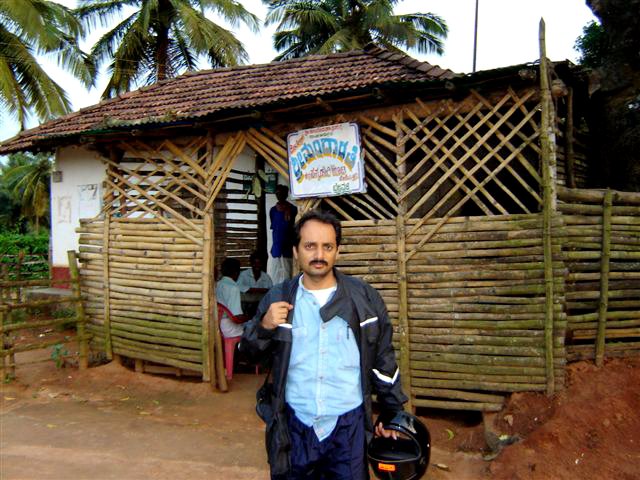
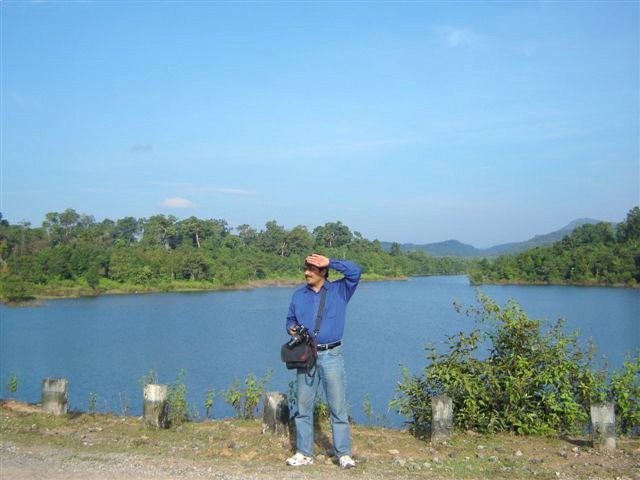
And me, hiding my face from the paparazzi:
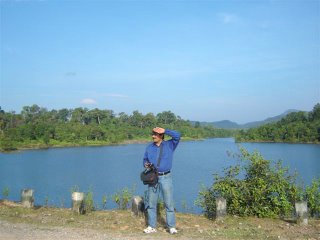
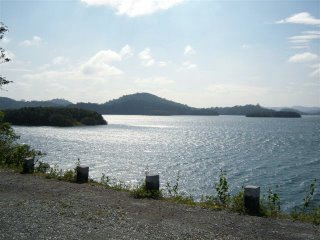
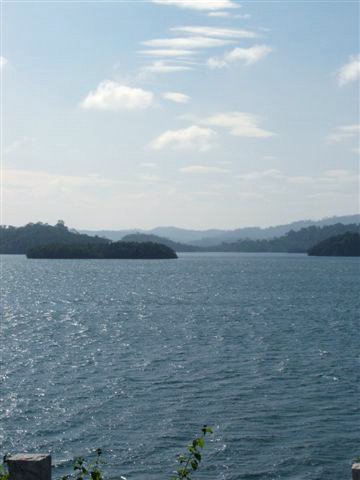
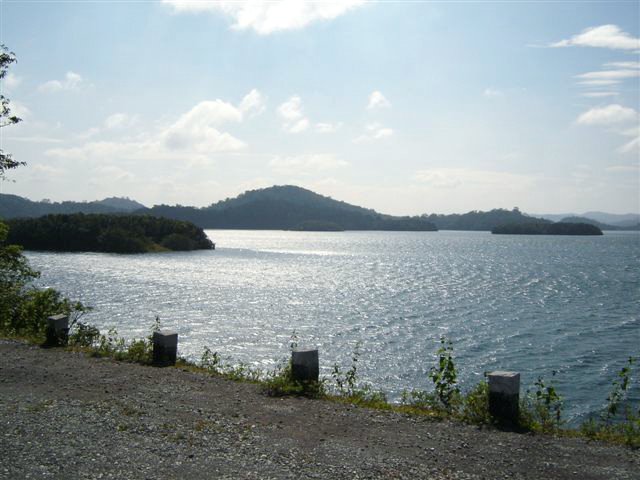
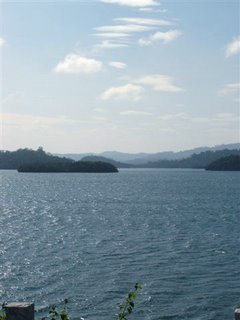
We reached the Mani dam at around ten. The dam was full. The strongish breeze raised mini waves and one could almost imagine it as the sea not a dam. The security guards at the entrance refused to let us in. No photos even. As we stood reading the details about the dam written on a board, the guards came down and told us that an LTTE threat to blow up some the KRS dam in Mysore as the reason for not letting us through. Security at all dams had been tightened. Also, the naxalites. One of them pointed out an area on the other side of the dam where he said naxalites were present. What do they do, we asked. They just stay with the villagers and help them and fight for them against the rich landlords, one of them replied. He was a temporary worker employed by a private firm, the other was a police constable. The former was especially bitter - his house was submerged by the dam, and his salary now was just two thousand rupees. Some people nearby could not even move out of the island created by the dam waters. In other places, water was being hoarded by the landlords. They also told us of contracts for big sums of money for lighting the dam. None of the bulbs worked. All this while they got paid a pittance. And they had to face unfair treatment at the hands of the engineers. One engineer had insisted on his relatives being allowed past the gates, saying the dam had recouped its cost by now and even if it were to be blown away it would not be a big loss. As the police constable said, maybe, but a few towns downstream would be submerged. The amount of water stored was huge. They also told us of how some persons who are now big businessmen started small at this very dam. And now there's no looking back for them. 'Money chases the rich man'. We don't know how much of what they said is true. But they surely had more sympathy for the naxalites than for the authorities. It was hard not to feel pity for them.

Some snaps from nearby:


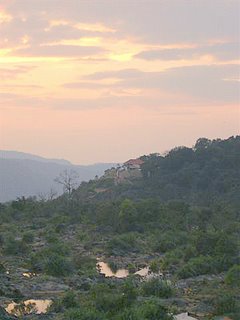
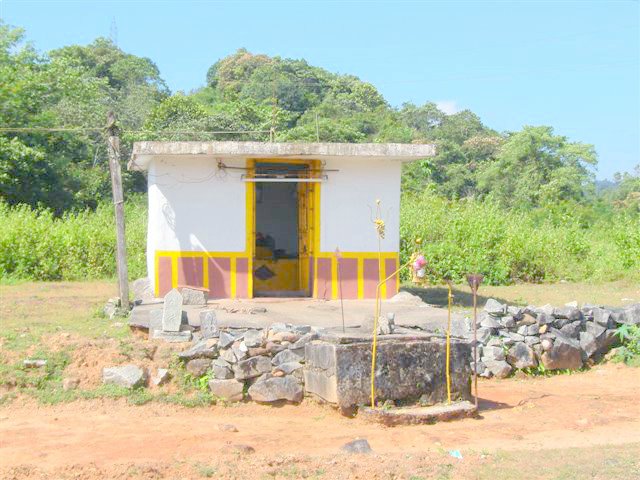
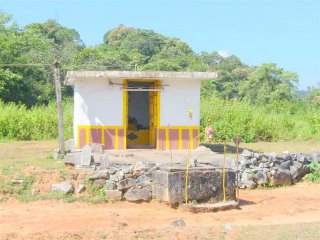
One the way back we stoped to click some snaps of this lonely temple, and other things:
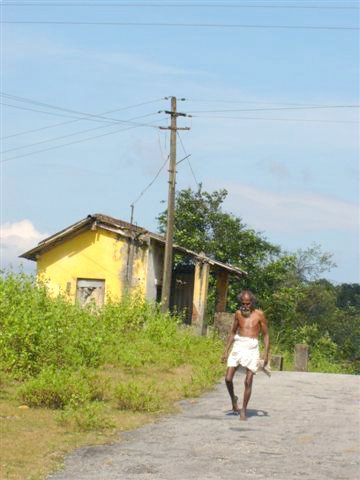
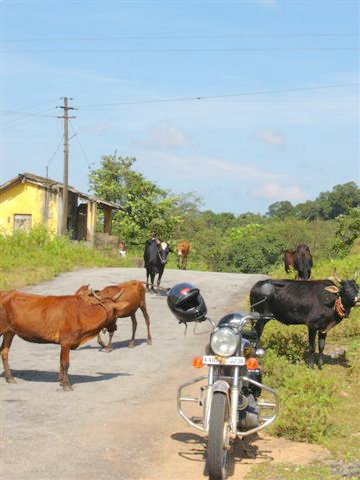
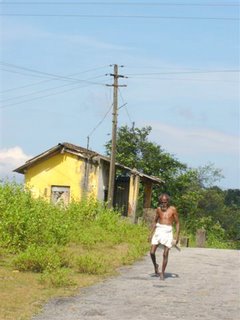
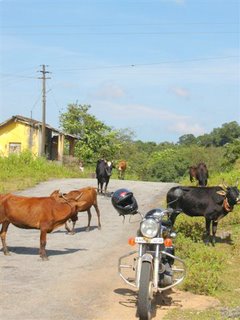
An old cowherd, and his cows checking out the A350:
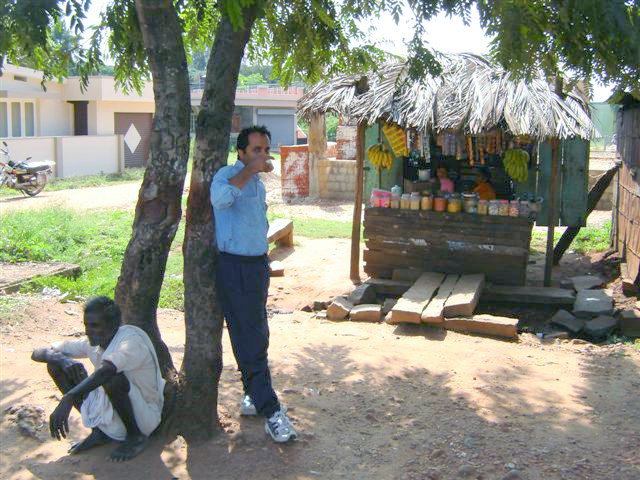
We stopped for tea at a roadside house-cum-hotel in Yadur, formerly a boom town when the dam was being built, now as charming as any other village. The owner of this hotel who told us of the boom, here:
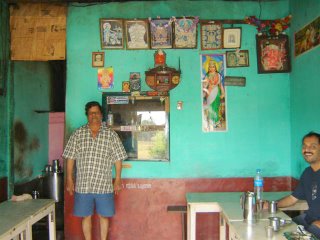

He keeps a trough of fresh water outside for the cows. A board warns people not to wash their feet or hands in it. And he serves nice idlies. He suggested we aim for lunch at a temple which was about half-way on the way back.

The route was to be Mastikatte - Hulikal Ghat - Balebare Temple - Hosangadi - Thirthahalli.

Lunch would be served at one. Not a bad idea. Though we tought we would be early, the hostile road conditions - Hulikal Ghat was a torture - meant that we were there just in time for things. The puja had started, and lunch would follow immediately. We had to remove our shoes and leave them by the roadside about which I had a few qualms. Without them, we were done for. No way we could change gears with bare feet. Still, there was no other option. Not that there was a serious risk of anyone taking them. All the people were here to visit the temple themselves. They came by car, on private and government buses. The lunch was very hot and very good. Some kids were seated next to us during lunch. By the time we'd finished, I knew how much the kid on my right ate at home, that he did not like curds, and other details. And he was not even talking to me, but to the kid sitting next to him. Kids don't have secrets. Later during the drive, thinking of the incident, I thought if there is a God and it had a smile, children have to be what the smile looks like. And when I say smile, I mean the most sunny, loving, all-encompassing smile ever. Like they say in the US, go figure.

We decided to visit Hosangadi - where the power generation station is. That was a mistake. The devilish roads and we were not even allowed to enter the gates due to security reasons. But we did get to click some snaps:

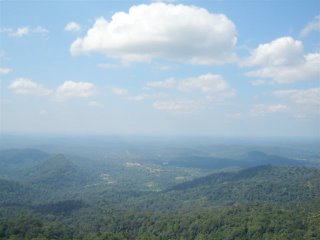
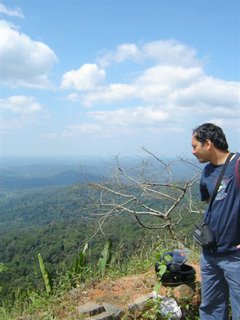
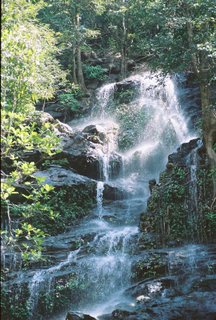
Then this mini waterfall by the road side.

We returned to our room in Thirthahalli, picked up our stuff and checked out. Jog Falls called . The route: Humcha - Rippanpet - Anandapura - Sagara - Jog Falls.

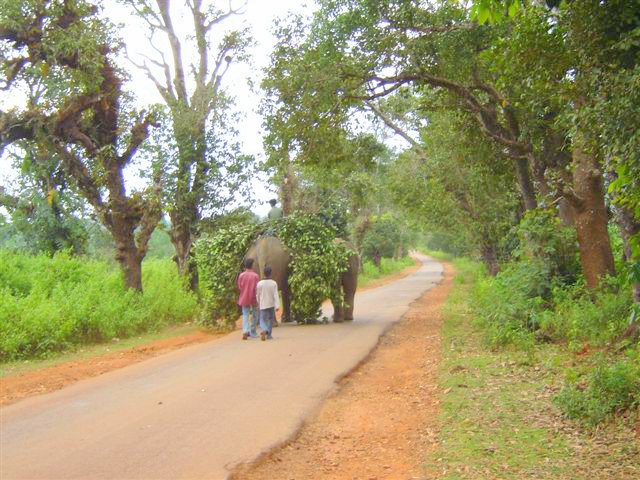
Pradeep took over the handle at Humcha. The roads had improved and he got into the groove quickly. We got some heavy company momentarily on one stretch of road, shown here:
Nearing Sagar Pradeep suffered one lapse of concentration which shook both of us. We were steady at around 70 kmph when I saw a turn which was almost a semi-circle. By now I'd relaxed and wasn't too bothered about how we would make it. When I see a curve I usually try to judge if I need to slow down or have some fun by turning the accelerator up a bit. If there are no vehicles coming from the other direction, if the road is good, if I'm not already going too fast, I generally increase the speed, and an inclination of the bike and its riders while taking the curve does it nicely and feels good. If not, I apply the front brake a few times or both the brakes if I'm going too fast, thus slowing down a bit before the curve starts. Sometimes, reducing the accelerator completely does the trick - the A350 then falls silent except for a subdued beat of the engine which is like a faint hint suggesting that the bike is just biding its time before it breaks out into a powerful roar again. An enjoyable sound - and I realise that I have grown to like the bike a lot.

Soon the curve was nearer and still no response from Pradeep. Now, a silent urgent question in my mind : would he take it properly? We are already in the curve and still no response from him! On the outer side of the curve is a drop - how deep we didn't know and it didn't even matter if we were to go into it. I grab his shoulders, yelling "Slower!". By now, we are going straight at the opposite side of the road - rather like a tangent drawn to the curve from the direction we came from. Then we stop. Luckily no buses or trucks or anything coming from the opposite direction. Narrow escape! Now, it became clear how different people think. While the thing was happening I had been thinking of how he was going to take the curve, whether we would make it and all that. Pradeep apparently was thinking "What is on the other side of the road?". He had by now decided that we would go down anyway and was worried more on where we would land. Once before too this had happened. Both of us were on the ground - my right glove had been completely scraped off by the fall. We had sustained a bit of damage to the bike. I was looking at a bus behind us , thinking, "Wow, thank god that bus was a bit far away". Pradeep was thinking "The headlight is broken". The leg guard was bent and touching the engine block, but he was thinking of the headlight.

As we continued, the milestones seemed to play games with us. Sometimes a place which was 48 km away, became 40 km within a few hundred yards. I guessed that the second distance was as the crow flies, since no road existed anyway. At one point, 45 km became 48 km within a few feet. Pradeep suggested that the crow circled a bit near the first signboard.

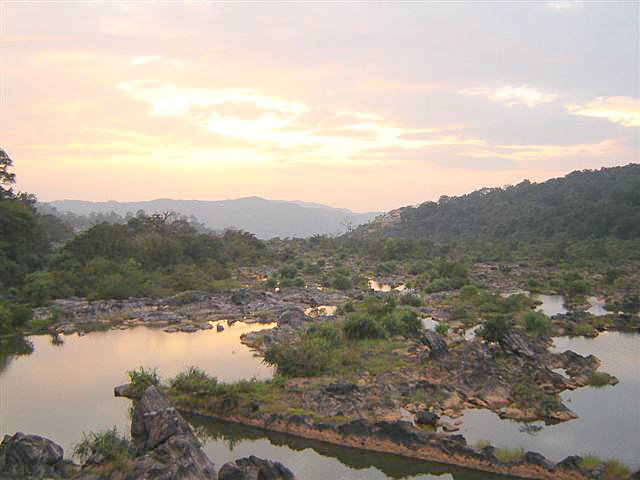
Some snaps from the approach road to Jog:


We reached Jog Falls at around six in the evening. We were in for some disappointment. Very little water had been released from the dam and the falls were anaemic. There were some people who had walked down the 300 m to the foot of the falls and were taking photographs. It had become dark and we wondered how they would find their way back. We later saw the three men - all in knickers and banians - looking weary. Pradeep thought they had lost their pants below in the dark.

We got back on our bikes around half past six. Three roads lead out of the area. None of them was labelled. There were no lights anywhere. So much for attracting tourists. We chose one road and had gone about five kilometres before we had doubts - that was not the route we came by. We turned back meaning to ask someone. We did not find anyone till we'd almost returned to the dam. Two students whom we had passed earlier, leaning against a rail, talking, far from anywhere. They didn't fit here. It looked as if they were living hereabouts. Probably doing their project. They gave us directions. But it was still a different route than the one we'd taken coming here. Kargal - Sagara - Shimoga.

We were in Shimoga by ten. We found a hotel, dumped out stuff and headed out for dinner. Trip over.

Day 3, Nov 6

Today it would be our first day's journey in reverse - Shimoga - Bhadravati - Terikere - Birur - Kadur - Banavara - Arasikere - Tiptur - Gubbi - Tumkur - Bangalore. The Indian Express kept us company for breakfast. Then we hit the road. The road upto Terikere was good. Then it was chinese torture till Kadur. Pradeep took over at Kadur.

The nether regions of our bodies were by now showing signs of great wear and tear. One hour of continuous back-seat riding was all we cold handle, but we went for two hours at a time. One needed the support of the driver's shoulders to even get off the bike. That shock absorber! Pradeep was not enjoying his driving much, as far as I could tell. The previous day's incident had tensed him up. He was finding it increasingly difficult to change to the lower gears in time to stop.

We lunched at the Kamat restaurant near Tumkur and were in Bangalore by three. The traffic was slow-moving. Still, we made it to Pradeep's house by four or so. I was home by five. My son had already forgotten me. Well, almost. Looking down from the first floor as I took off my shoes below, he was telling my wife 'some uncle' had come.

Some More Of The Same

Dravid's statement, from The Telegraph:
"In my opinion and the opinion of the umpires and Match Referee, both of whom I have spoken to, the Indian team did not act in any manner that was unsportsmanlike or against the spirit of the game. If that had been the case, the umpires and Match Referee would have taken action.

“We have the option of taking up the issue with the relevant authorities, but keeping in mind the relevance, the importance and the context of the series, we have decided to let the issue pass and set it to rest.”

What will the umpires and Match Referee's be talking about with the players next? If that cover-drive was really nice or just so-so? If Faisal Iqbal looked dumb or just sorry in the replay of that dropped catch in the third test? About the field placements? I think not, for some reason. Just as I feel they would have hazarded an opinion on the sportsmanlike-ness of that appeal. No, they might have confirm or reject the legality of that appeal and decision, but not whether it was sportsmanlike or not. Even if they did, their opinion would count for nothing at all. As The Telegraph itself points out, Dravid would have done well to call the batsman back - unless things happened too fast for him to comprehend it all. But the walk back to the pavilion takes a long time.

2 Feb 2006

More Cow

Two personalities, two answers. Dravid on being asked about Ganguly's performance (link here):
“I think we tend to get too caught up in individuals in India,” he replied tersely. “We tend to attribute losses and wins to individuals rather than focussing on the team. We look at statistics, we discuss numbers and figures a lot in India, and we try to crucify individuals when we should be concentrating on the team. I am not going to be a party to that sitting in a press conference.”
On being asked about Tendulkar's form:
“He tried his very best, he worked very hard. But we look at ourselves as a team. All of us could have done better, and that includes everyone.”
Dravid is being a bit partial here. If nothing else the former captain too seemed to try quite hard - at least as hard as Tendulkar. So the captain could have found some good words for the former captain surely? Here is what cricinfo.com had to say about his knock:
Apart from Yuvraj Singh's century, the one bright spot for India was Sourav Ganguly's fluent form. He only scored 37, but his decisive footwork and fluent strokeplay suggested he would score many more. He had an in-control factor of 93%, and made only four mistakes in 56 deliveries. Unfortunately for him, the fourth one was a decisive error, and ensured that there'll continue to be a question-mark over his place in the side.
Ganguly did get some support. From Dravid's opposite number:
I’m a big supporter of Sourav... He was aggressive and he fought... I hope his innings holds him in good stead.
NDTV reporters seem to suffer from a similar ailment (I'm writing from memory here) :
"Tendulkar walked in and immediately stamped his class on the proceedings ... Ganguly came in and seemed to be in a positive frame of mind. Yuvraj's century went in vain and unfortunately this is the second time he has made a century with India going on to lose the match."
Positive frame of mind? The man batted fluently by all accounts! And why denigrate Yuvraj's century thus? It would be alright if the reporter was spreading the blame around evenly not so selectively.

And I couldn't believe Dravid said this:
India’s batsmen all have impressive averages, but fail to deliver in crunch situations. “That’s why, when you lose, you have to think of collective failure,” he emphasised. “The guys at the top of the order made good contributions in the Faisalabad and Lahore Tests, but we didn’t deliver the goods here.”
Good contributions in the Faisalabad and Lahore tests? On those tracks? I thought Dravid was supposed to have a good cricketing brain and to be a thinking man himself!

Yesterday must have brought back another unpleasant memory for the Indian coach.

1 Feb 2006

Holy Cows

India looking down the barrel at two down for some paltry total on the fourth day of the last test match. The two includes Dravid and Sehwag. And the lunch-time session of Straight Drive hosted by Sanjay Manjrekar:
Manjrekar: What do you think Geoffrey - did Dravid do the right thing by opening? Or should someone else have opened?
Boycott: C'mon Sanjay he's got two centuries opening - of course he should've opened.
Manjrekar: He's been in the field for so long, I'm sure he'd be tired
Boycott: C'mon Sanjay don't make excuses. He's a professional cricketer, he should be prepared for it. No one expected Gavaskar not to open.
Manjrekar: But you didn't have such big innings in those days did you Geoffrey.
Manjrekar: Waqar do you think someone else, say Pathan, should have opened?
Waqar Younis: No I think I agree with Geoffrey..
Manjrekar : I know Geoffrey wants to interrupt
Boycott (laughing) : Pathan has bowled 25 overs and you want him to come in rather than Dravid! Look, the opener's job is a tough one. That is why everyone wants to slide down the batting order in Test cricket. Everyone wants to bat in the middle order because it is easier there. Tendulkar has never wanted to open in Tests.
Manjrekar: I know Geoffrey but that's a point of view. That is a point of view and I have to get it across.
Why does Sanjay Manjrekar have to get the point across? A point so weak that it can be brushed off so lightly by his fellow commentator? But then, it is almost an open secret that there are many tiny wheels within wheels and many unknown forces at play when it comes to Indian media covering Indian cricket and its shooting stars. So it shouldn't really surprise anyone. And I'm not even talking of the thick layers of hype.

27 Jan 2006

Passion

The Karnataka assembly is in session to decide if the CM has the required support to continue in office. It is live on TV. I think one can safely say that such passion is rarely seen in our politicians. The quest for power brings out the best in our leaders. But of course they are doing it for the sake of people - as they never stop claiming.

It is entertaining TV though. Naked hunger for power, passion, intrigue, suspense, comedy - mostly comedy for the watcher, pathos - mostly of the speaker, and a star-studded cast. One can only find fault with one aspect - the lack of love-interest.

When will someone serialise these things and create the next hit reality show?

Update: Kumaraswamy has been made the JDLP president by the Speaker after much debate. Long live the new government.

Update 2: Deve Gowda steps down as the national president of the JD(S). He is 'aghast' and 'pained' by the developments and attributes it all to 'karma'.